Cui Jiawen, Shang Xinchi, Liu Yuhao, Teng Xiaohua, Zhou Li, Yan Bing
Institute of Environmental Research at Greater Bay Area, Key Laboratory for Water Quality and Conservation of the Pearl River Delta, Ministry of Education, Guangzhou University, Guangzhou 510006, China.
Key Open Laboratory of Cold Water Fish Germplasm Resources and Breeding of Heilongjiang Province, Heilongjiang River Fisheries Research Institute, Chinese Academy of Fishery Sciences, Harbin 150070, China.
Environ Health (Wash). 2025 Feb 13;3(5):539-550. doi: 10.1021/envhealth.4c00242. eCollection 2025 May 16.
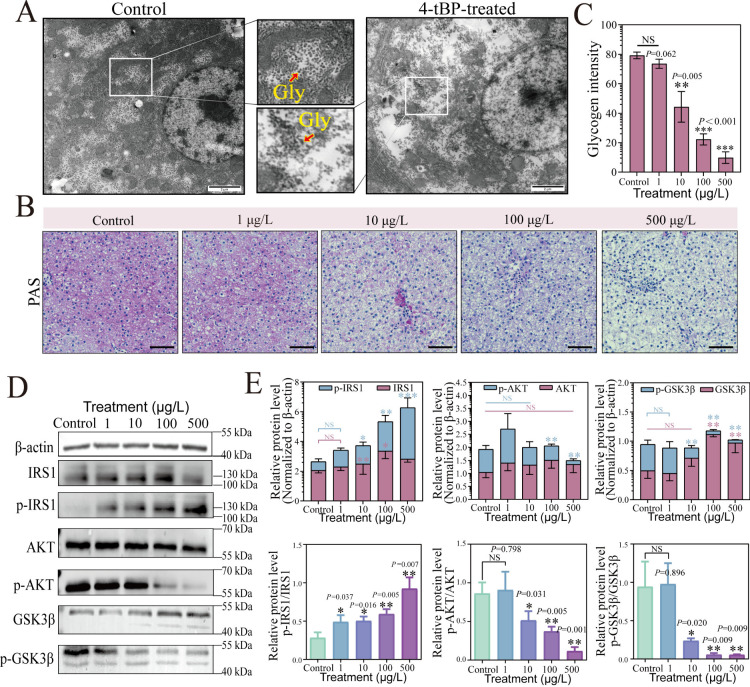
4--Butylphenol (4-tBP), widely used in manufacturing polycarbonate plastics and epoxy resins, is commonly found in aquatic environments globally. This study investigates the chronic (60 days) hepatotoxic effects and the underlying mechanism of 4-tBP on fish, including concentrations with environmental relevance (≤100 μg/L), using L. as the model. Results showed that 1-500 μg/L 4-tBP triggered significant alterations in oxidative stress markers (superoxide dismutase (SOD), glutathione peroxidase (GPx), and malondialdehyde (MDA)) and liver enzymes (alanine aminotransferase (ALT) and aspartate aminotransferase (AST)), with a dose-response relationship confirmed by the Integrated Biomarker Response (IBR) index. Histopathological analysis and molecular experiments revealed inflammatory responses, disruptions in glycogen metabolism, and critical insulin signaling pathways (IRS1, AKT, and GSK3β). Further investigations, including miRNA sequencing and assays in primary hepatocytes, identified the miR-363/PKCδ axis as a critical regulatory pathway affecting these changes. This study demonstrated that chronic, low-level exposure to 4-tBP can induce hepatotoxicity in L. via the miR-363/PKCδ axis. These findings highlight the potential ecological and health risks posed by 4-tBP in the environment and suggest potential targets for therapeutic intervention.
4-丁基苯酚(4-tBP)广泛应用于聚碳酸酯塑料和环氧树脂的制造,在全球水生环境中普遍存在。本研究以斑马鱼为模型,研究了4-tBP对鱼类的慢性(60天)肝毒性作用及其潜在机制,包括与环境相关的浓度(≤100μg/L)。结果表明,1-500μg/L的4-tBP引发了氧化应激标志物(超氧化物歧化酶(SOD)、谷胱甘肽过氧化物酶(GPx)和丙二醛(MDA))和肝酶(丙氨酸氨基转移酶(ALT)和天冬氨酸氨基转移酶(AST))的显著变化,综合生物标志物反应(IBR)指数证实了剂量反应关系。组织病理学分析和分子实验揭示了炎症反应、糖原代谢紊乱以及关键的胰岛素信号通路(IRS1、AKT和GSK3β)。进一步的研究,包括miRNA测序和原代肝细胞中的实验,确定了miR-363/PKCδ轴是影响这些变化的关键调节途径。本研究表明,长期低水平接触4-tBP可通过miR-363/PKCδ轴诱导斑马鱼肝毒性。这些发现突出了4-tBP在环境中造成的潜在生态和健康风险,并提出了治疗干预的潜在靶点。