Teshale Getachew, Jejaw Melak, Demissie Kaleb Assegid, Baykemagn Nebebe Demis, Yehuala Tirualem Zeleke, Kelkay Jenberu Mekurianew
Department of Health Systems and Policy, Institute of Public Health, College of Medicine and Health Sciences, University of Gondar, Po. Box 196, Gondar, Ethiopia.
Department of Health Informatics, Institute of Public Health, College of Medicine and Health Sciences, University of Gondar, Gondar, Ethiopia.
BMC Infect Dis. 2025 May 22;25(1):734. doi: 10.1186/s12879-025-11138-4.
Sexually transmitted infections (STIs) represent a significant global public health concern, contributing substantially to illness and mortality, particularly in Sub-Saharan Africa (SSA). Women of reproductive age who initiated sexual intercourse at an early age are at high risk of acquiring STIs. However, comprehensive data on their care-seeking behaviors in SSA are lacking. This study determines the prevalence of STI-related care-seeking behavior and identifies associated factors among these women.
This study utilized data from the most recent Demographic and Health Surveys (DHS) conducted in 22 SSA countries between 2018 and 2024. A weighted sample of 54,425 reproductive-age women who initiated sexual intercourse at an early age and reported STIs or related symptoms in the past year was analyzed. A multilevel mixed-effects logistic regression model identified individual and community-level factors, with statistical significance set at p < 0.05. Adjusted odds ratios (AORs) with 95% confidence intervals (CIs) were calculated.
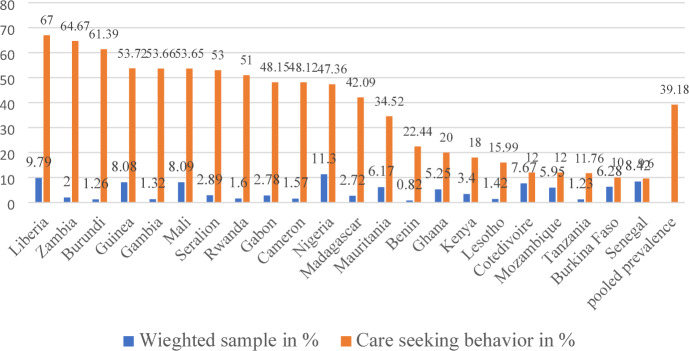
The pooled prevalence of STI-related care-seeking behavior among women initiated sexual intercourse at early age in SSA countries was 39.18% (95% CI: 33.25%, 45.03%). Multilevel analysis revealed significant associations with age, education, religion, pregnancy status, employment, household wealth, media exposure, financial barriers, awareness of AIDS/STIs, cervical cancer testing, residence, community education, media exposure, and poverty.
STI-related care-seeking behavior remains lower in this population compared to other studies. Associated factors include age, education, religion, pregnancy status, employment, household wealth, media exposure, financial barriers, awareness of AIDS/STIs, cervical cancer testing, residence, and community-level factors such as education, media exposure, and poverty. Public health efforts should prioritize socioeconomically disadvantaged women by strengthening counseling and awareness during cervical cancer screenings and antenatal visits. Policies to improve healthcare access and financial support for these women are essential.
性传播感染(STIs)是全球重大的公共卫生问题,对疾病和死亡率有重大影响,尤其是在撒哈拉以南非洲(SSA)。过早开始性行为的育龄妇女感染性传播感染的风险很高。然而,撒哈拉以南非洲地区关于她们就医行为的全面数据却很缺乏。本研究旨在确定与性传播感染相关的就医行为的患病率,并找出这些女性中的相关因素。
本研究利用了2018年至2024年期间在22个撒哈拉以南非洲国家进行的最新人口与健康调查(DHS)的数据。对54425名过早开始性行为且在过去一年中报告患有性传播感染或相关症状的育龄妇女的加权样本进行了分析。采用多级混合效应逻辑回归模型确定个体和社区层面的因素,统计学显著性设定为p<0.05。计算了调整后的优势比(AORs)及95%置信区间(CIs)。
撒哈拉以南非洲国家过早开始性行为的女性中,与性传播感染相关的就医行为的合并患病率为39.18%(95%CI:33.25%,45.03%)。多级分析显示,年龄、教育程度、宗教信仰、怀孕状况、就业情况、家庭财富、媒体接触、经济障碍、对艾滋病/性传播感染的认识、宫颈癌检测、居住地区、社区教育、媒体接触和贫困等因素存在显著关联。
与其他研究相比,该人群中与性传播感染相关的就医行为仍然较低。相关因素包括年龄、教育程度、宗教信仰、怀孕状况、就业情况、家庭财富、媒体接触、经济障碍、对艾滋病/性传播感染的认识、宫颈癌检测、居住地区,以及社区层面的因素,如教育程度、媒体接触和贫困。公共卫生工作应通过在宫颈癌筛查和产前检查期间加强咨询和提高认识,将社会经济弱势群体中的妇女作为优先对象。改善这些妇女获得医疗保健服务和财政支持的政策至关重要。