Research Center for Environmental Determinants of Health (RCEDH), Health Institute, Kermanshah University of Medical Sciences, Kermanshah, Iran.
Northern Arizona University, Flagstaff, USA.
BMC Womens Health. 2021 Jan 30;21(1):44. doi: 10.1186/s12905-021-01189-5.
Studies show that different socio-economic and structural factors can limit access to healthcare for women with disabilities. The aim of the current study was to review barriers in access to healthcare services for women with disabilities (WWD) internationally.
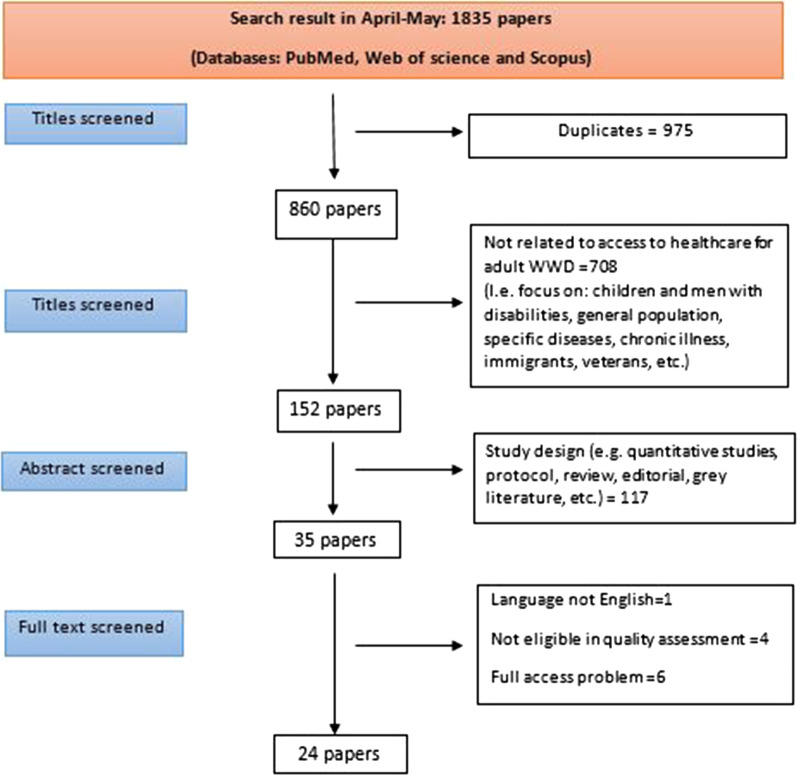
We conducted a systematic review of relevant qualitative articles in PubMed, Web of Science and Scopus databases from January 2009 to December 2017. The search strategy was based on two main topics: (1) access to healthcare; and (2) disability. In this review, women (older than 18) with different kinds of disabilities (physical, sensory and intellectual disabilities) were included. Studies were excluded if they were not peer-reviewed, and had a focus on men with disabilities.
Twenty four articles met the inclusion criteria for the final review. In each study, participants noted various barriers to accessing healthcare. Findings revealed that WWD faced different sociocultural (erroneous assumptions, negative attitudes, being ignored, being judged, violence, abuse, insult, impoliteness, and low health literacy), financial (poverty, unemployment, high transportation costs) and structural (lack of insurance coverage, inaccessible equipment and transportation facilities, lack of knowledge, lack of information, lack of transparency, and communicative problems) factors which impacted their access healthcare.
Healthcare systems need to train the healthcare workforce to respect WWD, pay attention to their preferences and choices, provide non-discriminatory and respectful treatment, and address stigmatizing attitudinal towards WWD. In addition, families and communities need to participate in advocacy efforts to promote WWD's access to health care.
研究表明,不同的社会经济和结构性因素可能会限制残疾妇女获得医疗保健的机会。本研究的目的是回顾国际上残疾妇女(WWD)获得医疗保健服务的障碍。
我们在 PubMed、Web of Science 和 Scopus 数据库中对 2009 年 1 月至 2017 年 12 月期间的相关定性文章进行了系统回顾。搜索策略基于两个主要主题:(1)获得医疗保健服务;(2)残疾。在本综述中,纳入了不同类型残疾(身体、感官和智力残疾)的女性(年龄大于 18 岁)。如果研究未经同行评审,且重点是残疾男性,则将其排除在外。
最终综述共纳入 24 篇符合纳入标准的文章。在每项研究中,参与者都指出了获得医疗保健服务的各种障碍。研究结果表明,残疾妇女面临着不同的社会文化(错误的假设、负面态度、被忽视、被评判、暴力、虐待、侮辱、不礼貌和健康素养低)、经济(贫困、失业、高交通成本)和结构性(缺乏保险覆盖、设备和交通设施不可用、缺乏知识、缺乏信息、缺乏透明度以及沟通问题)因素,这些因素影响了她们获得医疗保健的机会。
医疗保健系统需要培训医疗保健人员尊重残疾妇女,关注她们的偏好和选择,提供非歧视和尊重的待遇,并解决对残疾妇女的污名化态度。此外,家庭和社区需要参与宣传工作,促进残疾妇女获得医疗保健。