• 文献检索
  • 文档翻译
  • 深度研究
  • 学术资讯
  • Suppr Zotero 插件Zotero 插件
  • 邀请有礼
  • 套餐&价格
  • 历史记录
应用&插件
Suppr Zotero 插件Zotero 插件浏览器插件Mac 客户端Windows 客户端微信小程序
定价
高级版会员购买积分包购买API积分包
服务
文献检索文档翻译深度研究API 文档MCP 服务
关于我们
关于 Suppr公司介绍联系我们用户协议隐私条款
关注我们

Suppr 超能文献

核心技术专利:CN118964589B侵权必究
粤ICP备2023148730 号-1Suppr @ 2026

文献检索

告别复杂PubMed语法,用中文像聊天一样搜索,搜遍4000万医学文献。AI智能推荐,让科研检索更轻松。

立即免费搜索

文件翻译

保留排版,准确专业,支持PDF/Word/PPT等文件格式,支持 12+语言互译。

免费翻译文档

深度研究

AI帮你快速写综述,25分钟生成高质量综述,智能提取关键信息,辅助科研写作。

立即免费体验

智能手机语言功能可能有助于识别创伤后神经精神后遗症及其发展轨迹。

Smartphone language features may help identify adverse post-traumatic neuropsychiatric sequelae and their trajectories.

作者信息

Vizer Lisa, Pierce Jennifer, Ji Yinyao, Bucher Meredith A, Liu Mochuan, Ungar Lyle, Giorgi Salvatore, Xing Zhaopeng, House Stacey L, Beaudoin Francesca L, Stevens Jennifer S, Neylan Thomas C, Clifford Gari D, Jovanovic Tanja, Linnstaedt Sarah D, Zeng Donglin, Germine Laura T, Bollen Kenneth A, Rauch Scott L, Haran John P, Storrow Alan B, Lewandowski Christopher, Musey Paul I, Hendry Phyllis L, Sheikh Sophia, Jones Christopher W, Punches Brittany E, Hudak Lauren A, Pascual Jose L, Seamon Mark J, Harris Erica, Pearson Claire, Peak David A, Merchant Roland C, Domeier Robert M, O'Neil Brian J, Sergot Paulina, Sanchez Leon D, Bruce Steven E, Harte Steven E, Kessler Ronald C, Koenen Karestan C, McLean Samuel A, An Xinming

机构信息

Department of Medicine, Division of General Medicine and Clinical Epidemiology, University of North Carolina at Chapel Hill, Chapel Hill, NC 27559 USA.

Department of Anesthesiology, University of Michigan, Ann Arbor, MI 48109 USA.

出版信息

NPP Digit Psychiatry Neurosci. 2025;3(1):8. doi: 10.1038/s44277-025-00028-x. Epub 2025 May 20.

DOI:10.1038/s44277-025-00028-x
PMID:40406207
原文链接:https://pmc.ncbi.nlm.nih.gov/articles/PMC12092297/
Abstract

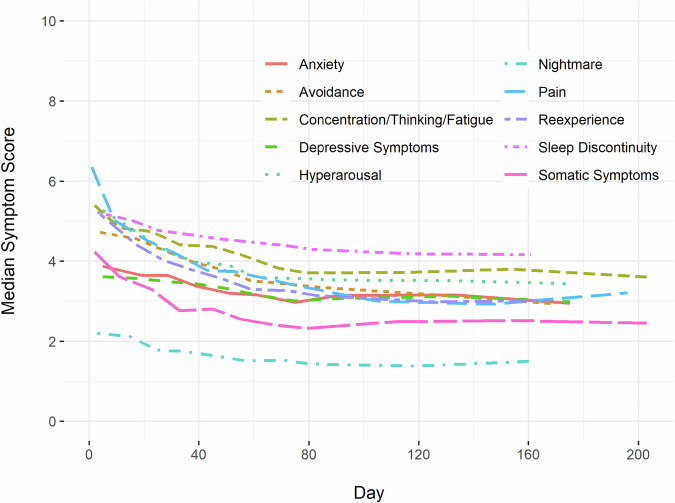
Language features may reflect underlying cognitive and emotional processes following a traumatic event that portend clinical outcomes. The authors sought to determine whether language features from usual smartphone use were markers associated with concurrent posttraumatic symptoms and worsening or improving posttraumatic symptoms over time following a traumatic exposure. This investigation was a secondary analysis of the Advancing Understanding of RecOvery afteR traumA study, a longitudinal study of traumatic outcomes among survivors recruited from 33 emergency departments across the United States. Adverse posttraumatic sequelae were assessed over the six months following the initial traumatic exposure. Language features were extracted from usual smartphone use in a specialized app. Bivariate linear mixed models were used to identify and validate language features that are markers associated with posttraumatic symptoms. Participants were 1744 trauma survivors, with a mean age of 39 [SD = 13] years old, and 56% were female. Fourteen language features were associated with severity level of posttraumatic symptoms at specific timepoints (cross-sectional markers) and five features were associated with change in severity level of posttraumatic symptoms (longitudinal markers). References to the body and health or illness were predictive of worsening pain, somatic, and thinking/concentration/fatigue symptom severity over time. An increase in references to others was associated with improvement in somatic symptom severity over time and increases in expressions of causation or cognitive processes were associated with improvement in pain symptom severity over time. Language features derived from usual smartphone use can convey important information about health, functioning, and recovery following a traumatic event. Clinicians might utilize such information to determine who may experience a high symptom burden or risk of worsening posttraumatic symptoms.

摘要

语言特征可能反映创伤事件后潜在的认知和情感过程,而这些过程预示着临床结果。作者试图确定日常智能手机使用中的语言特征是否是与创伤后症状并发以及创伤暴露后随着时间推移创伤后症状恶化或改善相关的标志物。这项调查是对“创伤后恢复的深入理解”研究的二次分析,该研究是一项纵向研究,研究对象是从美国33个急诊科招募的创伤幸存者的创伤结局。在首次创伤暴露后的六个月内评估创伤后不良后遗症。语言特征是从一个专门应用程序中日常智能手机使用情况中提取的。使用双变量线性混合模型来识别和验证作为创伤后症状标志物的语言特征。参与者为1744名创伤幸存者,平均年龄39岁[标准差=13],56%为女性。14种语言特征与特定时间点创伤后症状的严重程度相关(横断面标志物),5种特征与创伤后症状严重程度的变化相关(纵向标志物)。对身体以及健康或疾病的提及预示着随着时间推移疼痛、躯体症状以及思维/注意力/疲劳症状严重程度会加重。对他人提及的增加与随着时间推移躯体症状严重程度的改善相关,因果关系或认知过程表达的增加与随着时间推移疼痛症状严重程度的改善相关。日常智能手机使用产生的语言特征可以传达有关创伤事件后健康、功能和恢复的重要信息。临床医生可以利用这些信息来确定谁可能经历高症状负担或创伤后症状恶化的风险。
https://cdn.ncbi.nlm.nih.gov/pmc/blobs/cba8/12092297/db944e2f04b1/44277_2025_28_Fig1_HTML.jpg

相似文献

1
Smartphone language features may help identify adverse post-traumatic neuropsychiatric sequelae and their trajectories.智能手机语言功能可能有助于识别创伤后神经精神后遗症及其发展轨迹。
NPP Digit Psychiatry Neurosci. 2025;3(1):8. doi: 10.1038/s44277-025-00028-x. Epub 2025 May 20.
2
Folic acid supplementation and malaria susceptibility and severity among people taking antifolate antimalarial drugs in endemic areas.在流行地区,服用抗叶酸抗疟药物的人群中,叶酸补充剂与疟疾易感性和严重程度的关系。
Cochrane Database Syst Rev. 2022 Feb 1;2(2022):CD014217. doi: 10.1002/14651858.CD014217.
3
Use of serial smartphone-based assessments to characterize diverse neuropsychiatric symptom trajectories in a large trauma survivor cohort.利用基于智能手机的连续评估来描述大型创伤幸存者队列中不同的神经精神症状轨迹。
Transl Psychiatry. 2023 Jan 7;13(1):4. doi: 10.1038/s41398-022-02289-y.
4
Examining Associations Between Smartphone Use and Clinical Severity in Frontotemporal Dementia: Proof-of-Concept Study.探讨智能手机使用与额颞叶痴呆临床严重程度之间的关联:概念验证研究。
JMIR Aging. 2024 Jun 26;7:e52831. doi: 10.2196/52831.
5
Heart rate variability wrist-wearable biomarkers identify adverse posttraumatic neuropsychiatric sequelae after traumatic stress exposure.心率变异性腕部可穿戴生物标志物可识别创伤应激暴露后不良的创伤后神经精神后遗症。
Psychiatry Res. 2024 Dec;342:116260. doi: 10.1016/j.psychres.2024.116260. Epub 2024 Nov 7.
6
Utility of Wrist-Wearable Data for Assessing Pain, Sleep, and Anxiety Outcomes After Traumatic Stress Exposure.腕戴式数据在评估创伤后应激暴露后疼痛、睡眠和焦虑结果方面的效用。
JAMA Psychiatry. 2023 Mar 1;80(3):220-229. doi: 10.1001/jamapsychiatry.2022.4533.
7
Posttraumatic Stress Trajectories in World Trade Center Tower Survivors: Hyperarousal and Emotional Numbing Predict Symptom Change.世贸中心塔楼幸存者的创伤后应激轨迹:过度警觉和情感麻木预测症状变化。
J Trauma Stress. 2019 Feb;32(1):67-77. doi: 10.1002/jts.22357. Epub 2019 Jan 22.
8
[Posttraumatic stress disorder (PTSD) as a consequence of the interaction between an individual genetic susceptibility, a traumatogenic event and a social context].[创伤后应激障碍(PTSD)作为个体遗传易感性、创伤性事件和社会环境之间相互作用的结果]
Encephale. 2012 Oct;38(5):373-80. doi: 10.1016/j.encep.2011.12.003. Epub 2012 Jan 24.
9
Examining the Association Between Childhood Trauma, Brain Injury, and Neurobehavioral Symptoms Among Survivors of Intimate Partner Violence: A Cross-Sectional Analysis.探讨亲密伴侣暴力幸存者中心因创伤、脑损伤与神经行为症状之间的关联:一项横断面分析。
J Head Trauma Rehabil. 2022;37(1):24-33. doi: 10.1097/HTR.0000000000000752.
10
Understanding trajectories of underlying dimensions of posttraumatic psychopathology.理解创伤后精神病理学潜在维度的轨迹。
J Affect Disord. 2021 Apr 1;284:75-84. doi: 10.1016/j.jad.2021.01.086. Epub 2021 Feb 5.

本文引用的文献

1
Beyond trauma: a review of content and linguistic characteristics of nontrauma narratives in posttraumatic stress disorder.超越创伤:创伤后应激障碍中非创伤性叙述的内容和语言特征综述。
Eur J Psychotraumatol. 2024;15(1):2407733. doi: 10.1080/20008066.2024.2407733. Epub 2024 Oct 17.
2
Depression and anxiety have distinct and overlapping language patterns: Results from a clinical interview.抑郁和焦虑具有不同但又重叠的语言模式:来自临床访谈的结果。
J Psychopathol Clin Sci. 2023 Nov;132(8):972-983. doi: 10.1037/abn0000850. Epub 2023 Jul 20.
3
Objective analysis of language use in cognitive-behavioral therapy: associations with symptom change in adults with co-occurring substance use disorders and posttraumatic stress.
目的分析认知行为疗法中的语言使用:与同时患有物质使用障碍和创伤后应激障碍的成年人的症状变化的关联。
Cogn Behav Ther. 2021 Mar;50(2):89-103. doi: 10.1080/16506073.2020.1819865. Epub 2020 Oct 6.
4
Context- and Subgroup-Specific Language Changes in Individuals Who Develop PTSD After Trauma.创伤后发生创伤后应激障碍(PTSD)的个体中特定情境和亚组的语言变化
Front Psychol. 2020 May 15;11:989. doi: 10.3389/fpsyg.2020.00989. eCollection 2020.
5
The AURORA Study: a longitudinal, multimodal library of brain biology and function after traumatic stress exposure.AURORA 研究:创伤后应激暴露后大脑生物学和功能的纵向、多模态文库。
Mol Psychiatry. 2020 Feb;25(2):283-296. doi: 10.1038/s41380-019-0581-3. Epub 2019 Nov 19.
6
Studying expressions of loneliness in individuals using twitter: an observational study.利用推特研究个体的孤独感表达:一项观察性研究。
BMJ Open. 2019 Nov 4;9(11):e030355. doi: 10.1136/bmjopen-2019-030355.
7
Mutual maintenance of PTSD and physical symptoms for Veterans returning from deployment.从部署任务归来的退伍军人中创伤后应激障碍(PTSD)与身体症状的相互维持。
Eur J Psychotraumatol. 2019 May 21;10(1):1608717. doi: 10.1080/20008198.2019.1608717. eCollection 2019.
8
Early Linguistic Markers of Trauma-Specific Processing Predict Post-trauma Adjustment.创伤特异性加工的早期语言标记可预测创伤后的适应情况。
Front Psychiatry. 2018 Dec 5;9:645. doi: 10.3389/fpsyt.2018.00645. eCollection 2018.
9
Narratives in the Immediate Aftermath of Traumatic Injury: Markers of Ongoing Depressive and Posttraumatic Stress Disorder Symptoms.创伤后即刻的叙述:持续抑郁和创伤后应激障碍症状的标志物。
J Trauma Stress. 2018 Apr;31(2):273-285. doi: 10.1002/jts.22271. Epub 2018 Apr 6.
10
Forecasting the onset and course of mental illness with Twitter data.利用 Twitter 数据预测精神疾病的发病和病程。
Sci Rep. 2017 Oct 11;7(1):13006. doi: 10.1038/s41598-017-12961-9.