Zhang Zeyu, Yin Maopeng, Geng Xueyan, Zhao Hongxi, Zhang Shoucai, Liu Yingjie, Liang Yongyuan, Ji Jian, Zheng Guixi
Department of Clinical Laboratory, Qilu Hospital of Shandong University, Jinan, Shandong, People's Republic of China.
Shandong Engineering Research Center of Biomarker and Artificial Intelligence Application, Jinan, Shandong, People's Republic of China.
FASEB J. 2025 May 31;39(10):e70673. doi: 10.1096/fj.202403313R.
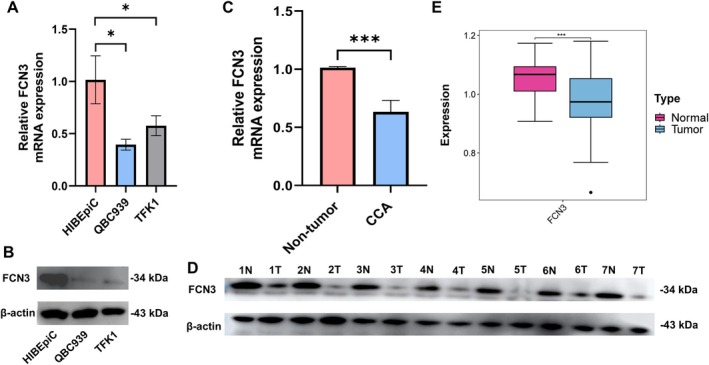
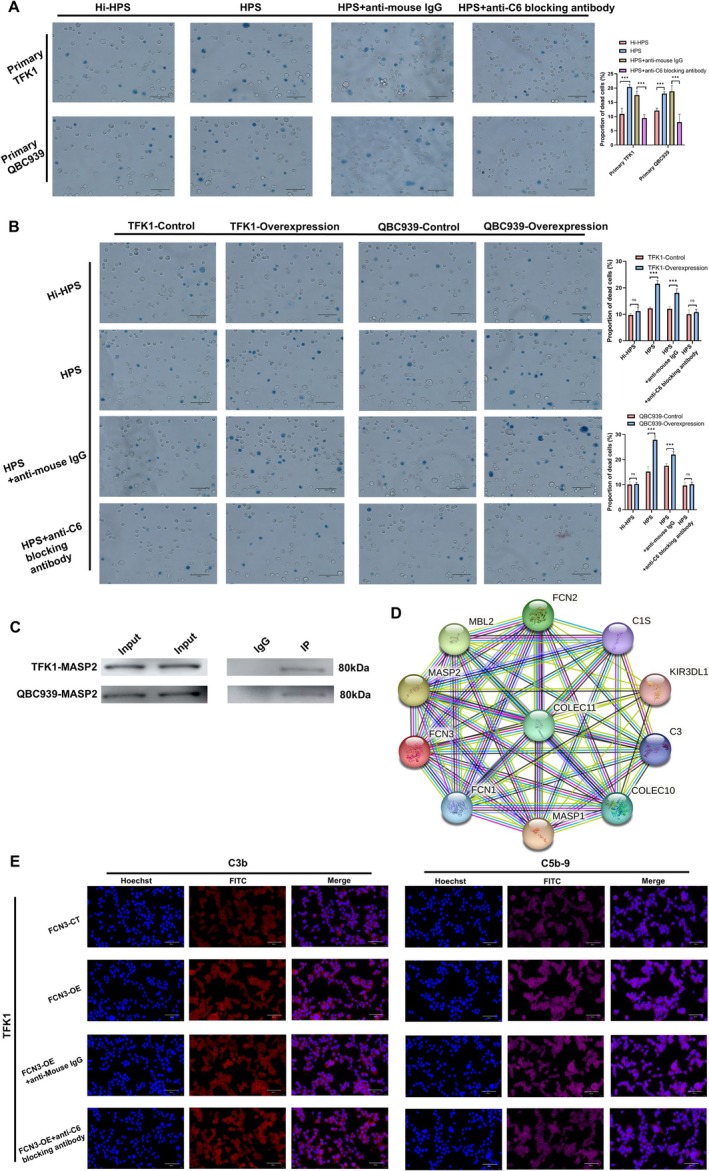
Ficolin 3 (FCN3) is a pattern recognition molecule that activates the complement system via the lectin pathway. While its immunological roles are known, the specific mechanisms by which FCN3 affects cholangiocarcinoma (CCA) pathogenesis remain unclear. In this study, we investigated FCN3 expression in CCA and benign cells, as well as tumor versus non-tumor tissues, using RT-qPCR and Western blotting analyses. The effects of FCN3 on CCA cell proliferation, migration, and invasion were analyzed through CCK-8, EdU, transwell, and wound-healing assays, with in vivo studies supporting these findings. The complement-mediated cytotoxicity of CCA cells was assessed using human serum with or without heat inactivation and an anti-C6 blocking antibody. Immunocytochemical staining was used to examine membrane attack complex (MAC) deposition, and an immunoprecipitation assay was adopted to evaluate the interaction between FCN3 and MASP family members. The role of FCN3 in inducing necroptosis was explored through transmission electron microscopy (TEM) and Western blotting analysis, focusing on the RIPK1/RIPK3/MLKL pathway. The results of the study demonstrate that FCN3 expression was significantly lower in CCA cells and tissues. Overexpressing FCN3 suppressed cell proliferation and migration, enhanced complement-mediated cytotoxicity via MASP2 binding, and increased MAC deposition. FCN3 also induced necroptosis through activating the RIPK1/RIPK3/MLKL pathway. These results highlight FCN3 as a tumor suppressor in CCA and suggest its potential as a therapeutic target for this malignancy.
纤维胶凝蛋白3(FCN3)是一种模式识别分子,可通过凝集素途径激活补体系统。虽然其免疫作用已为人所知,但FCN3影响胆管癌(CCA)发病机制的具体机制仍不清楚。在本研究中,我们使用RT-qPCR和蛋白质免疫印迹分析,研究了FCN3在CCA细胞、良性细胞以及肿瘤组织与非肿瘤组织中的表达情况。通过CCK-8、EdU、Transwell和伤口愈合试验分析了FCN3对CCA细胞增殖、迁移和侵袭的影响,体内研究支持了这些发现。使用经热灭活或未经热灭活的人血清以及抗C6阻断抗体评估CCA细胞的补体介导的细胞毒性。采用免疫细胞化学染色检测膜攻击复合物(MAC)沉积,并采用免疫沉淀试验评估FCN3与MASP家族成员之间的相互作用。通过透射电子显微镜(TEM)和蛋白质免疫印迹分析,聚焦于RIPK1/RIPK3/MLKL途径,探索了FCN3在诱导坏死性凋亡中的作用。研究结果表明,FCN3在CCA细胞和组织中的表达显著降低。过表达FCN3可抑制细胞增殖和迁移,通过与MASP2结合增强补体介导的细胞毒性,并增加MAC沉积。FCN3还通过激活RIPK1/RIPK3/MLKL途径诱导坏死性凋亡。这些结果突出了FCN3作为CCA中的肿瘤抑制因子,并表明其作为这种恶性肿瘤治疗靶点的潜力。