Czarny Justyna, Kadylak Damian, Sokołowska-Wojdyło Małgorzata, Nowicki Roman J
Department of Dermatology, Venerology and Allergology, Medical University of Gdańsk, Mariana Smoluchowskiego 17 Street, 80-214 Gdańsk, Poland.
Department of Dermatology, Venereology and Allergology, University Clinical Centre, Mariana Smoluchowskiego 17 Street, 80-214 Gdańsk, Poland.
Infect Dis Rep. 2025 Apr 27;17(3):41. doi: 10.3390/idr17030041.
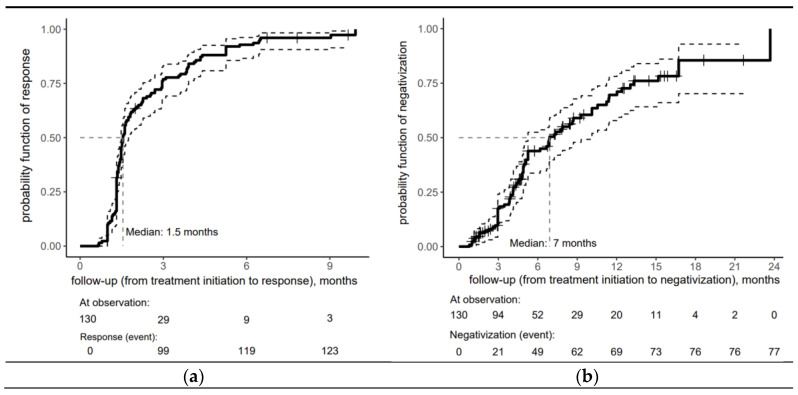
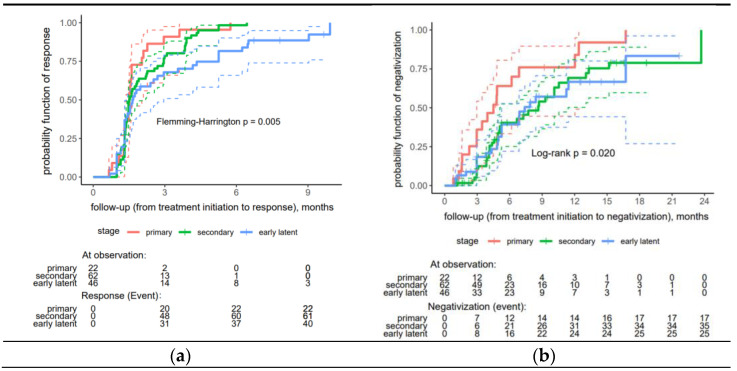
Syphilis is an infectious systemic disease that remains a public health threat, with an increasing incidence worldwide. Despite the availability of diagnostic tests and effective treatments, achieving a serological cure remains challenging for some patients. A retrospective cohort study of 130 male patients with early syphilis who attended the Department of Dermatology Venereology and Allergology in Gdansk was carried out between 2021 and 2024. This study assessed the rates of proper serological response and seroreversion of the VDRL test during the posttreatment follow-up period and analyzed selected factors influencing the achievement of these points. The treatment outcomes were favorable; 96.15% of the patients achieved a proper serological response at a median of 1.54 months and seroreversion of the VDRL test within 18 months (median time = 7 months). A significantly greater proper serological response was observed in the primary and secondary syphilis patients than in the early latent syphilis patients ( = 0.005). A proper serological response was associated with age over 30 years (risk ratio () = 1.381, = 0.008) and VDRL baseline titers (≥1:32) (RR = 1.484, = 0.005). The patients in the secondary or latent stage of early syphilis had a lower risk of seroreversion than those in the primary stage did (RR = 0.590, = 0.030; = 0.560, = 0.019, respectively). High titers at baseline (≥1:32) were also associated with a 30.8% reduced risk of seroreversion compared with lower titers ( = 0.692, = 0.038). : These results suggest that age, syphilis stage, and titer level are significant predictors of the response rate. Based on these results, it is recommended that serological follow-up be concentrated within the first three months posttreatment, as this period accounts for the majority of treatment responses.
梅毒是一种传染性全身性疾病,仍然对公共卫生构成威胁,在全球范围内发病率呈上升趋势。尽管有诊断测试和有效治疗方法,但对一些患者来说,实现血清学治愈仍然具有挑战性。2021年至2024年期间,对130名在格但斯克皮肤病、性病和变态反应科就诊的早期梅毒男性患者进行了一项回顾性队列研究。本研究评估了治疗后随访期间VDRL试验的正确血清学反应率和血清逆转率,并分析了影响这些指标达成的选定因素。治疗结果良好;96.15%的患者在中位时间1.54个月时实现了正确的血清学反应,VDRL试验在18个月内血清逆转(中位时间 = 7个月)。一期和二期梅毒患者的正确血清学反应明显高于早期潜伏梅毒患者(P = 0.005)。正确的血清学反应与30岁以上年龄(风险比[RR] = 1.381,P = 0.008)和VDRL基线滴度(≥1:32)(RR = 1.484,P = 0.005)相关。早期梅毒二期或潜伏阶段的患者血清逆转风险低于一期患者(RR = 0.590,P = 0.030;RR = 0.560,P = 0.019)。与较低滴度相比,基线高滴度(≥1:32)也与血清逆转风险降低30.8%相关(P = 0.692,P = 0.038)。:这些结果表明,年龄、梅毒分期和滴度水平是反应率的重要预测因素。基于这些结果,建议在治疗后前三个月集中进行血清学随访,因为这一时期占治疗反应的大部分。