Yang Chia-Jui, Lee Nan-Yao, Chen Tun-Chieh, Lin Yu-Hui, Liang Shiou-Haur, Lu Po-Liang, Huang Wen-Chi, Tang Hung-Jen, Lee Chen-Hsiang, Lin Hsi-Hsun, Chen Yen-Hsu, Ko Wen-Chien, Hung Chien-Ching
Department of Internal Medicine, Far East Memorial Hospital, New Taipei City, Taiwan.
Department of Internal Medicine, National Cheng Kung University College of Medicine and Hospital, Tainan, Taiwan.
PLoS One. 2014 Oct 6;9(10):e109667. doi: 10.1371/journal.pone.0109667. eCollection 2014.
One dose of benzathine penicillin G (BPG) has been recommended for HIV-infected patients with early syphilis (primary, secondary, and early latent syphilis) in the sexually transmitted diseases treatment guidelines, but clinical data to support such a recommendation are limited.
We prospectively observed the serological response to 1 or 3 weekly doses of BPG in HIV-infected adults who sought treatment of early syphilis at 8 hospitals around Taiwan. Rapid plasma reagin (RPR) titers were followed every 3-6 months after treatment. The serological response was defined as a 4-fold or greater decline in RPR titers at 12 months of treatment. The missing values were treated by following the last-observed-carried-forward principle. We hypothesized that 1 dose was non-inferior to 3 weekly doses of BPG with the non-inferiority margin for the difference of serological response set to 10%.
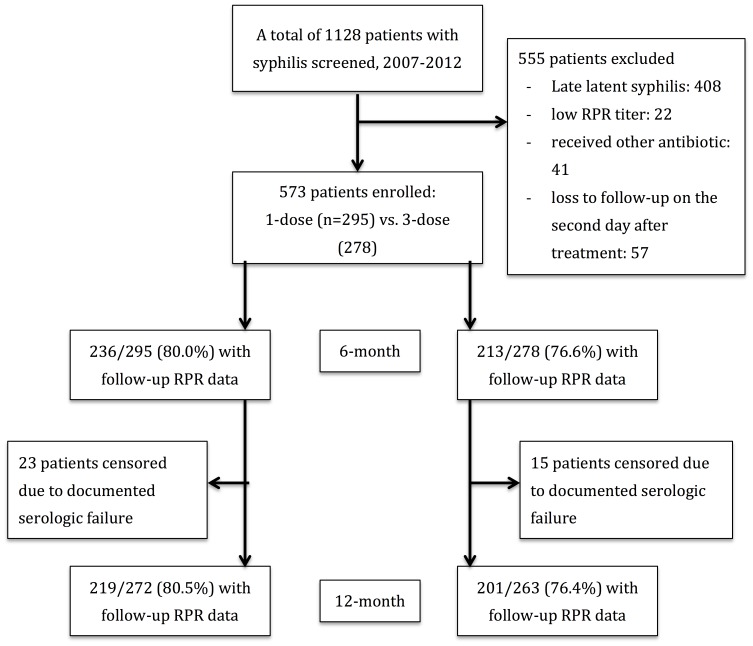
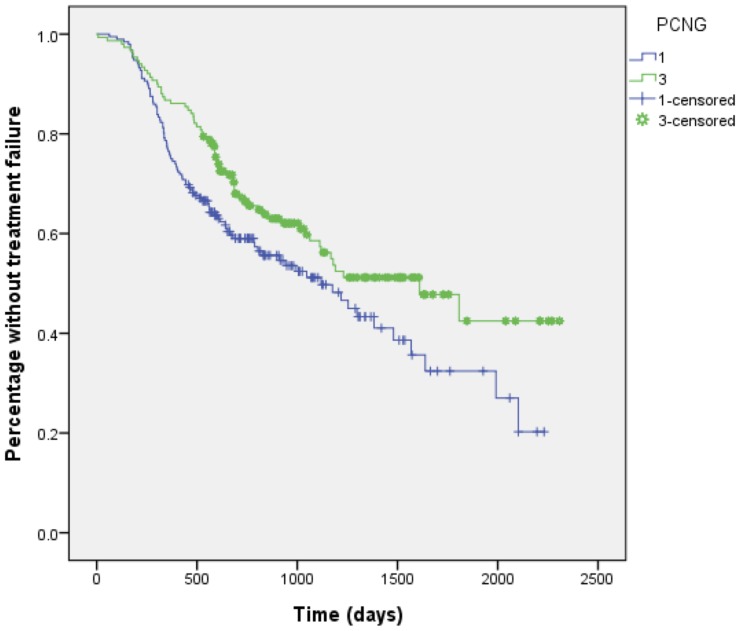
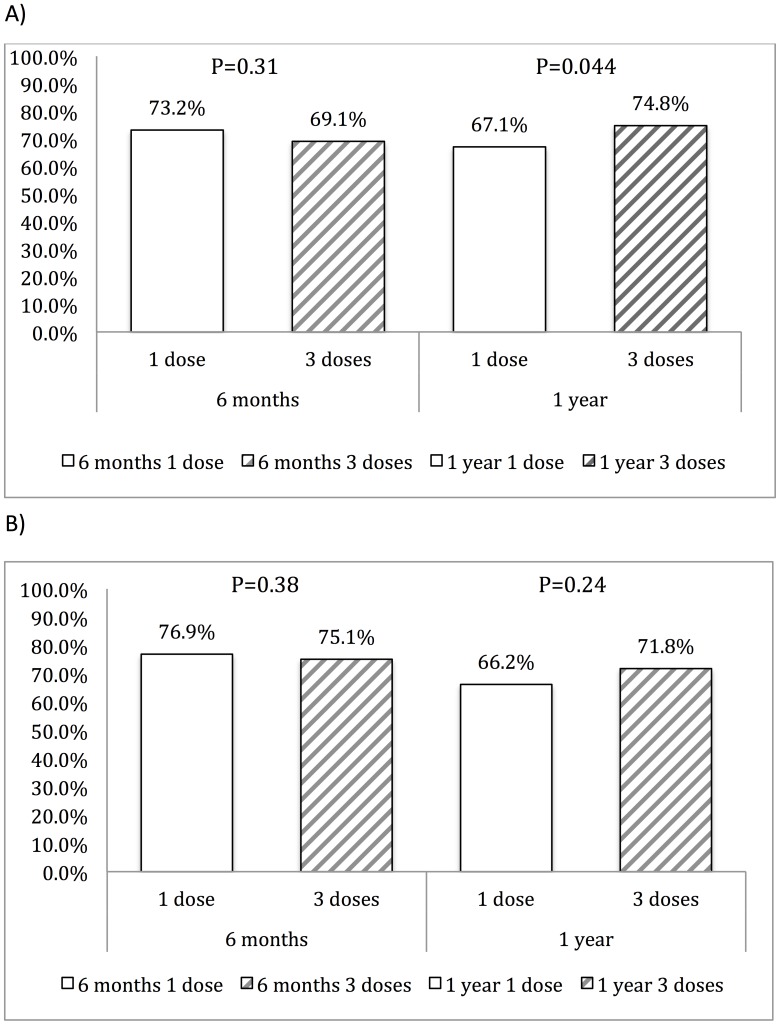
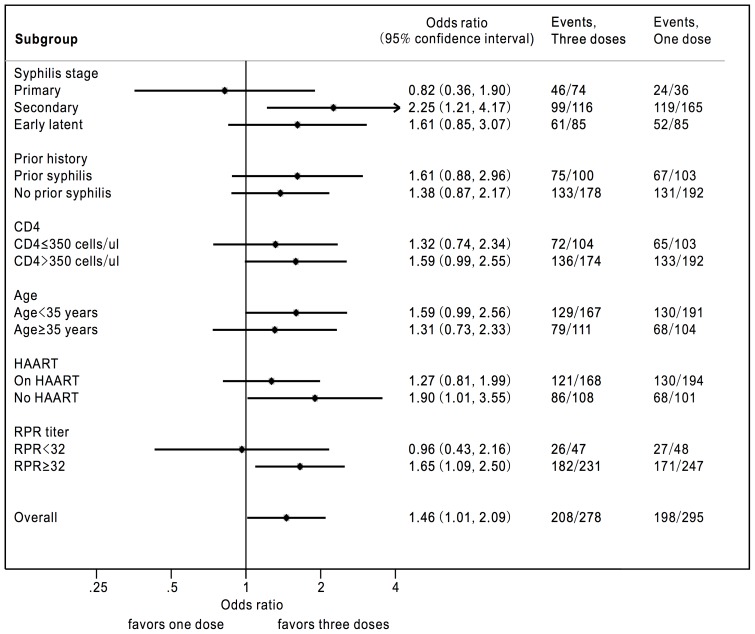
Between 2007 and 2012, 573 patients completed at least 12 months of follow-up: 295 (51.5%) receiving 1 dose of BPG (1-dose group) and 278 (48.5%) 3 doses (3-dose group). Overall, 198 patients (67.1%; 95% confidence interval [CI], 61.4-72.5%) in the 1-dose group achieved serological response at 12 months, as did 208 patients (74.8%; 95% CI, 69.3-79.8%) in the 3-dose group (one-sided 95% CI of the difference, 15.1%). In the multivariate analysis, secondary syphilis (adjusted odds ratio [AOR], 1.90; 95% CI 1.17-3.09), RPR titer ≥32 (AOR, 1.93; 95% CI, 1.38-2.69), and 3 doses of BPG (AOR, 1.68; 95% CI, 1.20-2.36) were independently associated with a serological response. The time to the first episode of treatment failure was 1184 (standard deviation [SD], 70.5) and 1436 (SD, 80.0) days for 1- and 3-dose group, respectively.
Single-dose BPG resulted in a higher serological failure rate and shorter time to treatment failure than 3 weekly doses of BPG in the treatment of early syphilis in HIV-infected patients.
性传播疾病治疗指南推荐对感染HIV的早期梅毒患者(一期、二期和早期潜伏梅毒)单次注射苄星青霉素G(BPG),但支持该推荐的临床数据有限。
我们前瞻性观察了台湾地区8家医院中寻求早期梅毒治疗的感染HIV的成年人接受1剂或每周3剂BPG后的血清学反应。治疗后每3 - 6个月检测快速血浆反应素(RPR)滴度。血清学反应定义为治疗12个月时RPR滴度下降4倍或更多。缺失值按照末次观察结转原则处理。我们假设1剂BPG不比每周3剂BPG差,设定血清学反应差异的非劣效界值为10%。
2007年至2012年期间,573例患者完成了至少12个月的随访:295例(51.5%)接受1剂BPG(1剂组),278例(48.5%)接受3剂(3剂组)。总体而言,1剂组198例患者(67.1%;95%置信区间[CI],61.4 - 72.5%)在12个月时达到血清学反应,3剂组208例患者(74.8%;95%CI,69.3 - 79.8%)达到血清学反应(差异的单侧95%CI为15.1%)。在多变量分析中,二期梅毒(校正比值比[AOR],1.90;95%CI 1.17 - 3.09)、RPR滴度≥32(AOR,1.93;95%CI,1.38 - 2.69)和3剂BPG(AOR,1.68;95%CI,1.20 - 2.36)与血清学反应独立相关。1剂组和3剂组首次出现治疗失败的时间分别为1184(标准差[SD],70.5)天和1436(SD,80.0)天。
在治疗感染HIV患者的早期梅毒时,单次注射BPG导致的血清学失败率高于每周3剂BPG,且治疗失败时间更短。