Cai Ruxia, Zhao Na, Sun Chaoqin, Huang Mingjiao, Jiao Zhenlong, Peng Jian, Zhang Jin, Guo Guo
School of Basic Medical Sciences, Guizhou Key Laboratory of Microbial and Infectious Disease Prevention & Control, Guizhou Medical University, Guiyang, Guizhou, China.
Key Laboratory of Environmental Pollution Monitoring and Disease Control (Guizhou Medical University), Ministry of Education, Guiyang, Guizhou, China.
PeerJ. 2025 May 20;13:e19372. doi: 10.7717/peerj.19372. eCollection 2025.
There is a pressing need to create innovative alternative treatment approaches considering the overuse of antifungal drugs causes the number of clinically isolated fluconazole-resistant species to increase. antimicrobial peptide (GmAMP) is a novel peptide screened by us using artificial intelligence modeling techniques, and pre-tests showed its strong antimicrobial activity against clinically fluconazole-resistant .
The study aimed to comprehensively investigate the antimicrobial activity and mechanisms of GmAMP against fluconazole-resistant . The antifungal activity of GmAMP against fluconazole-resistant was assessed by using broth microdilution method, growth and fungicidal kinetics, hypha transformation, and antibiofilm assay. To further uncover the potential mechanisms of action of GmAMP, we performed scanning electron microscopy, flow cytometry, cell membrane potential probe 3, 3'-Dipropylthiadicarbocyanine Iodide (DiSC(5)), and reactive oxygen species (ROS) probe 2', 7'-Dichlorodihydrofluorescein diacetate (DCFH-DA) detection to assess the cellular morphology and structure, membrane permeability, membrane depolarization, and ROS accumulation, respectively. At the same time, we used cytotoxicity and degree of erythrocyte hemolysis assays to assess GmAMP's toxicity . Cytotoxicity and treatment efficacy were evaluated by utilizing the larvae infection model.
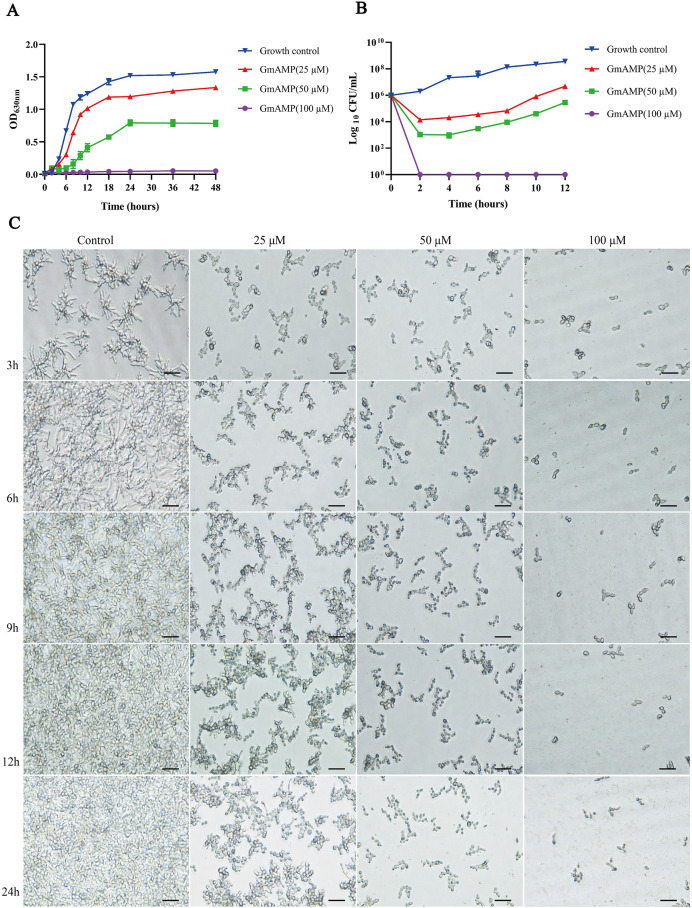
GmAMP exhibited significant antifungal activity against fluconazole-resistant with a minimum inhibitory concentration (MIC) of 25 µM and demonstrated fungicidal effects at 100 µM within 2 h. GmAMP prevented the transition from yeast to hypha morphology, inhibited the biofilm formation rate of 88.32%, and eradicated the mature biofilm rate of 58.28%. Additionally, GmAMP treatment at 100 µM caused cell structure damage in fluconazole-resistant , whereas GmAMP treatment at concentrations ranging from 25 to 100 µM caused membrane permeability, depolarization of cell membrane potential, and intracellular ROS accumulation. Moreover, GmAMP enhanced the survival rate of 75% for with fluconazole-resistant infection as well as reduced fungal burden by approximately 1.0 × 10 colony forming units per larva (CFU per larva).
GmAMP can disrupt the cell membrane of fluconazole-resistant and also shows favorable safety and therapeutic efficacy . Accordingly, GmAMP has the potential to be an agent against drug-resistant fungi.
考虑到抗真菌药物的过度使用导致临床分离的氟康唑耐药菌株数量增加,迫切需要创新的替代治疗方法。抗菌肽(GmAMP)是我们使用人工智能建模技术筛选出的一种新型肽,预试验显示其对临床氟康唑耐药菌具有强大的抗菌活性。
本研究旨在全面研究GmAMP对氟康唑耐药菌的抗菌活性及其作用机制。采用肉汤微量稀释法、生长和杀菌动力学、菌丝形态转化及生物膜检测法评估GmAMP对氟康唑耐药菌的抗真菌活性。为进一步揭示GmAMP的潜在作用机制,我们进行了扫描电子显微镜、流式细胞术、细胞膜电位探针3,3'-二丙基硫代二碳菁碘化物(DiSC(5))和活性氧(ROS)探针2',7'-二氯二氢荧光素二乙酸酯(DCFH-DA)检测,分别评估细胞形态和结构、膜通透性、膜去极化和ROS积累。同时,我们使用细胞毒性和红细胞溶血程度检测来评估GmAMP的毒性。利用幼虫感染模型评估细胞毒性和治疗效果。
GmAMP对氟康唑耐药菌表现出显著的抗真菌活性,最低抑菌浓度(MIC)为25μM,在100μM时2小时内显示出杀菌作用。GmAMP可阻止酵母形态向菌丝形态的转变,抑制生物膜形成率达88.32%,消除成熟生物膜率达58.28%。此外,100μM的GmAMP处理导致氟康唑耐药菌的细胞结构损伤,而25至100μM浓度的GmAMP处理导致膜通透性、细胞膜电位去极化和细胞内ROS积累。此外,GmAMP使氟康唑耐药菌感染的幼虫存活率提高了75%,并使每个幼虫的真菌负荷降低了约1.0×10个菌落形成单位(CFU/幼虫)。
GmAMP可破坏氟康唑耐药菌的细胞膜,且具有良好的安全性和治疗效果。因此,GmAMP有潜力成为一种抗耐药真菌的药物。