Martínez Gómez Edgar, Solar Ximena, Faria Daniel, Nombela Franco Luis, Jiménez Quevedo Pilar, Tirado Gabriela, Pozo Osinalde Eduardo, Olmos Blanco Carmen, Mahía Casado Patricia, Alberca Pedro Marcos, Luaces María, Gómez de Diego José Juan, Collado Yurrita Luis, Fernández-Ortiz Antonio, Pérez-Villacastín Julián, de Agustín José Alberto
Unidad de Imagen Cardiaca, Hospital Clínico San Carlos, Madrid, España Unidad de Imagen Cardiaca Hospital Clínico San Carlos Madrid España.
Servicio de Hemodinámica, Hospital Clínico San Carlos, Madrid, España Servicio de Hemodinámica Hospital Clínico San Carlos Madrid España.
REC Interv Cardiol. 2024 Jul 19;6(4):271-277. doi: 10.24875/RECIC.M24000465. eCollection 2024 Oct-Dec.
Several studies have shown that reduced (< 50%) left ventricular ejection fraction (LVEF) is an independent risk factor for cardiovascular events and mortality in patients with severe aortic stenosis (AS) undergoing valve replacement. Although patients with preserved LVEF (> 50%) have a better prognosis, there is a group with supranormal LVEF (≥ 70%) whose prognosis seems to differ due to their characteristics. The aim of this study was to evaluate outcomes after transcatheter aortic valve implantation (TAVI) in patients with severe AS and supranormal LVEF.
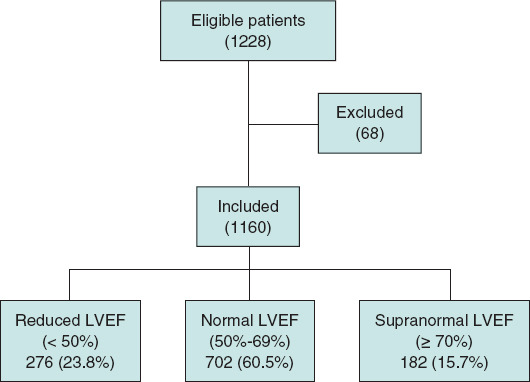
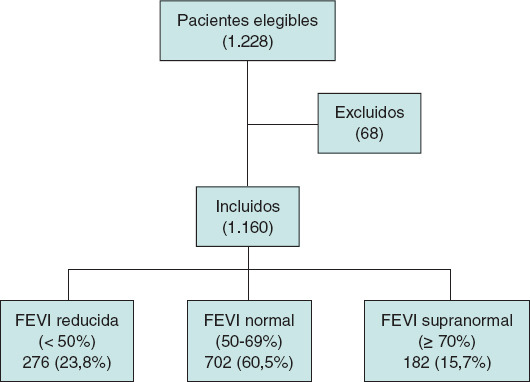
We performed a retrospective cohort study that included 1160 patients undergoing TAVI between 2007 and 2021 at (Madrid, Spain). The patients were classified according to preoperative LVEF into reduced (< 50%), normal (50% to 69%), and supranormal (≥ 70%). Clinical, echocardiographic variables, and the following outcomes were compared: death from any cause at 30 days and at 1 year, death from cardiovascular causes at 1 year, and rehospitalization due to cardiovascular causes at 1 year.
Of the 1160 patients with severe AS who underwent TAVI during the study period, 276 (23.8%) had reduced LVEF, 702 (60.5%) had normal LVEF, and 182 (15.7%) had supranormal LVEF. Patients with supranormal LVEF were predominantly men (82.9 ± 5.3 years) and had lower ventricular volumes, higher relative wall thickness, and concentric geometry. There were no differences in 30-day or 1-year mortality. However, rehospitalization for cardiovascular causes at 1 year was significantly higher in the supranormal LVEF group (LVEF < 50%: 29.2%; LVEF 50% to 69%: 27.4%; LVEF ≥ 70%: 34.4%; < .043).
Patients with severe AS and supranormal preprocedural LVEF (≥ 70%) who underwent TAVI had a higher rate of cardiovascular rehospitalization at 1 year, with no differences in mortality.
多项研究表明,左心室射血分数(LVEF)降低(<50%)是接受瓣膜置换的重度主动脉瓣狭窄(AS)患者发生心血管事件和死亡的独立危险因素。尽管LVEF保留(>50%)的患者预后较好,但有一组LVEF超常(≥70%)的患者,因其自身特征,预后似乎有所不同。本研究的目的是评估重度AS且LVEF超常患者经导管主动脉瓣植入术(TAVI)后的结局。
我们进行了一项回顾性队列研究,纳入了2007年至2021年在西班牙马德里某中心接受TAVI的1160例患者。根据术前LVEF将患者分为降低组(<50%)、正常组(50%至69%)和超常组(≥70%)。比较临床、超声心动图变量以及以下结局:30天和1年时的任何原因死亡、1年时的心血管原因死亡以及1年时因心血管原因再次住院。
在研究期间接受TAVI的1160例重度AS患者中,276例(23.8%)LVEF降低,702例(60.5%)LVEF正常,182例(15.7%)LVEF超常。LVEF超常的患者以男性为主(82.9±5.3岁),心室容积较小,相对室壁厚度较高,呈向心性几何形态。30天或1年死亡率无差异。然而,1年时因心血管原因再次住院的情况在LVEF超常组显著更高(LVEF<50%:29.2%;LVEF 50%至69%:27.4%;LVEF≥70%:34.4%;P<.043)。
接受TAVI的重度AS且术前LVEF超常(≥70%)的患者1年时心血管再次住院率较高,死亡率无差异。