Roothans Nina, Pabst Martin, van Diemen Menno, Herrera Mexicano Claudia, Zandvoort Marcel, Abeel Thomas, van Loosdrecht Mark C M, Laureni Michele
Delft University of Technology, Delft, the Netherlands.
Waternet, Amsterdam, the Netherlands.
Nat Water. 2025;3(5):590-604. doi: 10.1038/s44221-025-00430-x. Epub 2025 May 7.
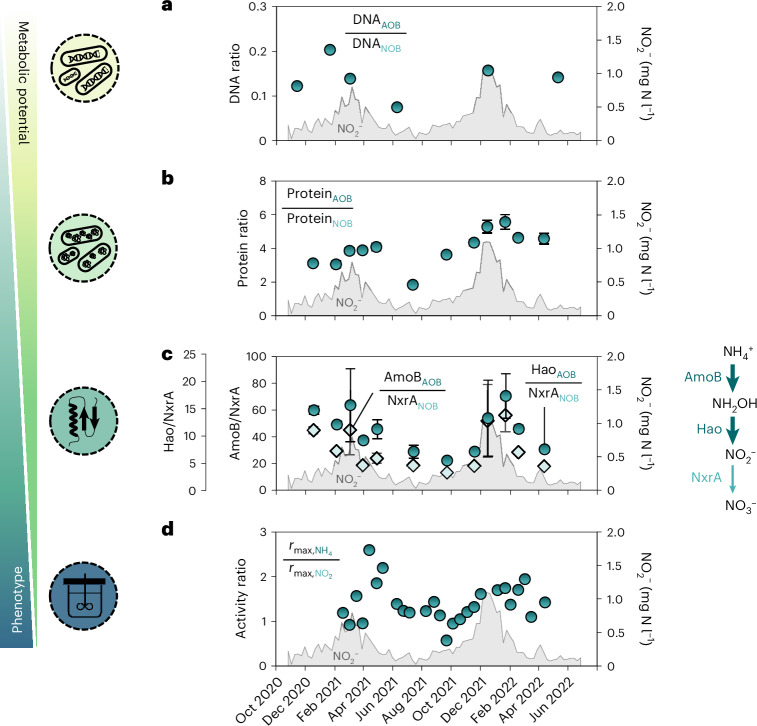
Nitrous oxide (NO) is the third most important greenhouse gas and originates primarily from natural and engineered microbiomes. Effective emission mitigations are currently hindered by the largely unresolved ecophysiological controls of coexisting NO-converting metabolisms in complex communities. To address this, we used biological wastewater treatment as a model ecosystem and combined long-term metagenome-resolved metaproteomics with ex situ kinetic and full-scale operational characterization over nearly 2 years. By leveraging the evidence independently obtained at multiple ecophysiological levels, from individual genetic potential to actual metabolism and emergent community phenotype, the cascade of environmental and operational triggers driving seasonal NO emissions has ultimately been resolved. We identified nitrifier denitrification as the dominant NO-producing pathway and dissolved O as the prime operational parameter, paving the way to the design and fostering of robust emission control strategies. This work exemplifies the untapped potential of multi-meta-omics in the mechanistic understanding and ecological engineering of microbiomes towards reducing anthropogenic impacts and advancing sustainable biotechnological developments.
一氧化二氮(N₂O)是第三重要的温室气体,主要源自天然和人工微生物群落。目前,由于复杂群落中共存的N₂O转化代谢在很大程度上尚未得到解决的生态生理控制,有效的排放缓解措施受到阻碍。为了解决这一问题,我们将生物废水处理作为一个模型生态系统,并结合了近2年的长期宏基因组解析宏蛋白质组学以及异位动力学和全规模运行特征分析。通过利用在从个体遗传潜力到实际代谢和新兴群落表型的多个生态生理水平上独立获得的证据,最终解决了驱动季节性N₂O排放的一系列环境和运行触发因素。我们确定硝化反硝化是主要的N₂O产生途径,溶解氧是主要的运行参数,为设计和培育强大的排放控制策略铺平了道路。这项工作例证了多组学在微生物群落的机理理解和生态工程中尚未开发的潜力,以减少人为影响并推动可持续生物技术发展。