Zhuang Miaoqing, Hassan Intan Idiana, W Ahmad Wan Muhamad Amir, Abdul Kadir Azidah, Liu Xiaodong, Li Furong, Gao Yinuo, Guan Yang, Song Shuting
Department of Nursing, College of Nursing and Rehabilitation, Xi'an Jiaotong University City College, Xi 'an, China.
School of Health Sciences, Health Campus, Universiti Sains Malaysia, Kota Bharu, Malaysia.
J Med Internet Res. 2025 May 26;27:e76323. doi: 10.2196/76323.
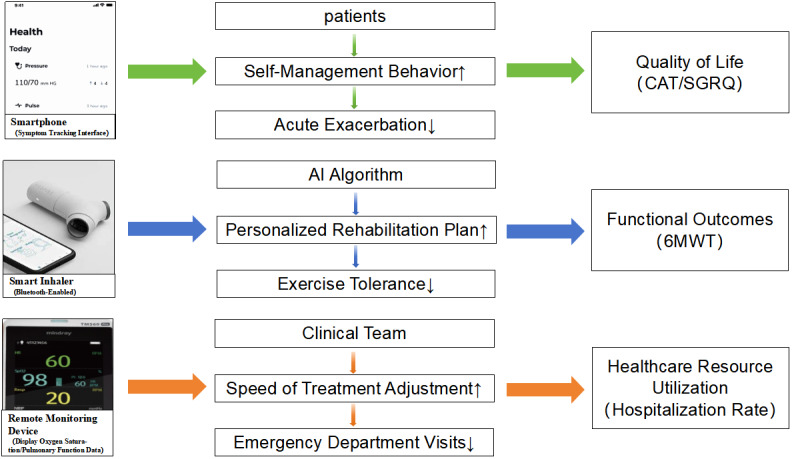
Chronic obstructive pulmonary disease (COPD), marked by dyspnea, cough, and sputum production, significantly impairs patients' quality of life and functionality. Effective management strategies, particularly those empowering patients to manage their condition, are essential to reduce this burden and health care use. Digital health interventions-such as mobile apps for symptom tracking, wearable sensors for vital sign monitoring, and web-based pulmonary rehabilitation programs-can enhance self-efficacy and promote greater patient engagement. By improving self-management skills, these interventions also help alleviate pressure on health care systems.
This systematic review and meta-analysis assesses the clinical effectiveness of smartphone apps, wearable monitors, and web-delivered platforms in four COPD management areas: (1) quality of life (measured by the COPD Assessment Test [CAT] and St George's Respiratory Questionnaire), (2) self-efficacy (assessed by the General Self-Efficacy Scale), (3) functional capacity (evaluated via the 6-minute walk test and Modified Medical Research Council Dyspnea Scale), and (4) health care use (indicated by hospital and emergency department visits).
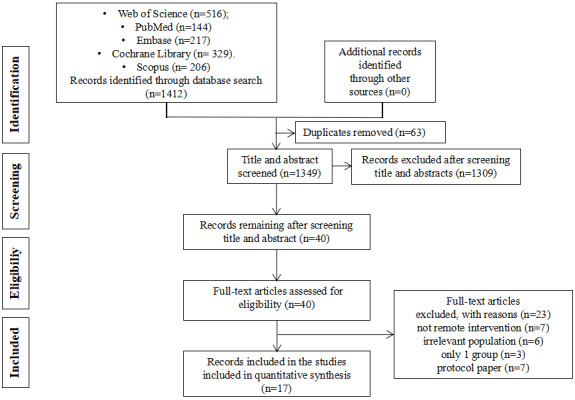
A systematic review was conducted using predefined search terms in PubMed, Embase, Cochrane, and Web of Science up to January 26, 2025, to identify randomized trials on digital health interventions for COPD. Two reviewers independently screened studies and extracted data. Outcomes included quality of life, self-efficacy, functional status, and health care use.
This review included 17 studies with 2027 participants from 11 countries. Eleven trials involved health care professionals in digital platform use, and 12 reported adherence strategies. Digital tools for COPD primarily focused on telerehabilitation (eg, video-guided exercises) and self-management systems (eg, artificial intelligence-driven exacerbation alerts). The study participants were predominantly older adults. Meta-analysis results indicated that digital health interventions significantly improved quality of life at 3 months on the CAT (mean difference [MD] -1.65, 95% CI -3.17 to -0.14; P=.03); at 6 months on the CAT (MD -2.43, 95% CI -3.93 to -0.94; P=.001) and St George's Respiratory Questionnaire (MD 3.25, 95% CI 0.69-5.81; P=.01); at 12 months on the CAT (MD -2.53, 95% CI -3.91 to -1.16; P<.001), EQ-5D (MD 0.04, 95% CI 0.01-0.07; P=.02), and EQ-5D visual analogue scale (MD 5.88, 95% CI 0.38-11.37; P=.04); the General Self-Efficacy Scale at 3 months (MD 1.65, 95% CI 0.62-2.69; P=.002) and 6 months (MD 1.94, 95% CI 0.83-3.05; P<.001); and the Modified Medical Research Council Dyspnea Scale at more than 3 months (MD -0.23, 95% CI -0.36 to -0.11; P=.003). However, no significant differences were observed in the 6-minute walk test, emergency department admissions, hospital admissions, emergency department admissions for COPD, or hospital admissions for COPD.
Our findings suggest that digital health interventions may benefit COPD patients, but their clinical effectiveness remains uncertain. Further robust studies are needed, particularly those involving larger numbers of older adults with COPD.
PROSPERO CRD420251032053; https://www.crd.york.ac.uk/PROSPERO/view/CRD420251032053.
慢性阻塞性肺疾病(COPD)以呼吸困难、咳嗽和咳痰为特征,严重损害患者的生活质量和功能。有效的管理策略,尤其是那些使患者能够自我管理病情的策略,对于减轻这种负担和减少医疗保健使用至关重要。数字健康干预措施,如用于症状跟踪的移动应用程序、用于生命体征监测的可穿戴传感器以及基于网络的肺康复计划,可以提高自我效能并促进患者更多地参与。通过提高自我管理技能,这些干预措施也有助于减轻医疗保健系统的压力。
本系统评价和荟萃分析评估智能手机应用程序、可穿戴监测器和基于网络的平台在慢性阻塞性肺疾病四个管理领域的临床效果:(1)生活质量(通过慢性阻塞性肺疾病评估测试[CAT]和圣乔治呼吸问卷测量),(2)自我效能(通过一般自我效能量表评估),(3)功能能力(通过6分钟步行试验和改良医学研究理事会呼吸困难量表评估),以及(4)医疗保健使用(以医院和急诊科就诊次数表示)。
截至2025年1月26日,在PubMed、Embase、Cochrane和科学网中使用预定义的搜索词进行系统评价,以识别关于慢性阻塞性肺疾病数字健康干预措施的随机试验。两名评价员独立筛选研究并提取数据。结果包括生活质量、自我效能、功能状态和医疗保健使用。
本评价纳入了来自11个国家的17项研究,共2027名参与者。11项试验让医疗保健专业人员参与数字平台的使用,12项报告了依从性策略。慢性阻塞性肺疾病的数字工具主要侧重于远程康复(如视频指导锻炼)和自我管理系统(如人工智能驱动的病情加重警报)。研究参与者主要是老年人。荟萃分析结果表明,数字健康干预措施在3个月时显著改善了CAT的生活质量(平均差[MD]-1.65,95%置信区间-3.17至-0.14;P=.03);在6个月时改善了CAT(MD -2.43,95%置信区间-3.93至-0.94;P=.001)和圣乔治呼吸问卷(MD 3.25,95%置信区间0.69-5.81;P=.01);在12个月时改善了CAT(MD -2.53,95%置信区间-3.91至-1.16;P<.001)、EQ-5D(MD 0.04,95%置信区间0.01-0.07;P=.02)和EQ-5D视觉模拟量表(MD 5.88,95%置信区间0.38-11.37;P=.04);在3个月(MD 1.65,95%置信区间0.62-2.69;P=.002)和6个月(MD 1.94,95%置信区间0.83-3.05;P<.001)时改善了一般自我效能量表;在超过3个月时改善了改良医学研究理事会呼吸困难量表(MD -0.23,95%置信区间-0.36至-0.11;P=.003)。然而,在6分钟步行试验、急诊科入院、医院入院、慢性阻塞性肺疾病急诊科入院或慢性阻塞性肺疾病医院入院方面未观察到显著差异。
我们的研究结果表明,数字健康干预措施可能对慢性阻塞性肺疾病患者有益,但其临床效果仍不确定。需要进一步进行有力的研究,特别是那些涉及大量慢性阻塞性肺疾病老年患者的研究。
PROSPERO CRD420251032053;https://www.crd.york.ac.uk/PROSPERO/view/CRD420251032053 。