Rodríguez-Lobato Luis Gerardo, de Daniel Anna, Pereira Arturo, Fernández de Larrea Carlos, Tovar Natalia, Cibeira M Teresa, Moreno David F, Mateos Jose Miguel, Llobet Noemí, Carcelero Esther, Munárriz Daniel, Bladé Joan, Rosiñol Laura
Amyloidosis and Multiple Myeloma Unit, Department of Hematology, Hospital Clínic de Barcelona, Universitat de Barcelona, Barcelona, Spain.
Institut d'Investigacions Biomèdiques August Pi i Sunyer (IDIBAPS), Barcelona, Spain.
Blood Cancer J. 2025 May 26;15(1):103. doi: 10.1038/s41408-025-01311-y.
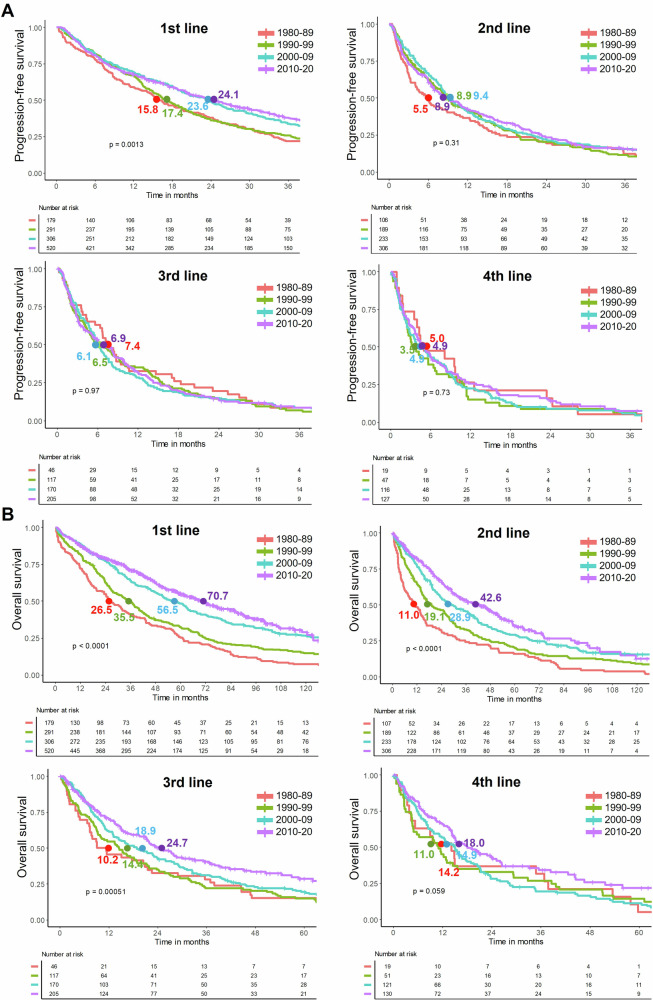
The treatment landscape of multiple myeloma (MM) has evolved significantly over four decades, driven by novel therapies and optimized supportive care. However, the attrition rate (AR), defined as the proportion of patients who die without advancing to the next line of therapy (LOT) after treatment failure, remains a major challenge. To assess how treatment patterns and outcomes have evolved, we analyzed 1,297 MM patients treated between 1980 and 2020, stratified by diagnosis period and age. ARs declined from 38-55% in the 1980s to 15-20% in 2010-2020, but remained high in older patients, with 46.9% of those over 80 unable to proceed beyond first LOT. While progression-free survival gains were primarily observed in the first LOT (15.8 to 24.1 months, p = 0.001), overall survival (OS) improved across all LOTs and age groups, likely due to more effective salvage therapies and supportive care. Achieving a complete response in first-line therapy was associated with a significant OS benefit (4.5 vs. 1.6 years, p < 0.001), underscoring its importance, as many patients, particularly older ones, are less likely to reach subsequent LOTs. Despite advances in MM treatment, patient loss to attrition remains a challenge, highlighting the need for more effective therapies early in the disease course.
在新型疗法和优化的支持性治疗的推动下,多发性骨髓瘤(MM)的治疗格局在四十多年间发生了显著演变。然而,损耗率(AR),即治疗失败后未进入下一线治疗(LOT)就死亡的患者比例,仍然是一个重大挑战。为了评估治疗模式和结果是如何演变的,我们分析了1980年至2020年间接受治疗的1297例MM患者,按诊断时期和年龄进行分层。损耗率从20世纪80年代的38%-55%下降到2010-2020年的15%-20%,但老年患者的损耗率仍然很高,80岁以上的患者中有46.9%无法进入一线治疗之后的阶段。虽然无进展生存期的延长主要出现在一线治疗中(从15.8个月延长至24.1个月,p = 0.001),但所有治疗阶段和年龄组的总生存期(OS)均有所改善,这可能得益于更有效的挽救疗法和支持性治疗。一线治疗中实现完全缓解与显著的总生存期获益相关(4.5年对1.6年,p < 0.001),这凸显了其重要性,因为许多患者,尤其是老年患者,进入后续治疗阶段的可能性较小。尽管MM治疗取得了进展,但患者损耗仍是一个挑战,这突出了在疾病早期阶段需要更有效疗法的必要性。