
在活体小鼠模型中,骨关节炎不同阶段滑液向关节软骨和软骨下骨的溶质转运
Solute transport from synovial fluid to articular cartilage and subchondral bone at different stages of osteoarthritis in a live mouse model.
作者信息
Chen Mengcun, Yang Yanmei, Cui Mingshu, Wang Bin
机构信息
Center for Translational Medicine, Departments of Medicine and Orthopaedic Surgery, Sidney Kimmel Medical College, Thomas Jefferson University, Philadelphia, PA, 19107, United States.
Department of Orthopaedic Surgery, Sidney Kimmel Medical College, Thomas Jefferson University, Philadelphia, PA, 19107, United States.
出版信息
J Orthop Translat. 2025 May 3;52:291-300. doi: 10.1016/j.jot.2025.04.012. eCollection 2025 May.
OBJECTIVE
This study aims to (1) identify a simplified method to preserve sample integrity and maintain original fluorescence distribution; (2) assess the diffusivity of small and large molecules within articular cartilage (AC), calcified cartilage (CC), and subchondral bone (SB); and (3) investigate the changes in solute transport at various stages of osteoarthritis (OA) in a destabilization of the medial meniscus (DMM) murine model.
METHODS
Fluorescent dyes of small and large molecules were injected into the knee joints of live mice. Joints were harvested and rapidly frozen immediately post-euthanasia. Optimal dye concentrations and dwelling times were determined through exploratory studies. Mice underwent either DMM or sham surgery and were evaluated at 2 and 8 weeks postoperatively. Relative fluorescence intensity was quantified within the AC, CC and SB, complemented by micro-CT, safranin O staining, and collagen II immunohistochemistry staining.
RESULTS
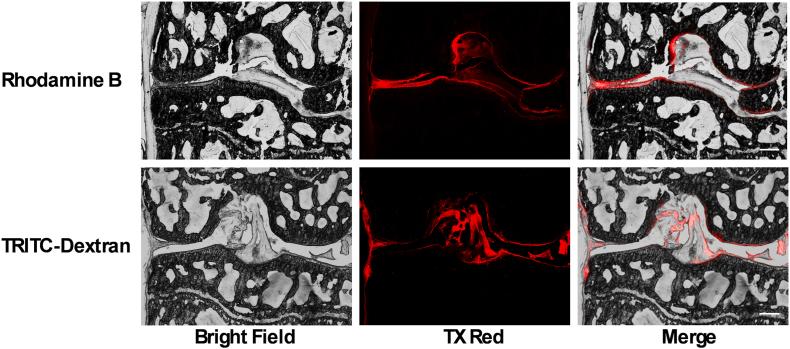
The methodology successfully preserved sample integrity and original dye distribution. Fluorescent imaging revealed that small solute was mainly restricted by the tidemark, while large solute showed limited permeability in AC. Permeability of AC remained elevated in the DMM group at both time points. Increased permeability in CC and SB was observed only at 8 weeks post-DMM surgery, accompanied by reduced collagen II amount.
CONCLUSIONS
In live mice, the tidemark serves as a barrier to small molecule diffusion, while the cartilage surface restricts larger molecules; however, both structures exhibit increased permeability in OA. These findings advance the understanding of OA pathogenesis and suggest potential therapeutic targets related to cartilage permeability.
TRANSLATIONAL POTENTIAL
The findings of this study advance the understanding of osteoarthritis pathogenesis by elucidating the role of solute transport alterations in cartilage and subchondral bone, thereby suggesting potential therapeutic targets aimed at modulating cartilage permeability to improve joint health in osteoarthritis.
目的
本研究旨在(1)确定一种简化方法以保持样本完整性并维持原始荧光分布;(2)评估小分子和大分子在关节软骨(AC)、钙化软骨(CC)和软骨下骨(SB)内的扩散率;(3)在半月板不稳定(DMM)小鼠模型中研究骨关节炎(OA)各阶段溶质转运的变化。
方法
将小分子和大分子荧光染料注入活小鼠的膝关节。在安乐死后立即采集关节并迅速冷冻。通过探索性研究确定最佳染料浓度和停留时间。小鼠接受DMM手术或假手术,并在术后2周和8周进行评估。在AC、CC和SB内对相对荧光强度进行定量,并辅以显微CT、番红O染色和II型胶原免疫组织化学染色。
结果
该方法成功保持了样本完整性和原始染料分布。荧光成像显示,小溶质主要受潮标的限制,而大溶质在AC中的渗透性有限。在两个时间点,DMM组AC的渗透性均保持升高。仅在DMM手术后8周观察到CC和SB的渗透性增加,同时II型胶原含量减少。
结论
在活小鼠中,潮标是小分子扩散的屏障,而软骨表面限制大分子;然而,在OA中这两种结构的渗透性均增加。这些发现增进了对OA发病机制的理解,并提示了与软骨渗透性相关的潜在治疗靶点。
转化潜力
本研究结果通过阐明溶质转运改变在软骨和软骨下骨中的作用,增进了对骨关节炎发病机制的理解,从而提示了旨在调节软骨渗透性以改善骨关节炎关节健康的潜在治疗靶点。




 Zotero 插件