Mosca Sarah, Ottaviani Monica, Briganti Stefania, Di Nardo Anna, Flori Enrica
Laboratory of Cutaneous Physiopathology and Integrated Center of Metabolomics Research, San Gallicano Dermatological Institute, IRCCS, 00144 Rome, Italy.
Cells. 2025 May 20;14(10):747. doi: 10.3390/cells14100747.
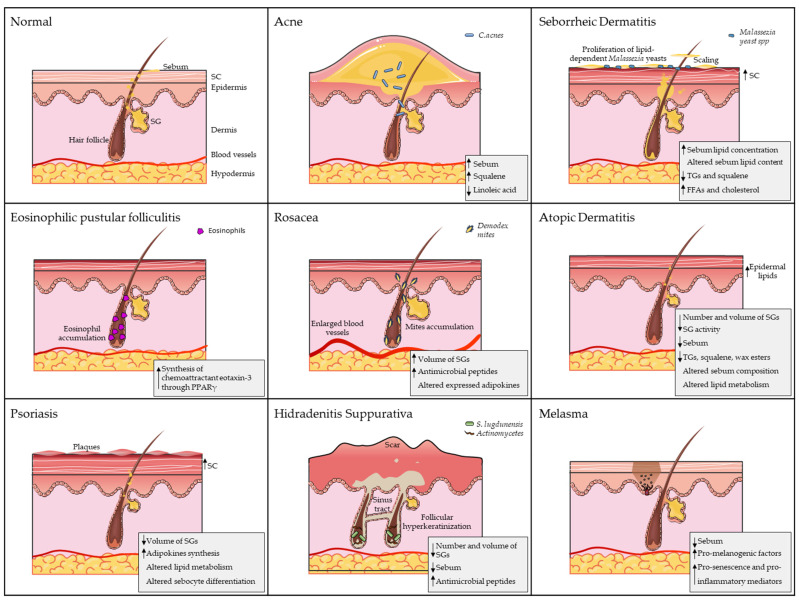
The sebaceous gland (SG) is an integral part of the pilosebaceous unit and is a very active and dynamic organ that contributes significantly to the maintenance of skin homeostasis. In addition to its primary role in sebum production, the SG is involved in the maintenance of skin barrier function, local endocrine/neuroendocrine function, the innate immune response, and the regulation of skin bacterial colonization. Structural and functional alterations of SGs leading to the dysregulation of sebum production/composition and immune response may contribute to the pathogenesis of inflammatory dermatoses. This review summarises the current knowledge on the contribution of SGs to the pathogenesis of common inflammatory skin diseases. These findings are crucial for the development of more effective therapeutic strategies for the treatment of inflammatory dermatoses.
皮脂腺(SG)是毛囊皮脂腺单位的一个组成部分,是一个非常活跃且动态变化的器官,对维持皮肤内环境稳定起着重要作用。除了在皮脂分泌中起主要作用外,皮脂腺还参与皮肤屏障功能的维持、局部内分泌/神经内分泌功能、固有免疫反应以及皮肤细菌定植的调节。皮脂腺的结构和功能改变导致皮脂分泌/成分失调和免疫反应异常,可能会促使炎症性皮肤病的发病。本综述总结了目前关于皮脂腺在常见炎症性皮肤病发病机制中作用的相关知识。这些发现对于开发更有效的炎症性皮肤病治疗策略至关重要。