Cho Soohyun
Department of Neurology, Uijeongbu Eulji Medical Center, Eulji University School of Medicine, 712, Dongil-ro, Uijeongbu 11749, Republic of Korea.
Biomedicines. 2025 May 9;13(5):1150. doi: 10.3390/biomedicines13051150.
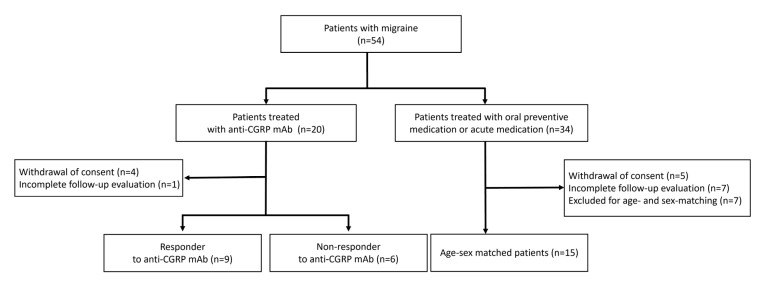
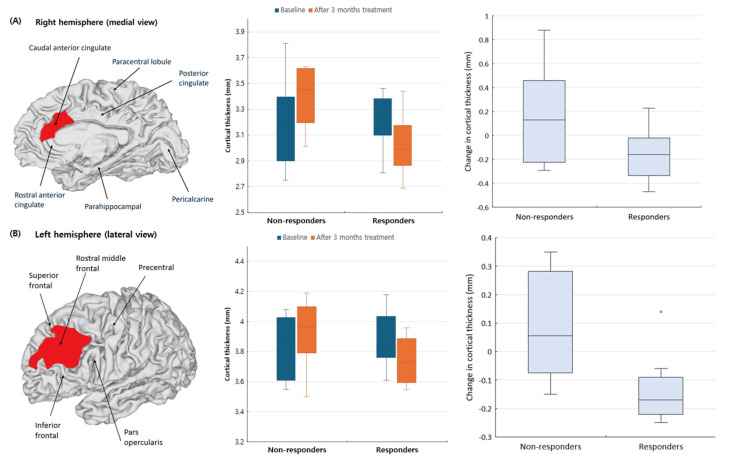
Migraine is associated with structural brain abnormalities, including cortical thickness changes. Anti-calcitonin gene-related peptide monoclonal antibodies (anti-CGRP mAbs) are a novel therapy for migraine prevention, but their effects on cortical structures are poorly understood. In this prospective age- and sex-matched controlled study, 30 migraine patients receiving either anti-CGRP mAbs (fremanezumab) ( = 15) or oral preventive medications ( = 15) underwent 3T MRI scans before and after treatment. Treatment response was defined as a ≥50% reduction in monthly headache days after 3 months. Cortical thickness was analyzed across 46 cortical regions, comparing patients treated with anti-CGRP mAbs to those receiving oral preventive treatment, as well as responders to non-responders within the anti-CGRP group. Cortical thickness changes did not differ significantly between the anti-CGRP and oral treatment groups. However, among patients receiving anti-CGRP mAbs, responders showed significant decreases in cortical thickness compared to non-responders, particularly in the right caudal anterior cingulate ( = 0.026) and left rostral middle frontal cortex ( = 0.007). These cortical changes correlated with treatment response to anti-CGRP mAbs (β = -0.429, 95% CI [-0.777, -0.081], = 0.016 in the right caudal anterior cingulate; β = -0.224, 95% CI [-0.390, -0.057], = 0.008 in the left rostral middle frontal cortex). This exploratory study, based on a small sample size, suggests that cortical thickness changes may be associated with treatment response to anti-CGRP mAbs rather than with CGRP mAb treatment itself. Further studies with larger cohorts are needed to confirm these findings.
偏头痛与脑结构异常有关,包括皮质厚度变化。抗降钙素基因相关肽单克隆抗体(抗CGRP单克隆抗体)是预防偏头痛的一种新疗法,但其对皮质结构的影响尚不清楚。在这项年龄和性别匹配的前瞻性对照研究中,30名接受抗CGRP单克隆抗体(fremanezumab)(n = 15)或口服预防性药物(n = 15)的偏头痛患者在治疗前后接受了3T磁共振成像扫描。治疗反应定义为3个月后每月头痛天数减少≥50%。对46个皮质区域的皮质厚度进行了分析,将接受抗CGRP单克隆抗体治疗的患者与接受口服预防性治疗的患者进行比较,以及抗CGRP组中的反应者与无反应者进行比较。抗CGRP组和口服治疗组之间的皮质厚度变化没有显著差异。然而,在接受抗CGRP单克隆抗体的患者中,与无反应者相比,反应者的皮质厚度显著降低,特别是在右侧尾侧前扣带回(P = 0.026)和左侧喙侧中额叶皮质(P = 0.007)。这些皮质变化与抗CGRP单克隆抗体的治疗反应相关(右侧尾侧前扣带回β = -0.429,95%CI [-0.777,-0.081],P = 0.016;左侧喙侧中额叶皮质β = -0.224,95%CI [-0.390,-0.057],P = 0.008)。这项基于小样本量的探索性研究表明,皮质厚度变化可能与抗CGRP单克隆抗体的治疗反应有关,而不是与CGRP单克隆抗体治疗本身有关。需要更大样本量的进一步研究来证实这些发现。