Raunak Raunak, Rakshit Roopshali, Bahl Aayush, Sinha Soumya, Pandey Saurabh, Kant Sashi, Tripathi Deeksha
Microbial Pathogenesis and Microbiome Lab, Department of Microbiology, School of Life Sciences, Central University of Rajasthan, Ajmer 305817, Rajasthan, India.
Department of Biochemistry, School of Chemical and Life Sciences, Jamia Hamdard, New Delhi 110062, Delhi, India.
Biology (Basel). 2025 May 18;14(5):565. doi: 10.3390/biology14050565.
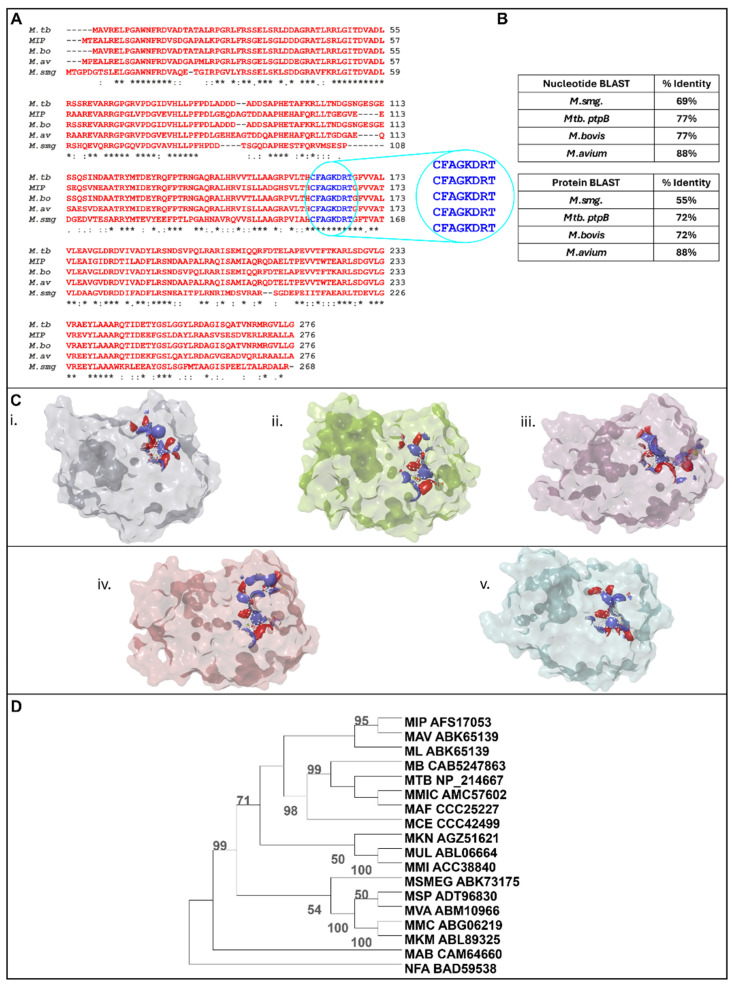
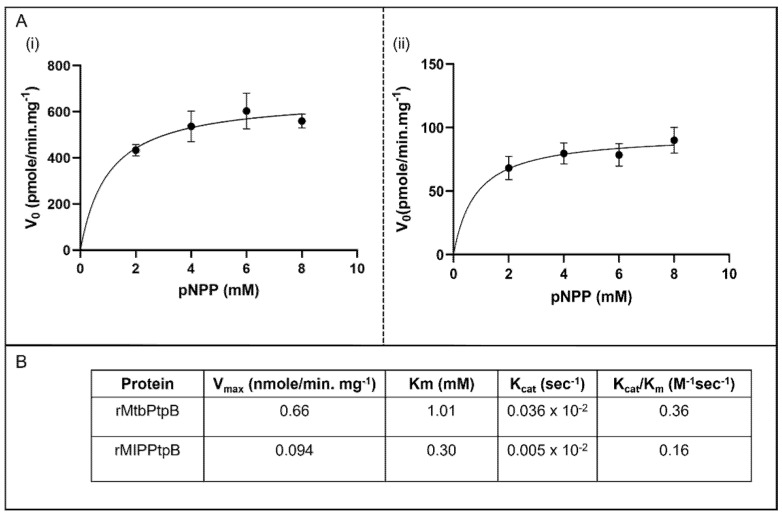
(MIP), an atypical mycobacterium originally developed as an anti-leprosy vaccine, has emerged as a potent immunomodulator with diverse therapeutic applications. Despite its clinical significance, molecular mechanisms underlying MIP's immunomodulatory properties remain largely unexplored. Bacterial phosphatases are recognized as crucial virulence factors that enable pathogens to evade host defenses by modulating host immune signaling pathways, including phosphoinositide metabolism. MIP_07528 was identified as a putative protein tyrosine phosphatase B (PtpB) ortholog through in silico analysis, with significant sequence conservation observed within catalytic domains of pathogenic mycobacterial PtpB proteins. Phosphatase activity was detected in both cell lysate and culture filtrate fractions, revealing differential expression patterns between MIP and . Upregulation of MIP_07528 was demonstrated under oxidative stress, suggesting involvement in stress adaptation. The recombinant protein exhibited distinctive kinetic properties, characterized by higher substrate affinity yet increased susceptibility to oxidative inactivation compared to its M. tuberculosis counterpart. In macrophages, MIP_07528 suppressed pro-inflammatory cytokines while enhancing anti-inflammatory IL-10 production. These findings establish MIP_07528 as a functional phosphatase that may contribute to MIP's immunomodulatory properties. This work advances understanding of phosphatase function in non-pathogenic mycobacteria while providing insights into virulence factor evolution and establishing a foundation for novel antimicrobial strategies.
(MIP)是一种最初作为抗麻风病疫苗开发的非典型分枝杆菌,已成为一种具有多种治疗应用的强效免疫调节剂。尽管其具有临床意义,但MIP免疫调节特性的分子机制在很大程度上仍未得到探索。细菌磷酸酶被认为是关键的毒力因子,可使病原体通过调节宿主免疫信号通路(包括磷酸肌醇代谢)来逃避宿主防御。通过计算机分析,MIP_07528被鉴定为推定的蛋白酪氨酸磷酸酶B(PtpB)直系同源物,在致病性分枝杆菌PtpB蛋白的催化域内观察到显著的序列保守性。在细胞裂解物和培养滤液组分中均检测到磷酸酶活性,揭示了MIP与……之间的差异表达模式。在氧化应激下,MIP_07528的表达上调,表明其参与应激适应。与结核分枝杆菌的对应物相比,重组蛋白表现出独特的动力学特性,其特征是底物亲和力更高,但对氧化失活的敏感性增加。在巨噬细胞中,MIP_07528抑制促炎细胞因子,同时增强抗炎性IL-10的产生。这些发现表明MIP_07528是一种功能性磷酸酶,可能有助于MIP的免疫调节特性。这项工作增进了对非致病性分枝杆菌中磷酸酶功能的理解,同时为毒力因子进化提供了见解,并为新型抗菌策略奠定了基础。