Screpis Daniele, Qordja Fjorela, De Berardinis Luca, Piovan Gianluca, Magnanelli Stefano, Amarossi Andrea, Gigante Antonio Pompilio, Zorzi Claudio
Department of Orthopaedics, IRCCS Ospedale Sacro Cuore Don Calabria, 37024 Negrar di Valpolicella, Italy.
Clinical Orthopaedics, Department of Clinical and Molecular Science, School of Medicine, Università Politecnica delle Marche, Via Tronto, 10/a, 60126 Ancona, Italy.
J Clin Med. 2025 May 12;14(10):3350. doi: 10.3390/jcm14103350.
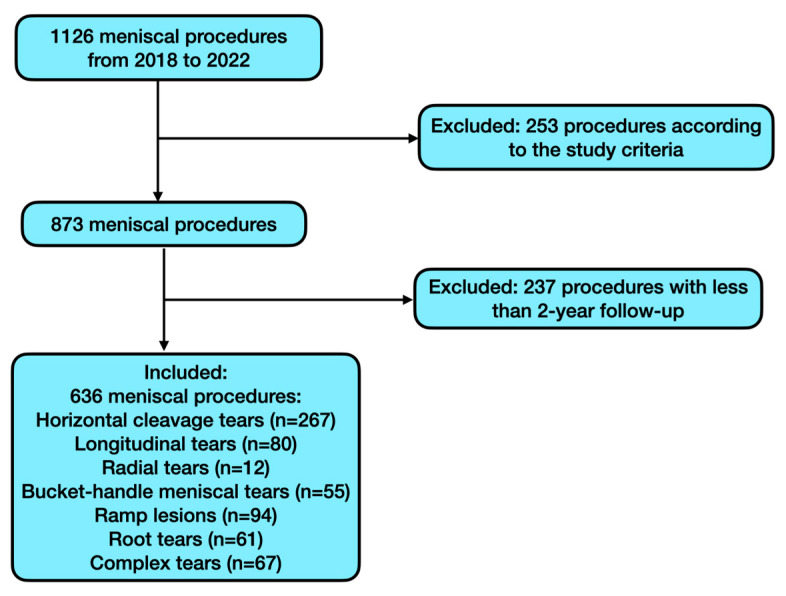
Despite advances in repair techniques, the failure rates of meniscal surgery are still high. The seven most common tear types-horizontal cleavage tears (HCTs), radial tears (RTs), meniscal ramp lesions (MRLs), meniscal root tears (MRTs), longitudinal tears (LTs), bucket-handle tears (BHMTs), and complex meniscal tears (CMTs)-were reviewed. The present retrospective observational study aimed to analyze their characteristics, incidence, treatment approach and failure rates of a consecutive cohort of patients undergoing meniscal arthroscopic repair. The database of a high-volume meniscal suture center was examined for lesions managed by all-inside, inside-out, outside-in, or transtibial pull-out techniques from January 2018 to September 2022. Demographic (gender, age at surgery, laterality of the affected knee) and intraoperative data (tear type/site, repair technique, and suture number/combination) were collected in order to calculate the failure rates of the cohort and of each tear type and suture technique. Altogether, 636 procedures met our criteria of having at least a 2-year follow-up. The overall failure rate was 1.98%. The most frequent lesions were HCTs (41.98%), with most injuries being in the body/posterior horn (88.52%) of the right knee (56.92%). Treatment predominantly (92.50%) included all-inside sutures. All-inside repair had the highest failure rate (2.98%), followed by inside-out (1.56%) repair ( = 1.0), whereas outside-in and pull-out techniques never failed. Failure rates by lesion included BHMTs (7.27%), HCTs (2.25%), CMTs (1.49%), and LTs (1.25%); RMT, RML, and MRT repair were always successful. Findings at two years suggest that 1-3 all-inside sutures minimize MRL failure, whereas three or more all-inside sutures or combined techniques seem to be effective for HCTs, LTs, and RTs but not BHMTs. Pull-out repair worked best for complete tears/avulsion types of MRTs, whereas all-inside sutures effectively managed partial lesions. Results for CMTs were inconclusive.
尽管修复技术有所进步,但半月板手术的失败率仍然很高。我们回顾了七种最常见的撕裂类型——水平劈裂撕裂(HCT)、放射状撕裂(RT)、半月板斜坡损伤(MRL)、半月板根部撕裂(MRT)、纵向撕裂(LT)、桶柄状撕裂(BHMT)和复杂半月板撕裂(CMT)。本项回顾性观察研究旨在分析连续一组接受半月板关节镜修复患者的撕裂特征、发生率、治疗方法及失败率。我们检查了一个大容量半月板缝合中心的数据库,该数据库涵盖了2018年1月至2022年9月期间采用全内、由内向外、由外向内或经胫骨拉出技术处理的损伤。收集了人口统计学数据(性别、手术年龄、患侧膝关节的侧别)和术中数据(撕裂类型/部位、修复技术以及缝线数量/组合),以便计算该队列以及每种撕裂类型和缝线技术的失败率。总共有636例手术符合我们至少随访2年的标准。总体失败率为1.98%。最常见的损伤是HCT(41.98%),大多数损伤位于右膝(56.92%)的体部/后角(88.52%)。治疗主要(92.50%)包括全内缝线。全内修复的失败率最高(2.98%),其次是由内向外修复(1.56%)(P = 1.0),而由外向内和拉出技术从未失败过。按损伤类型划分的失败率包括BHMT(7.27%)、HCT(2.25%)、CMT(1.49%)和LT(1.25%);RMT、RML和MRT修复始终成功。两年的研究结果表明,1至3根全内缝线可将MRL失败率降至最低,而三根或更多根全内缝线或联合技术似乎对HCT、LT和RT有效,但对BHMT无效。拉出修复对MRT的完全撕裂/撕脱类型效果最佳,而全内缝线可有效处理部分损伤。CMT的结果尚无定论。