Popa Ilie Ioana Rada, Butuca Anca, Homorodean Calin, Dobrea Carmen Maximiliana, Morgovan Claudiu, Frum Adina, Ghibu Steliana
Department of Endocrinology, Faculty of Medicine, "Iuliu Haţieganu" University of Medicine and Pharmacy, 3-5 Louis Pasteur Street, 400349 Cluj-Napoca, Romania.
Preclinical Department, Faculty of Medicine, "Lucian Blaga" University of Sibiu, 550169 Sibiu, Romania.
J Clin Med. 2025 May 17;14(10):3518. doi: 10.3390/jcm14103518.
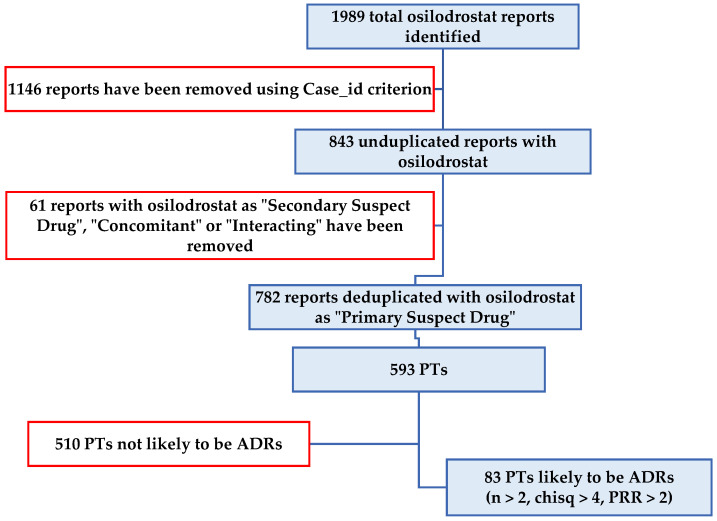
Cushing's syndrome (CS), including Cushing's disease (CD)-the most common type-has a substantial negative impact on morbidity, mortality, and patients' quality of life. Medical management of CS is essential for controlling hypercortisolism as part of preoperative preparation for definitive surgical treatment and for managing residual or relapsed hypercortisolism post-surgery. Osilodrostat, a dual inhibitor of glucocorticoid and mineralocorticoid biosynthetic pathways, has been approved for the medical treatment of CS since early 2020. However, real-world data on its adverse effects remain limited. We mined the FAERS database and analyzed the reports associated with osilodrostat up to 1 October 2024. Descriptive and disproportionality methods based on Relative Odds Ratio (ROR), Chi-square (χ), and Proportional Reporting Ratio (PRR), were used to discern potential safety signals and assess the significance of osilodrostat-associated adverse events. This study identified 782 reports in which osilodrostat was the primary suspected drug, containing 593 preferred terms (PTs) and 2481 occurrences. The most frequently registered events belonged to the following SOCs: "General disorders and administration site conditions" ( = 457, 18.4%), "Injury, poisoning and procedural complications" ( = 311, 12.5%), "Gastrointestinal disorders" ( = 278, 11.2%), "Investigations" ( = 260, 10.5%), and "Nervous system disorders" ( = 184, 7.4%). Among PTs, off-label use was the most commonly reported, aligning with the fact that the vast majority of cases originated from the U.S. (84%), where osilodrostat is officially approved only for the treatment of CD. Disproportionality analysis confirmed previously known and new potential adverse drug reactions associated with osilodrostat treatment, including reports of cardiac flutter (: 4; PRR: 19.42; χ: 49.57), ventricular extrasystoles (: 4; PRR: 11.85; χ: 29.62), muscular weakness (: 8; PRR: 2.25; χ: 4.38), rib fracture (: 4; PRR: 6.66; χ: 13.99), spinal fracture (: 3; PRR: 4.66; χ: 5.35), sepsis (: 9; PRR: 2.63; χ: 7.56), fungal infections (: 4; PRR: 3.67; χ: 5.33), and COVID-19 (: 32; PRR: 5.07; χ: 101.16). This study highlights new risks and offers valuable insights into osilodrostat use; however, further research and validation are necessary, particularly for adverse reactions not yet explicitly documented in the summary of product characteristics.
库欣综合征(CS),包括最常见的类型——库欣病(CD),对发病率、死亡率和患者生活质量有重大负面影响。CS的药物治疗对于控制高皮质醇血症至关重要,这是确定性手术治疗术前准备的一部分,也是术后管理残余或复发高皮质醇血症的手段。奥西卓司他是一种糖皮质激素和盐皮质激素生物合成途径的双重抑制剂,自2020年初以来已被批准用于CS的药物治疗。然而,关于其不良反应的真实世界数据仍然有限。我们挖掘了FAERS数据库,并分析了截至2024年10月1日与奥西卓司他相关的报告。基于相对比值比(ROR)、卡方(χ)和比例报告比(PRR)的描述性和不成比例性方法,用于识别潜在的安全信号并评估奥西卓司他相关不良事件的显著性。本研究确定了782份报告,其中奥西卓司他是主要怀疑药物,包含593个首选术语(PTs)和2481次出现。最常记录的事件属于以下系统器官分类(SOCs):“全身性疾病和给药部位状况”(=457,18.4%)、“损伤、中毒和手术并发症”(=311,12.5%)、“胃肠道疾病”(=278,11.2%)、“检查”(=260,10.5%)和“神经系统疾病”(=184,7.4%)。在PTs中,超适应症使用是最常报告的,这与绝大多数病例来自美国(84%)这一事实相符,在美国,奥西卓司他仅被正式批准用于治疗CD。不成比例性分析证实了与奥西卓司他治疗相关的先前已知和新的潜在药物不良反应,包括心房扑动报告(:4;PRR:19.42;χ:49.57)、室性早搏(:4;PRR:11.85;χ:29.62)、肌肉无力(:8;PRR:2.25;χ:4.38)、肋骨骨折(:4;PRR:6.66;χ:13.99)、脊柱骨折(:3;PRR:4.66;χ:5.35)、败血症(:9;PRR:2.63;χ:7.56)、真菌感染(:4;PRR:3.67;χ:5.33)和2019冠状病毒病(:32;PRR:5.07;χ:101.16)。本研究突出了新的风险,并为奥西卓司他的使用提供了有价值的见解;然而,需要进一步的研究和验证,特别是对于产品特性总结中尚未明确记录的不良反应。