Heydari Soroush, Mahmoud Qusay H
Department of Electrical, Computer and Software Engineering, Ontario Tech University, Oshawa, ON L1G 0C5, Canada.
Sensors (Basel). 2025 May 19;25(10):3191. doi: 10.3390/s25103191.
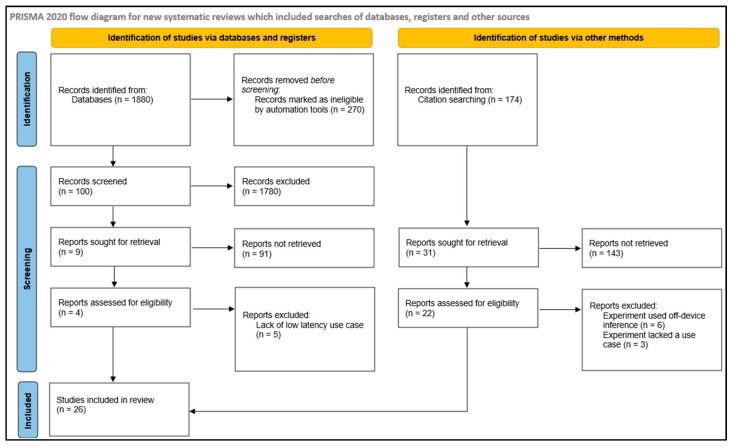
The growth in artificial intelligence and its applications has led to increased data processing and inference requirements. Traditional cloud-based inference solutions are often used but may prove inadequate for applications requiring near-instantaneous response times. This review examines Tiny Machine Learning, also known as TinyML, as an alternative to cloud-based inference. The review focuses on applications where transmission delays make traditional Internet of Things (IoT) approaches impractical, thus necessitating a solution that uses TinyML and on-device inference. This study, which follows the PRISMA guidelines, covers TinyML's use cases for real-world applications by analyzing experimental studies and synthesizing current research on the characteristics of TinyML experiments, such as machine learning techniques and the hardware used for experiments. This review identifies existing gaps in research as well as the means to address these gaps. The review findings suggest that TinyML has a strong record of real-world usability and offers advantages over cloud-based inference, particularly in environments with bandwidth constraints and use cases that require rapid response times. This review discusses the implications of TinyML's experimental performance for future research on TinyML applications.
人工智能及其应用的发展导致数据处理和推理需求增加。传统的基于云的推理解决方案经常被使用,但对于需要近乎即时响应时间的应用来说可能并不足够。本综述考察了 Tiny Machine Learning(也称为 TinyML)作为基于云的推理的替代方案。该综述聚焦于传输延迟使传统物联网(IoT)方法不切实际的应用,因此需要一种使用 TinyML 和设备端推理的解决方案。本研究遵循 PRISMA 指南,通过分析实验研究并综合当前关于 TinyML 实验特征(如机器学习技术和实验所用硬件)的研究,涵盖了 TinyML 在实际应用中的用例。本综述确定了现有研究差距以及解决这些差距的方法。综述结果表明,TinyML 在实际可用性方面有出色记录,并且与基于云的推理相比具有优势,特别是在带宽受限的环境以及需要快速响应时间的用例中。本综述讨论了 TinyML 的实验性能对未来 TinyML 应用研究的影响。