
2019年冠状病毒病大流行对桡骨远端骨折治疗的影响。
Impact of the COVID-19 Pandemic on Buckle Fracture Treatment.
作者信息
Kilinc Mehmet E, Sandefur Evan P, Zainab Mosufa, Peterman Nicholas J, Yu-Shan Andrea A, Apel Peter J
机构信息
Musculoskeletal Education and Research Center, Department of Orthopaedic Surgery, Institute for Orthopaedics & Neurosciences, Carilion Clinic, 2331 Franklin Road Southwest, Roanoke, VA, USA.
Virginia Tech Carilion School of Medicine, 2 Riverside Circle, Roanoke, VA, USA.
出版信息
J Pediatr Soc North Am. 2025 Mar 13;11:100162. doi: 10.1016/j.jposna.2025.100162. eCollection 2025 May.
BACKGROUND
Based on the existing consensus in the literature, we have coined a term at our institution to describe optimal treatment for distal radius buckle fractures: Buckle Evidence-based Strategic Treatment (BEST). BEST includes a single provider visit, education, a removable wrist brace/bandage, no additional follow-up visits, and no additional X-rays. During the COVID-19 pandemic, many providers were pressured to reduce the number of in-person visits, promote physical distancing, and minimize in-person interaction with the healthcare system. It is unknown if a secondary effect of the COVID-19 pandemic was increased use of BEST practices and if there was a sustained effect. This investigation analyzed the adherence to BEST practices for treating distal radius buckle fractures in the pre-COVID-19 and COVID-19 era.
METHODS
A retrospective cohort study of buckle fracture care was conducted across 2018-2019 (pre-COVID-19) and 2020-2022 (COVID-19 era). Subset analysis was also conducted for 2020 (peak COVID-19 era) and 2021-2022 (post-peak COVID-19 era). Adherence to BEST practices was assessed by chart review. The provider type was documented and subclassified into fellowship-trained pediatric orthopaedic surgeons, non-pediatric fellowship-trained orthopaedic surgeons, and non-physicians. Analyses were performed using chi-squared testing.
RESULTS
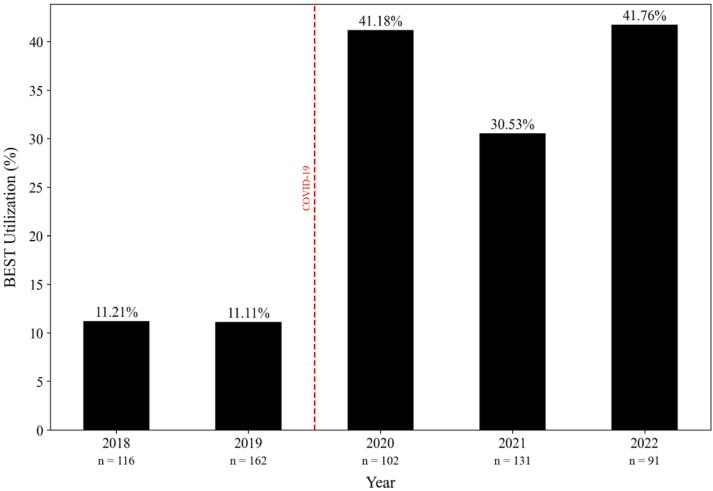
A total of 602 distal radius buckle fractures met inclusion, with an average patient age of 9.4 years. Pre-COVID-19 BEST practice adherence was 11.15%. During peak COVID-19 era, adherence rates improved significantly to 41.18% ( < .001). This effect was sustained for the post-peak COVID-19 era. There were significantly different rates of adherence depending on provider type ( < .001).
CONCLUSIONS
The COVID-19 pandemic was associated with a significant increase in BEST practice utilization for buckle fracture management across all provider types. Adherence to BEST practices varied significantly based on provider type, with pediatric fellowship-trained orthopaedic surgeons having the highest level of adherence. This study demonstrates that external factors can impact treatment decisions for distal radius buckle fractures. Advocacy to change practice patterns for pediatric fracture care must first understand the factors that influence decision-making.
KEY CONCEPTS
(1)The COVID-19 pandemic was associated with an increase in the adoption of BEST practices for the management of buckle fractures across all provider groups.(2)Fellowship-trained pediatric orthopaedic surgeons have the highest level of BEST practice adherence compared to other provider types.(3)Initiatives aimed at altering clinical practice must prioritize an understanding of the decisional factors affecting healthcare providers.
LEVEL OF EVIDENCE
III.
背景
基于文献中现有的共识,我们机构创造了一个术语来描述桡骨远端 buckle 骨折的最佳治疗方法:基于证据的 buckle 骨折策略性治疗(BEST)。BEST 包括一次医生就诊、教育、一个可摘除的手腕支具/绷带,无需额外的随访就诊,也无需额外的 X 光检查。在 COVID-19 大流行期间,许多医疗服务提供者面临着减少面对面就诊次数、促进身体距离并尽量减少与医疗系统的面对面互动的压力。目前尚不清楚 COVID-19 大流行的一个次要影响是否是 BEST 实践的使用增加,以及是否存在持续影响。本研究分析了 COVID-19 之前和 COVID-19 时代治疗桡骨远端 buckle 骨折时对 BEST 实践的遵循情况。
方法
对 2018 - 2019 年(COVID-19 之前)和 2020 - 2022 年(COVID-19 时代)的 buckle 骨折护理进行回顾性队列研究。还对 2020 年(COVID-19 高峰期)和 2021 - 2022 年(COVID-19 高峰期之后)进行了亚组分析。通过病历审查评估对 BEST 实践的遵循情况。记录医疗服务提供者类型并将其细分为接受过 fellowship 培训的小儿骨科医生、接受过非小儿 fellowship 培训的骨科医生和非医生。使用卡方检验进行分析。
结果
共有 602 例桡骨远端 buckle 骨折符合纳入标准,患者平均年龄为 9.4 岁。COVID-19 之前对 BEST 实践的遵循率为 11.15%。在 COVID-19 高峰期,遵循率显著提高至 41.(此处原文可能有误,推测为 41.18%)18%(P <.001)。这种效果在 COVID-19 高峰期之后持续存在。根据医疗服务提供者类型,遵循率存在显著差异(P <.001)。
结论
COVID-19 大流行与所有医疗服务提供者类型在 buckle 骨折管理中对 BEST 实践的利用率显著增加有关。对 BEST 实践的遵循因医疗服务提供者类型而异,接受过 fellowship 培训的小儿骨科医生的遵循水平最高。本研究表明外部因素会影响桡骨远端 buckle 骨折的治疗决策。倡导改变小儿骨折护理的实践模式必须首先了解影响决策的因素。
关键概念
(1)COVID-19 大流行与所有医疗服务提供者群体在 buckle 骨折管理中采用 BEST 实践的增加有关。(2)与其他医疗服务提供者类型相比,接受过 fellowship 培训的小儿骨科医生对 BEST 实践的遵循水平最高。(3)旨在改变临床实践的举措必须优先了解影响医疗服务提供者的决策因素。
证据水平
III 级



 Zotero 插件