Wang Michael Ke, Razeghi Ghazal, Baskaran Geethan, Park Louis, Blum Steffen, Heo Rachel, Stegmann Tina, Devereaux P J, McIntyre William F, Healey Jeff S, Prystajecky Michael, LeBlanc Rémi, Ruzycki Shannon M, Panju Mohamed, Vuong Kiven, Conen David
Department of Medicine, McMaster University, Toronto, Canada.
Population Health Research Institute, McMaster University, Toronto, Canada.
CJC Open. 2025 Jan 28;7(5):579-587. doi: 10.1016/j.cjco.2025.01.018. eCollection 2025 May.
For patients with perioperative atrial fibrillation (POAF) after noncardiac surgery, earlier conversion to sinus rhythm might improve outcomes. The efficacy of a rhythm vs rate control strategy for the acute management of POAF remains uncertain.
We searched databases for randomized controlled trials (RCTs) and observational studies that included patients with POAF after noncardiac surgery and reported outcomes for patients acutely treated with a rhythm control strategy vs either a rate control or no treatment strategy. Studies were pooled using random effects models.
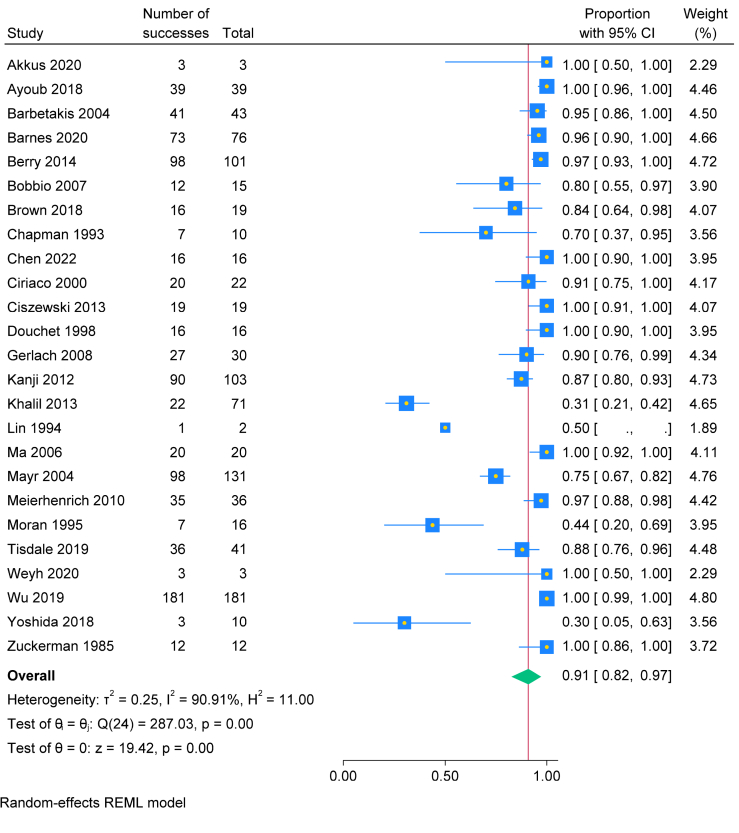
Of the observational studies, a rhythm control strategy was associated with higher conversion rates to sinus rhythm compared with a rate control or no treatment strategy (risk ratio [RR], 1.93; 95% confidence interval [CI], 1.25-2.97; 9 studies; N = 591). Compared with a rate control or no treatment strategy, a rhythm control strategy was not associated with differences in length of hospital stay (mean difference, -1.67 days; 95% CI, -7.10 to 3.76; 2 studies), length of intensive care stay (mean difference, -1.90 days; 95% CI, -7.62 to 3.82; 1 study), or all-cause mortality (RR, 1.12; 95% CI, 0.62-2.00; 5 studies). In an RCT that compared amiodarone vs magnesium, the RR was 0.56 for conversion to sinus rhythm (95% CI, 0.31-1.03; N = 34).
A rhythm control strategy was associated with greater success rates for conversion to sinus rhythm compared with a rate control or no treatment strategy. However, the observational studies were of low quality and only 1 small RCT was identified, and few data were available for other outcomes.
对于非心脏手术后发生围手术期心房颤动(POAF)的患者,更早恢复窦性心律可能改善预后。节律控制与心率控制策略在POAF急性处理中的疗效仍不确定。
我们检索数据库以查找随机对照试验(RCT)和观察性研究,这些研究纳入了非心脏手术后发生POAF的患者,并报告了采用节律控制策略与心率控制或不治疗策略进行急性治疗的患者的预后情况。研究采用随机效应模型进行汇总。
在观察性研究中,与心率控制或不治疗策略相比,节律控制策略与更高的窦性心律转复率相关(风险比[RR],1.93;95%置信区间[CI],1.25 - 2.97;9项研究;N = 591)。与心率控制或不治疗策略相比,节律控制策略与住院时间(平均差,-1.67天;95% CI,-7.10至3.76;2项研究)、重症监护病房住院时间(平均差,-1.90天;95% CI,-7.62至3.82;1项研究)或全因死亡率(RR,1.12;95% CI,0.62 - 2.00;5项研究)的差异无关。在一项比较胺碘酮与镁的RCT中,窦性心律转复的RR为0.56(95% CI,0.31 - 1.03;N = 34)。
与心率控制或不治疗策略相比,节律控制策略与更高的窦性心律转复成功率相关。然而,观察性研究质量较低,仅识别出1项小型RCT,且其他预后的可用数据较少。