Liu Dillys Xiaodi, Ip Mary Sau-Man, Lam David Chi-Leung, Chappell Francesca M, Clancy Una, Jaime Garcia Daniela, Arteaga-Reyes Carmen, Valdés Hernández Maria Del C, Thrippleton Michael, Stringer Michael S, Cheng Yajun, Zhang Junfang, Doubal Fergus, Lau Gary Kui Kai, Wardlaw Joanna M
Division of Neurology, Department of Medicine, LKS Faculty of Medicine, The University of Hong Kong, China.
Division of Respiratory Medicine, Department of Medicine, LKS Faculty of Medicine, The University of Hong Kong, China.
Neurology. 2025 Jun 24;104(12):e213734. doi: 10.1212/WNL.0000000000213734. Epub 2025 May 28.
Disturbed sleep is common after stroke, yet its relationship with cerebral small vessel disease (SVD) and cognitive performance in the stroke population, particularly patients with TIA/mild stroke who are on the milder end of the cerebrovascular spectrum, remains understudied. We aim to examine the associations of self-reported sleep metrics with neuroimaging markers of SVD and cognitive performance in patients with TIA/mild stroke from 2 prospective stroke cohorts.
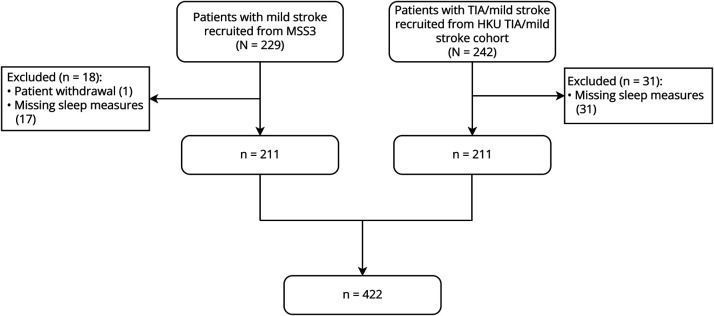
We studied adult patients with TIA/mild stroke (NIH Stroke Scale [NIHSS] score <7) who were consecutively recruited from Mild Stroke Study 3 (MSS3, University of Edinburgh) and the stroke cohort (the University of Hong Kong, HKU) during 2018-2022. Both MSS3 (N = 211) and HKU (N = 211) cohorts assessed SVD burden visually on brain MRI, cognitive performance using Montreal Cognitive Assessment (MoCA), and sleep quality using a structured sleep questionnaire at baseline visit. The primary outcomes were SVD markers, and the secondary outcome was total MoCA score. The associations of sleep metrics with SVD markers and cognitive performance were assessed using regression models, adjusted for demographics, vascular risk factors, history of depression and stroke, and study sites.
In 422 patients (65.6 ± 11.8 years, 67% male, median NIHSS score 1.0), longer in-bed time was independently associated with greater global SVD and Fazekas periventricular white matter hyperintensity (WMH) burden: odds ratio (OR) = 1.27 per 1-SD increase (95% CI 1.05-1.53), false discovery rate (FDR)-adjusted = 0.04; OR = 1.53 per 1-SD increase (95% CI 1.18-2.00), = 0.003. Longer sleep duration was independently associated with presence of cerebral microbleeds: OR = 1.42 per 1-SD increase (95% CI 1.09-1.87), = 0.04. Longer in-bed time was associated with a lower total MoCA score after covariate adjustment: standardized β = -0.58 (95% CI -0.99 to -0.16), = 0.02.
Disturbed sleep, including longer in-bed time and longer sleep duration, was cross-sectionally associated with greater SVD burden and worse cognitive performance in patients with TIA/mild stroke. Future longitudinal studies are warranted to validate our findings.
中风后睡眠障碍很常见,但其与中风人群中脑小血管疾病(SVD)及认知表现之间的关系,尤其是在脑血管疾病谱较轻端的短暂性脑缺血发作/轻度中风患者中,仍未得到充分研究。我们旨在研究来自两个前瞻性中风队列的短暂性脑缺血发作/轻度中风患者自我报告的睡眠指标与SVD神经影像学标志物及认知表现之间的关联。
我们研究了在2018年至2022年期间从轻度中风研究3(MSS3,爱丁堡大学)和中风队列(香港大学,HKU)连续招募的成年短暂性脑缺血发作/轻度中风患者(美国国立卫生研究院卒中量表[NIHSS]评分<7)。MSS3(N = 211)和HKU(N = 211)队列在基线访视时通过脑MRI视觉评估SVD负担,使用蒙特利尔认知评估(MoCA)评估认知表现,并使用结构化睡眠问卷评估睡眠质量。主要结局是SVD标志物,次要结局是MoCA总分。使用回归模型评估睡眠指标与SVD标志物及认知表现之间的关联,并对人口统计学、血管危险因素、抑郁和中风病史以及研究地点进行了调整。
在422例患者(65.6±11.8岁,67%为男性,NIHSS评分中位数为1.0)中,卧床时间较长与更严重的整体SVD和Fazekas脑室周围白质高信号(WMH)负担独立相关:每增加1个标准差,优势比(OR)=1.27(95%置信区间1.05 - 1.53),错误发现率(FDR)调整后 = 0.04;每增加1个标准差,OR = 1.53(95%置信区间1.18 - 2.00), = 0.003。睡眠时间较长与脑微出血的存在独立相关:每增加1个标准差,OR = 1.42(95%置信区间1.09 - 1.87), = 0.04。协变量调整后,卧床时间较长与较低的MoCA总分相关:标准化β = -0.58(95%置信区间 -0.99至 -0.16), = 0.02。
在短暂性脑缺血发作/轻度中风患者中,包括较长的卧床时间和较长的睡眠时间在内的睡眠障碍与更严重的SVD负担和更差的认知表现存在横断面关联。未来有必要进行纵向研究以验证我们的发现。