Berger Mathea, Ehlers Jan Peter, Nitsche Julia
Department of Human Medicine, Division of Didactics and Educational Research in Health Care, Faculty of Health, Witten/Herdecke University, Witten, Germany.
J Med Internet Res. 2025 May 28;27:e71795. doi: 10.2196/71795.
Climate change, driven by greenhouse gas emissions, threatens human health and biodiversity. While the digitalization of health care, including telemedicine and artificial intelligence, offers sustainability benefits, it also raises concerns about energy use and electronic waste. Balancing these factors is key to a sustainable health care future.
The objective of this review was to examine the extent to which digitalization in the health care sector influences environmental sustainability. Specifically, it aimed to assess how digitalization can contribute to reducing the health care sector's impact on global climate change. From these findings, conclusions were drawn regarding the extent to which digitalization aligns with the objectives of the Planetary Health movement and how these 2 movements may mutually reinforce each other.
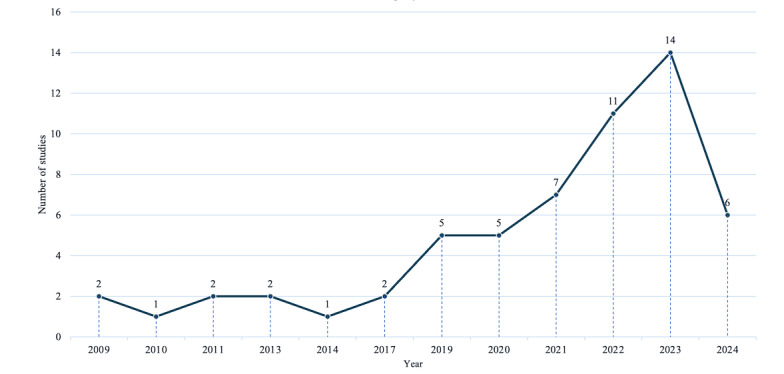
A scoping review guided by the PRISMA (Preferred Reporting Items for Systematic Reviews and Meta-Analyses) 2020 guidelines using databases such as PubMed and Scopus was conducted, and 58 quantitative studies from 2009 to 2024 were analyzed for environmental, social, and economic outcomes aligned with Planetary Health goals.
This review analyzed 58 studies on the environmental impact of digitalization in health care primarily focusing on telemedicine, which was examined in 91% (53/58) of the studies. Most studies (56/58, 97%) quantified transport-related emissions avoided through digitalization, with some also assessing emissions from health care facilities, medical equipment, and energy consumption. Findings indicated that telemedicine significantly reduces carbon dioxide emissions, with total avoided emissions amounting to approximately 830 million kg. A substantial proportion of the studies (36/58, 62%) focused on social aspects, highlighting factors such as patient satisfaction, time efficiency, and overall convenience. In addition, economic considerations were analyzed in 48% (28/58) of the studies, emphasizing cost reductions and resource optimization. However, only 12% (7/58) of the studies evaluated the full life cycle impact of digital technologies, highlighting the need for further research on their long-term environmental sustainability.
This review calls for further research beyond telemedicine, advocating for life cycle analyses and actionable strategies for a sustainable digitalization in health care systems. The Planetary Health framework is highlighted as a guide for ensuring sustainable digital transformation in health care.
由温室气体排放驱动的气候变化威胁着人类健康和生物多样性。虽然包括远程医疗和人工智能在内的医疗保健数字化带来了可持续发展的益处,但也引发了对能源使用和电子垃圾的担忧。平衡这些因素是实现医疗保健可持续未来的关键。
本综述的目的是研究医疗保健部门的数字化在多大程度上影响环境可持续性。具体而言,旨在评估数字化如何有助于减少医疗保健部门对全球气候变化的影响。基于这些发现,得出了关于数字化与地球健康运动目标的契合程度以及这两个运动如何相互促进的结论。
按照PRISMA(系统评价和Meta分析的首选报告项目)2020指南进行范围综述,使用PubMed和Scopus等数据库,并分析了2009年至2024年的58项定量研究,以获取与地球健康目标一致的环境、社会和经济成果。
本综述分析了58项关于医疗保健数字化环境影响的研究,主要聚焦于远程医疗,91%(53/58)的研究对其进行了考察。大多数研究(56/58,97%)量化了通过数字化避免的与交通相关的排放,一些研究还评估了医疗保健设施、医疗设备和能源消耗的排放。研究结果表明,远程医疗显著减少了二氧化碳排放,总共避免的排放量约为8.3亿千克。相当一部分研究(36/58,62%)关注社会方面,突出了患者满意度、时间效率和总体便利性等因素。此外,48%(28/58)的研究分析了经济因素,强调了成本降低和资源优化。然而,只有12%(7/58)的研究评估了数字技术的全生命周期影响,这凸显了对其长期环境可持续性进行进一步研究的必要性。
本综述呼吁在远程医疗之外进行进一步研究,倡导对医疗保健系统中可持续数字化进行生命周期分析和可操作的策略。地球健康框架被强调为确保医疗保健领域可持续数字转型的指南。