Cunha Lara Daniela Matos, Han Paul K J, Ventura Filipa, Pestana-Santos Márcia, Lomba Lurdes, Santos Margarida Reis
Health Sciences Research Unit: Nursing (UICISA: E), Coimbra Nursing School, Coimbra, Portugal.
School of Medicine and Biomedical Sciences (ICBAS) - University of Porto (UP), Porto, Portugal.
BMC Nurs. 2025 May 28;24(1):605. doi: 10.1186/s12912-025-03193-8.
While it is acknowledged that effectively managing uncertainty in nursing clinical practice is imperative for ensuring safe healthcare delivery, there remains a scarcity of guidance on enhancing uncertainty management within the clinical reasoning of nurses.
To describe strategies that nurses in post-anesthesia care units use to manage uncertainty in clinical reasoning; and to map these strategies within the Integrative Framework of Uncertainty Management, and the clinical realities of Wiedenbach's Prescriptive Theory.
MATERIAL & METHODS: A descriptive qualitative study. Fourteen nurses from a post-anesthesia care unit of a third-level hospital at the center region of Portugal were recruited using a convenience sampling method. Data were collected through semi-structured interviews and analyzed using thematic analysis using MAXQDA software. Consolidated Criteria for Reporting Qualitative Research (COREQ) checklist was used for reporting. Ethical approval was obtained from the relevant Ethics Committee, with informed consent, confidentiality, and data protection measures in place to ensure participant anonymity and compliance with the Declaration of Helsinki.
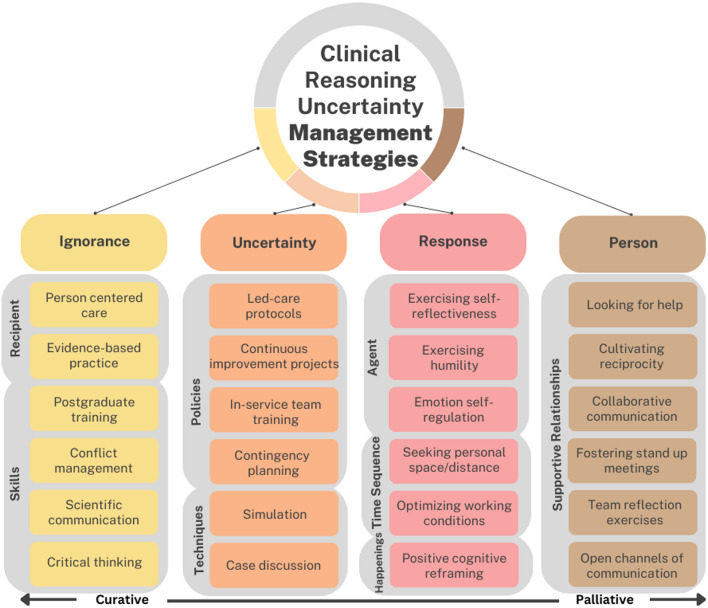
The major theme 'uncertainty management strategies in clinical reasoning of nurses in Post-anesthesia Care Units' included four themes: ignorance-focused strategies, uncertainty-focused strategies, response-focused strategies, and person-focused strategies. These themes were mapped within key domains of nursing care: recipient, skills, policies, techniques, time sequence, agent, happenings, and supportive relationships. The domains encompassed various approaches such as person-centered care, evidence-based practice, postgraduate training, conflict management, critical thinking, continuous improvement projects, in-service team training, contingency planning, case discussions, simulation, self-reflectiveness, emotion self-regulation, optimizing working conditions, positive cognitive reframing, seeking support, fostering team reflection, and collaborative communication.
Nurses in the Post-anesthesia Care Unit employed a range of uncertainty management strategies, which were effectively categorized within the Integrative Framework of Uncertainty Management (IFUM). Emphasizing nursing as a process, as described in Wiedenbach's Prescriptive Theory, these strategies were aligned with addressing the clinical realities tailored to each strategy. More research is needed to understand how the use of different strategies can promote nurses' wellbeing and enhance the safety of nursing care.
Not applicable.
虽然人们认识到,在护理临床实践中有效管理不确定性对于确保安全的医疗服务至关重要,但在加强护士临床推理中的不确定性管理方面,仍然缺乏相关指导。
描述麻醉后护理单元的护士在临床推理中用于管理不确定性的策略;并将这些策略映射到不确定性管理综合框架以及威登巴赫规范理论的临床现实中。
一项描述性定性研究。采用便利抽样法,从葡萄牙中部地区一家三级医院的麻醉后护理单元招募了14名护士。通过半结构化访谈收集数据,并使用MAXQDA软件进行主题分析。采用定性研究报告统一标准(COREQ)清单进行报告。获得了相关伦理委员会的伦理批准,并采取了知情同意、保密和数据保护措施,以确保参与者的匿名性并符合《赫尔辛基宣言》。
主要主题“麻醉后护理单元护士临床推理中的不确定性管理策略”包括四个主题:关注无知的策略、关注不确定性的策略、关注反应的策略和关注人的策略。这些主题映射到护理的关键领域:接受者、技能、政策、技术、时间顺序、主体、事件和支持性人际关系。这些领域涵盖了各种方法,如以患者为中心的护理、循证实践、研究生培训、冲突管理、批判性思维、持续改进项目、在职团队培训、应急计划、病例讨论、模拟、自我反思、情绪自我调节、优化工作条件、积极认知重构、寻求支持、促进团队反思和协作沟通。
麻醉后护理单元的护士采用了一系列不确定性管理策略,这些策略在不确定性管理综合框架(IFUM)中得到了有效分类。正如威登巴赫规范理论中所描述的,强调护理是一个过程,这些策略与针对每种策略的临床现实相契合。需要更多的研究来了解不同策略的使用如何促进护士的幸福感并提高护理安全性。
不适用。