Rašticová Martina, Šácha Jakub, Lakomý Martin, Mishra Pawan Kumar
Mendel University in Brno, Faculty of Business and Economics, Department of Management, Brno, Czechia.
Mendel University in Brno, Faculty of Business and Economics, Department of Statistics and Operational Research, Brno, Czechia.
Psychol Res Behav Manag. 2025 May 24;18:1211-1225. doi: 10.2147/PRBM.S508500. eCollection 2025.
This study explores the impact of two major labor market phenomena-the aging workforce and digitalization, which have global significance. The COVID-19 pandemic accelerated the adoption of digital technologies, resulting in economic growth, improved business processes, and reduced social isolation. However, the study also addresses the challenges and threats associated with digitalization, with a specific focus on technostress. The research analyses the primary techno-stressors experienced by older employees and self-employed individuals in four EU countries. Investigating various demographic factors such as gender, age, education level, employment type, and country of origin, the study aims to identify stress levels related to techno-demands and techno-disruption.
This study utilized a quantitative research design with a cross-sectional survey approach. A Quota sampling method in combination with Computer Assisted Web Interviewing (CAWI) was used to collect data. The overall response rate was 42% (varied by country) in total data collected. A sample of 1306 workers (aged 50-64), representing diverse demographics, was recruited and interviewed. The techno-stressors were assessed using a 14-item scale encompassing major stress-creating conditions as already reported in earlier studies.
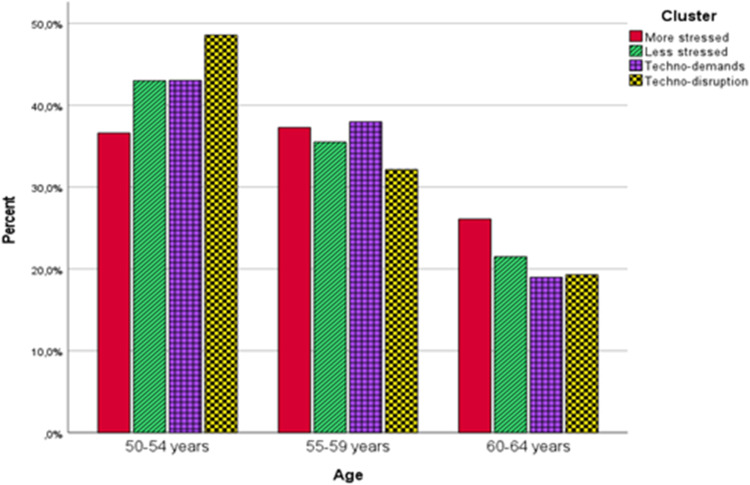
The results reveal intriguing patterns, particularly notable gender-based differences in technostress experiences across age groups. Younger male seniors and female seniors reported higher levels of techno-disruption, while techno-demands were more problematic for female seniors. Additionally, respondents' country of origin also influenced their experiences with technostress.
Overall, the study sheds light on the challenges of digitalization for older workers in central European perspective and provides important missing information and data on variation in technostress based on nationality, age, and gender. The results prompt further research on longitudinal trends and discussions on geography, industry, and country specific impact of digitalization on the modern workforce.
本研究探讨了两大具有全球意义的劳动力市场现象——劳动力老龄化和数字化的影响。新冠疫情加速了数字技术的采用,带来了经济增长、业务流程改善以及社会隔离减少。然而,该研究也探讨了与数字化相关的挑战和威胁,特别关注技术压力。该研究分析了四个欧盟国家老年员工和个体经营者所经历的主要技术压力源。通过调查性别、年龄、教育水平、就业类型和原籍国等各种人口因素,该研究旨在确定与技术需求和技术干扰相关的压力水平。
本研究采用定量研究设计和横断面调查方法。采用配额抽样方法结合计算机辅助网络访谈(CAWI)来收集数据。在收集的总数据中,总体回复率为42%(因国家而异)。招募并采访了1306名年龄在50 - 64岁之间、代表不同人口特征的工人样本。使用一个包含14个项目的量表来评估技术压力源,该量表涵盖了早期研究中已报道的主要压力产生情况。
结果揭示了有趣的模式,特别是不同年龄组在技术压力体验方面存在显著的基于性别的差异。年轻男性老年人和女性老年人报告的技术干扰水平较高,而技术需求对女性老年人来说问题更大。此外,受访者的原籍国也影响了他们的技术压力体验。
总体而言,该研究从中欧视角揭示了老年工人在数字化方面面临的挑战,并提供了关于基于国籍、年龄和性别的技术压力差异的重要缺失信息和数据。研究结果促使人们进一步研究纵向趋势,并就数字化对现代劳动力的地理、行业和国家特定影响展开讨论。