Jin Yilin, Geng Xiang, Wang Qiaojie, Xue Feng, Lu Shengdi, Huang Lihua
Department of Orthopedic Surgery, Huashan Hospital, Fudan University, Shanghai, China.
School of Nursing, Fudan University, Shanghai, China.
Front Endocrinol (Lausanne). 2025 May 14;16:1560536. doi: 10.3389/fendo.2025.1560536. eCollection 2025.
Both physical activity and nature exposure are associated with several health benefits for both knee osteoarthritis (KOA) and type 2 diabetes mellitus (T2DM). However, the health outcomes when being physically active in nature, called green exercise (GE), are less clear. The purpose of this study is to evaluate the psychosocial and physiological outcomes for green exercise in KOA patients coexisting with T2DM compared to indoor exercise.
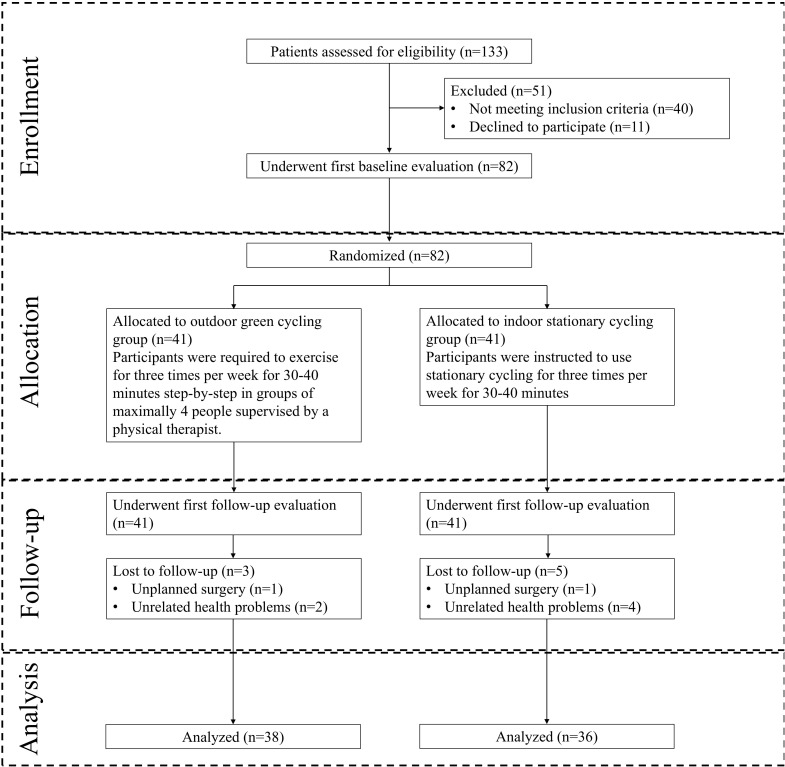
A prospective, randomized, open-label, parallel, multi-center clinical trial conducted at two hospitals in Shanghai that included 82 patients T2DM and KOA. Enrollment occurred between January 2020 and March 2022, and follow-up was completed October 2022. Participants were randomized to outdoor green cycling (OGC) group and indoor stationary cycling (ISC) group. Psychosocial and physiological health outcomes were evaluated through questionnaires comprising standard international measures of self-esteem (Rosenberg Self-esteem Scale [RSE]), perceived stress (Perceived Stress Scale [PSS]), mood (Profile of Mood States [POMS]) and nature relatedness (Nature Relatedness Scale - short-form version). Participants' enjoyment of exercise and intention for a future exercise behavior was measured in a questionnaire using a 100mm visual analogue scale as a continuum from 0 - 'not at all' to 100 - 'very much'.
Among 82 patients, 74 (90.2%) completed the trial. By 24 weeks, the OGC group showed a greater reduction in perceived stress (3.7 vs. 2.8, P = 0.007), and total mood disturbance (POMS) scores decreased more in the OGC group (-7.2 vs. -6.1, P = 0.030). Tension and depression subscales also showed greater reductions in the OGC group (P < 0.001 for both), along with higher improvements in vigor (10.2 vs. 8.1, P < 0.001). Enjoyment of exercise was slightly higher in the OGC group, though this difference did not reach statistical significance (P = 0.061), and their intention to continue exercising was also significantly stronger (P = 0.021). Participants in OGC group achieved significant decrease of HbA1c than participants in ISC group.
Green exercise offers an accessible provision for improving short-term psychological wellbeing than indoor exercises.
https://www.chictr.org.cn/, identifier ChiCTR2100042872.
体育活动和接触自然都对膝关节骨关节炎(KOA)和2型糖尿病(T2DM)有多种健康益处。然而,在自然环境中进行体育活动(即绿色运动,GE)对健康的影响尚不清楚。本研究旨在评估与室内运动相比,绿色运动对合并T2DM的KOA患者心理社会和生理方面的影响。
在上海的两家医院进行了一项前瞻性、随机、开放标签、平行、多中心临床试验,纳入了82例T2DM和KOA患者。研究于2020年1月至2022年3月进行入组,2022年10月完成随访。参与者被随机分为户外绿色骑行(OGC)组和室内固定骑行(ISC)组。通过问卷评估心理社会和生理健康状况,问卷包括自尊(罗森伯格自尊量表[RSE])、感知压力(感知压力量表[PSS])、情绪(情绪状态剖面图[POMS])和与自然的关联(自然关联量表简版)等国际标准测量指标。使用100毫米视觉模拟量表以连续体形式从0 - “一点也不”到100 - “非常”测量参与者对运动的享受程度和未来运动行为的意愿。
82例患者中,74例(90.2%)完成了试验。到24周时,OGC组的感知压力降低幅度更大(3.7对2.8,P = 0.007),OGC组的总情绪紊乱(POMS)得分下降更多(-7.2对-6.1,P = 0.030)。OGC组的紧张和抑郁子量表得分也下降得更多(两者P < 0.001),活力改善也更高(10.2对8.1,P < 0.001)。OGC组对运动的享受程度略高,尽管这一差异未达到统计学意义(P = 0.061),且他们继续锻炼的意愿也明显更强(P = 0.021)。OGC组参与者的糖化血红蛋白(HbA1c)水平比ISC组参与者显著降低。
与室内运动相比,绿色运动在改善短期心理健康方面更具可行性。