Nikitina Victoria, Santi Laurini Greta, Montanaro Nicola, Motola Domenico
Unit of Pharmacology, Department of Medical and Surgical Sciences, Alma Mater Studiorum University of Bologna, Bologna, Italy.
Alma Mater Studiorum University of Bologna, Bologna, Italy.
Headache. 2025 Jul-Aug;65(7):1080-1094. doi: 10.1111/head.14962. Epub 2025 May 29.
OBJECTIVES/BACKGROUND: This study was undertaken to evaluate the postmarketing safety of monoclonal antibodies (mAbs) targeting the calcitonin gene-related peptide pathway used for migraine prophylaxis through pharmacovigilance data analysis by examining suspected adverse events reported in Europe. Migraine is one of the most prevalent and debilitating neurological disorders globally. The introduction of mAbs targeting the calcitonin gene-related peptide pathway has transformed migraine prophylaxis. However, their safety profiles in real-world settings are not fully established, and ongoing safety monitoring is essential, as clinical trials may not capture all potential adverse drug reactions associated with new therapies.
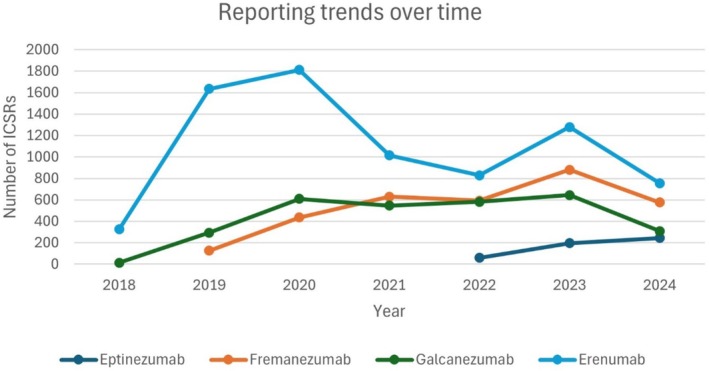
A disproportionality analysis was carried out by analyzing postmarketing pharmacovigilance data from the EudraVigilance database, focusing on four mAbs: eptinezumab, fremanezumab, galcanezumab, and erenumab. Descriptive and statistical analyses were performed on data retrieved from the date of marketing authorization of each medicine up to June 16, 2024. The reporting odds ratio (ROR), information component, and empirical Bayes geometric mean were calculated to detect signals of disproportionate reporting comparing their safety profiles to topiramate, a standard preventive migraine treatment.
A total of 14,285 reports had emerged; most of them were from females and concerned patients aged 18-64 years. The most frequently reported adverse drug reactions were primarily nonserious, aligning with literature and previously established safety profiles, such as fatigue and injection site reactions. The statistical analysis revealed 15 significant disproportionality signals: 11 for eptinezumab and four for galcanezumab. Eptinezumab highlighted potential new safety signals such as palpitations (ROR = 6.93, 95% confidence interval [CI] = 3.39-14.18), oropharyngeal pain (ROR = 7.19, 95% CI = 3.40-15.24), and erythema (ROR = 12.31, 95% CI = 4.58-33.12). These findings suggest a potential class effect, warranting further investigations and highlighting the importance of continued monitoring regarding the long-term safety of mAbs.
Almost all of the most reported and statistically significant adverse events were nonserious and consistent with the existing literature. Given the chronic nature of migraine treatment, continuous pharmacovigilance monitoring is essential to ensure their constant safe use in clinical practice.
目的/背景:本研究旨在通过对欧洲报告的疑似不良事件进行药物警戒数据分析,评估用于偏头痛预防的靶向降钙素基因相关肽途径的单克隆抗体(mAbs)的上市后安全性。偏头痛是全球最常见且使人衰弱的神经系统疾病之一。靶向降钙素基因相关肽途径的单克隆抗体的引入改变了偏头痛的预防方法。然而,它们在现实环境中的安全性尚未完全确立,持续的安全性监测至关重要,因为临床试验可能无法捕捉到与新疗法相关的所有潜在药物不良反应。
通过分析来自欧洲药物警戒数据库(EudraVigilance)的上市后药物警戒数据进行不成比例分析,重点关注四种单克隆抗体:eptinezumab、fremanezumab、galcanezumab和erenumab。对从每种药物上市许可日期至2024年6月16日检索到的数据进行描述性和统计分析。计算报告比值比(ROR)、信息成分和经验贝叶斯几何均值,以检测与标准预防性偏头痛治疗药物托吡酯相比报告不成比例的信号,从而比较它们的安全性。
共出现14285份报告;其中大多数来自女性,涉及年龄在18 - 64岁的患者。最常报告的药物不良反应主要为非严重不良反应,与文献及先前确立的安全性特征相符,如疲劳和注射部位反应。统计分析揭示了15个显著的不成比例信号:eptinezumab有11个,galcanezumab有4个。eptinezumab突出了潜在的新安全信号,如心悸(ROR = 6.93,95%置信区间[CI] = 3.39 - 14.18)、口咽痛(ROR = 7.19,95% CI = 3.40 - 15.24)和红斑(ROR = 12.31,95% CI = 4.58 - 33.12)。这些发现提示可能存在类效应,需要进一步研究,并强调了持续监测单克隆抗体长期安全性的重要性。
几乎所有报告最多且具有统计学意义的不良事件均为非严重事件,与现有文献一致。鉴于偏头痛治疗的慢性性质,持续的药物警戒监测对于确保其在临床实践中的持续安全使用至关重要。