Martínez-Valle Adolfo
Centro de Investigación en Políticas, Población y Salud, Facultad de Medicina, Universidad Nacional Autónoma de México, Ciudad Universitaria, Edificio CIPPS Piso 2, Centro Cultural, Coyoacán, 04510, Mexico City, Mexico.
J Public Health Policy. 2025 Sep;46(3):710-716. doi: 10.1057/s41271-025-00564-y. Epub 2025 May 29.
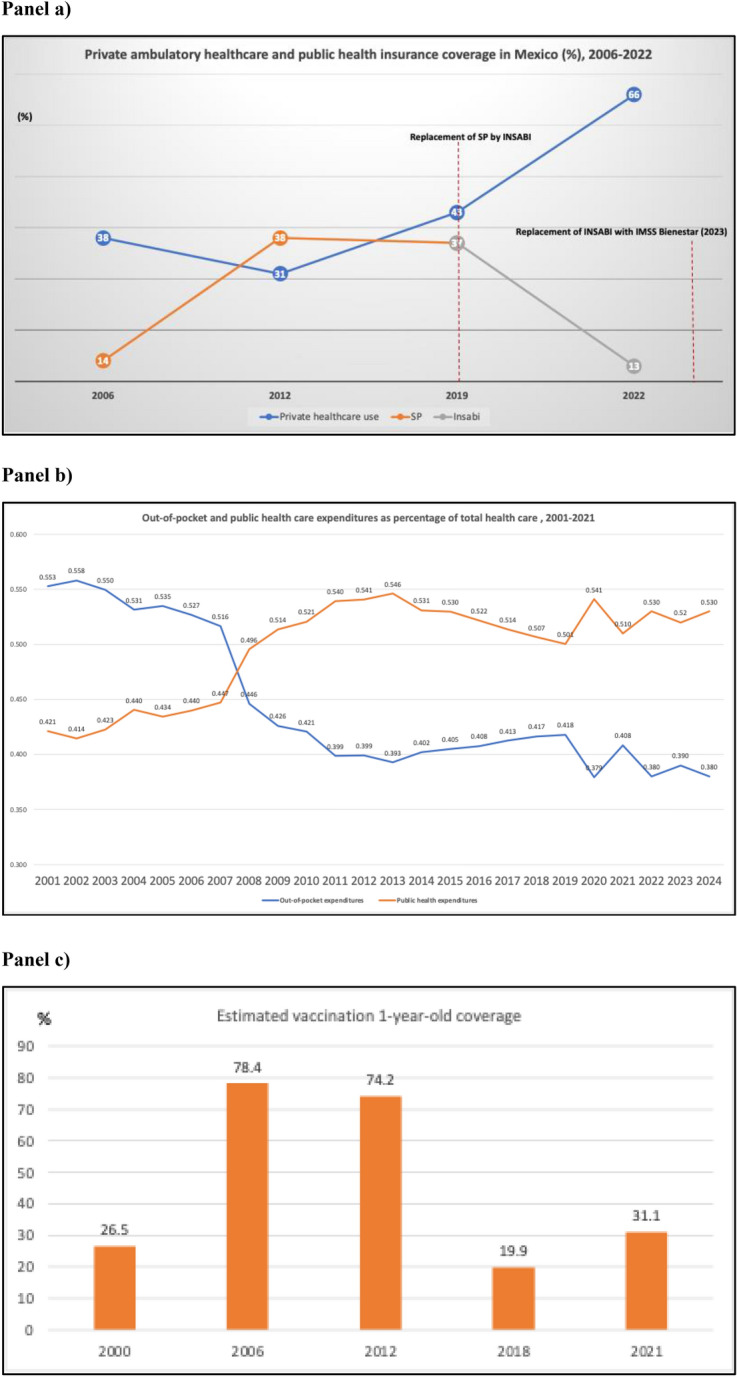
Despite expanding public insurance coverage and investment in public healthcare supply, the Mexican population not covered by social security has increasingly used private-sector outpatient health services over the past two decades. This is a public health policy problem because Mexico is committed to a constitutional right to health protection, which means unmet ambulatory needs must be fulfilled. This brief aims to measure the magnitude of unmet ambulatory health care needs, analyze factors that led to their growth, and formulate policy options to address them. Private services' share of total ambulatory care grew from 38 percent in 2006 to 66 percent in 2022, despite two national policy efforts to increase public coverage to nearly 50 million people. Neither policy provided adequate ambulatory coverage for its targeted population, leading to care seeking through private outpatient providers. We recommend strengthening public ambulatory care by increasing financial resources for public primary care and implementing more effective allocation to improve timeliness and quality of care.
尽管公共保险覆盖范围不断扩大,对公共医疗供应的投资也在增加,但在过去二十年里,未纳入社会保障的墨西哥人口越来越多地使用私营部门的门诊医疗服务。这是一个公共卫生政策问题,因为墨西哥致力于保障宪法规定的健康保护权,这意味着未满足的门诊需求必须得到满足。本简报旨在衡量未满足的门诊医疗需求的规模,分析导致其增长的因素,并制定应对这些需求的政策选项。尽管国家做出了两项政策努力,将公共覆盖范围扩大到近5000万人,但私营服务在门诊医疗服务总量中的占比仍从2006年的38%增长到2022年的66%。这两项政策都没有为其目标人群提供足够的门诊覆盖,导致人们寻求私营门诊服务。我们建议通过增加公共初级保健的财政资源,并实施更有效的资源分配,以提高医疗服务的及时性和质量,从而加强公共门诊医疗服务。