Leupold Jochen, Weigel Matthias, Bär Sébastien
Division of Medical Physics, Department of Diagnostic and Interventional Radiology, University Medical Center Freiburg, Faculty of Medicine, University of Freiburg, Freiburg, Germany.
Translational Imaging in Neurology (ThINk) Basel, Department of Biomedical Engineering, Faculty of Medicine, University Hospital Basel and University of Basel, Basel, Switzerland.
PLoS One. 2025 May 30;20(5):e0324455. doi: 10.1371/journal.pone.0324455. eCollection 2025.
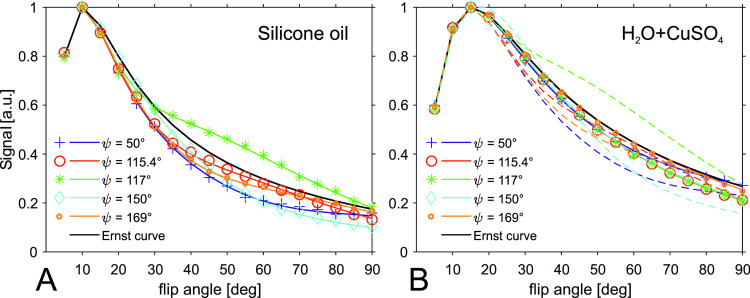
In magnetic resonance imaging, the radiofrequency-spoiled gradient-echo method aims for fast acquisition of T1-weighted images. The spoiling mechanism is driven by the radiofrequency phase difference increment. In clinical (in-vivo) imaging, the phase difference increments of 50°, 115.4°, 117° and 150° are in standard use. In this work, we examine how accurate these increments guarantee T1-weighting also in free liquids, in particular with different diffusion coefficients. The non-standard phase difference increment 169°, which was shown to improve T1 quantification methods, is considered as well. Signal simulations were performed with the extended phase-graph with diffusion concept; experiments were performed on different liquid phantoms (water with contrast medium, silicone oil). In the simulations, a parameter space consisting of relaxation times, diffusion coefficient, sequence repetition time, flip angle and image resolution was examined. The resulting efficiency of radiofrequency spoiling was quantified by the average deviation of the simulated signal-vs-flipangle curve from the ideal curve. It was found that ideal spoiling is generally better approximated with a phase difference increment of 169° compared to the other examined values. From the four commonly used values, 115.4° is recommended, in particular when the influence of diffusion is low. For clinical in-vivo imaging parameters, all examined values of the phase difference increments offer a good approximation of ideal spoiling as expected. In conclusion, radiofrequency spoiling in free liquids can be improved by using a phase difference increment of 169°.
在磁共振成像中,射频扰相梯度回波方法旨在快速采集T1加权图像。扰相机制由射频相位差增量驱动。在临床(体内)成像中,50°、115.4°、117°和150°的相位差增量为标准用法。在本研究中,我们研究了这些增量在自由液体中保证T1加权的准确性如何,特别是在不同扩散系数的情况下。还考虑了已证明能改进T1定量方法的非标准相位差增量169°。使用具有扩散概念的扩展相位图进行信号模拟;在不同的液体模型(含造影剂的水、硅油)上进行实验。在模拟中,研究了由弛豫时间、扩散系数、序列重复时间、翻转角和图像分辨率组成的参数空间。通过模拟信号-翻转角曲线与理想曲线的平均偏差来量化所得的射频扰相效率。结果发现,与其他研究值相比,169°的相位差增量通常能更好地逼近理想扰相。在四个常用值中,推荐115.4°,特别是在扩散影响较低时。对于临床体内成像参数,如预期的那样,所有研究的相位差增量值都能很好地逼近理想扰相。总之,使用169°的相位差增量可改善自由液体中的射频扰相。