Tian Bin, Tian Yanming, Cai Dongjie, Cao Huanhuan, Wu Liping, Wang Mingshu, Yang Qiao, Wu Ying, Jia Renyong, Zhu Dekang, Liu Mafeng, Chen Shun, Zhao Xinxin, Zhang Shaqiu, Huang Juan, Sun Di, Ou Xumin, Wu Zhen, Cheng Anchun
Engineering Research Center of Southwest Animal Disease Prevention and Control Technology for Ministry of Education of the People's Republic of China, International Joint Research Center for Animal Disease Prevention and Control of Sichuan Province, Key Laboratory of Animal Disease and Human Health of Sichuan Province, Research Center of Avian Disease and Institute of Veterinary Medicine and Immunology, College of Veterinary Medicine, Sichuan Agricultural University, Chengdu 611130, China.
Engineering Research Center of Southwest Animal Disease Prevention and Control Technology for Ministry of Education of the People's Republic of China, International Joint Research Center for Animal Disease Prevention and Control of Sichuan Province, Key Laboratory of Animal Disease and Human Health of Sichuan Province, Research Center of Avian Disease and Institute of Veterinary Medicine and Immunology, College of Veterinary Medicine, Sichuan Agricultural University, Chengdu 611130, China; Veterinary Department in College of Aminal Science, State Key Laboratory of Green Pesticide, Institute of Veterinary Immunology and Green Drugs, Guizhou University, Guiyang 550025, China.
Poult Sci. 2025 May 26;104(8):105336. doi: 10.1016/j.psj.2025.105336.
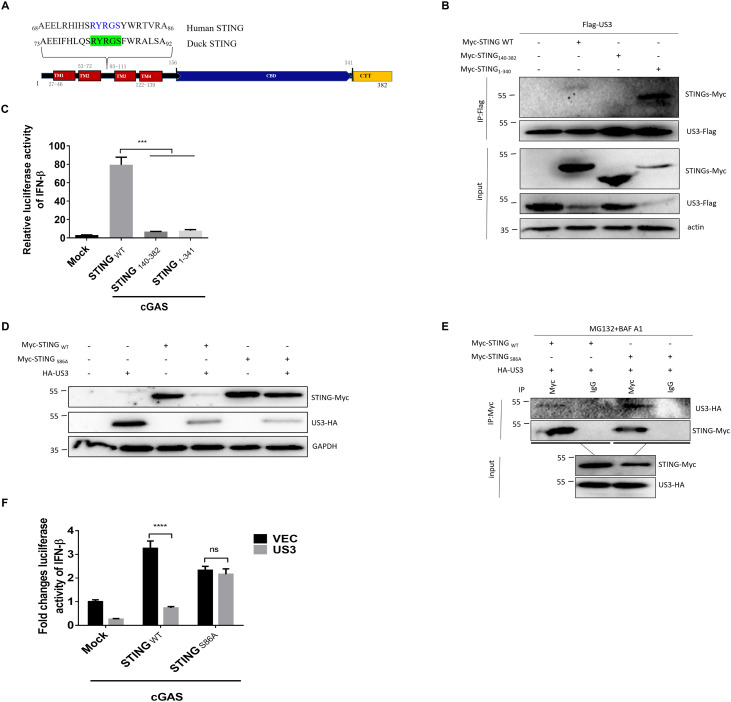
Duck plague virus (DPV) causes the highest mortality rate among aquatic birds; however, its antago nistic mechanism against antiviral innate immune responses remains elusive. In this study, we systematically screened and found that most DPV genes have inhibitory potential for duck cyclic guanosine monophosphate-adenosine monophosphate synthetase (cGAS)/stimulator of interferon (IFN) gene (STING) pathway-mediated antiviral responses, with the DPV US3 kinase showing the strongest inhibitory activity. Co-immunoprecipitation and immunoblotting assays demonstrated that DPV US3 interacted with STING and induced its degradation. Further mutagenesis experiments revealed that DPV US3 kinase activity was essential for phosphorylating STING, reducing STING dimerization, and inhibiting STING-mediated antiviral responses. Sequence alignment and mutagenesis studies have demonstrated that DPV US3 phosphorylates STING at serine 86, near the Endoplasmic reticulum (ER) retention sequence (RYRGS), disrupting its association with tank-binding kinase 1 (TBK1) and inducing STING degradation. Finally, US3 knockout attenuated DPV replication by activating higher levels of IFN and ISGs in vitro and in vivo. These results demonstrate that DPV promotes viral infection and pathogenicity by inducing STING degradation through the encoded US3 kinase, providing new insights into the mechanism of DPV immune evasion.
鸭瘟病毒(DPV)在水禽中导致的死亡率最高;然而,其对抗病毒天然免疫反应的拮抗机制仍不清楚。在本研究中,我们系统地筛选并发现,大多数DPV基因对鸭环磷酸鸟苷-磷酸腺苷合成酶(cGAS)/干扰素(IFN)基因刺激物(STING)途径介导的抗病毒反应具有抑制潜力,其中DPV US3激酶显示出最强的抑制活性。免疫共沉淀和免疫印迹分析表明,DPV US3与STING相互作用并诱导其降解。进一步的诱变实验表明,DPV US3激酶活性对于磷酸化STING、减少STING二聚化以及抑制STING介导的抗病毒反应至关重要。序列比对和诱变研究表明,DPV US3在内质网(ER)保留序列(RYRGS)附近的丝氨酸86处磷酸化STING,破坏其与 Tank结合激酶1(TBK1)的关联并诱导STING降解。最后,US3基因敲除通过在体外和体内激活更高水平的IFN和ISG来减弱DPV复制。这些结果表明,DPV通过编码的US3激酶诱导STING降解来促进病毒感染和致病性,为DPV免疫逃逸机制提供了新的见解。