Spicuzza Lucia, Pennisi Francesco, Caci Grazia, Cibella Fabio, Campagna Davide, Adebisi Yusuff A, Saitta Claudio, George Jacob, Geraci Giulio, Polosa Riccardo
Center of Excellence for the Acceleration of HArm Reduction (CoEHAR), University of Catania, Catania, Italy.
Department of Clinical & Experimental Medicine, University of Catania, Catania, Italy.
Sci Rep. 2025 May 31;15(1):19104. doi: 10.1038/s41598-025-03904-w.
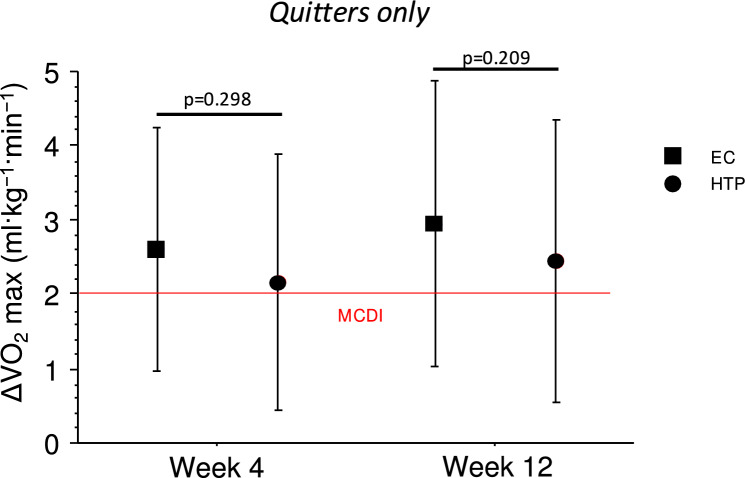
Smoking negatively impacts aerobic capacity, primarily by reducing V̇O2max, the gold standard measure of cardiorespiratory fitness. While smoking cessation is known to improve vascular function, exercise performance, and oxygen uptake, its specific impact on V̇O2max remains underexplored. Specifically, no research has yet evaluated V̇O2max changes following a switch to electronic cigarettes (ECs) or heated tobacco products (HTPs). This is a secondary analysis of the CEASEFIRE trial, a 12-weeks randomized controlled switching trial comparing the impact of ECs or HTPs on changes in smoking behaviour. The trial offers a unique opportunity to prospectively examine the relationship between smoking behavior and aerobic capacity, and to examine-for the first time-the specific impact of exclusive EC or HTP use on V̇O2max. Changes in VO₂max were analized across three smoking phenotypes: continuous smokers, those who reduced smoking, and those who abstained from smoking Additionally, VO2max was also evaluated specifically in participants who completely abstained from smoking tobacco cigarettes, evaluating outcomes in exclusive EC and HTP users. Quitters showed the greatest improvement in VO2max at both week 4 (2.4 ± 1.7 mL kg min) and week 12 (2.7 ± 1.9 mL kg min). Reducers also exhibited significant VO2max increases (1.3 ± 1.9 mL kg min at week 4: 1.9 ± 1.8 mL kg min at week 12), while Failures (i.e. those who continued smoking) showed no change. Exclusive use of EC and HTP resulted in statistically significant and clinically relevant improvements in V̇O2max. Compared to baseline, V̇Omax significantly increased at week 4 (EC: 38.4 ± 5.9 to 41.0 ± 6.1 mL kg min; HTP: 39.2 ± 6.7 to 41.4 ± 6.4 mL kg min, both p < 0.0001) and week 12 (EC: 38.4 ± 5.9 to 41.4 ± 6.3; HTP: 39.2 ± 6.7 to 41.6 ± 6.5 mL kg min, both p < 0.0001). No significant differences between EC and HTP were observed at either time point. Rapid improvements in V̇O2max can happen when healthy smokers switch to exclusive use of ECs or HTPs. These findings reinforce the potential cardiorespiratory benefits of smoking cessation and harm reduction strategies.
吸烟对有氧能力有负面影响,主要是通过降低最大摄氧量(V̇O2max),这是心肺适能的金标准测量指标。虽然已知戒烟可改善血管功能、运动表现和氧气摄取,但其对最大摄氧量的具体影响仍未得到充分研究。具体而言,尚无研究评估改用电子烟(EC)或加热烟草制品(HTP)后最大摄氧量的变化。这是对CEASEFIRE试验的二次分析,该试验是一项为期12周的随机对照转换试验,比较了EC或HTP对吸烟行为变化的影响。该试验提供了一个独特的机会,可前瞻性地研究吸烟行为与有氧能力之间的关系,并首次研究仅使用EC或HTP对最大摄氧量的具体影响。在三种吸烟表型中分析了最大摄氧量的变化:持续吸烟者、减少吸烟者和戒烟者。此外,还专门对完全戒烟的参与者进行了最大摄氧量评估,评估仅使用EC和HTP者的结果。戒烟者在第4周(2.4±1.7 mL·kg⁻¹·min⁻¹)和第12周(2.7±1.9 mL·kg⁻¹·min⁻¹)时最大摄氧量改善最为显著。减少吸烟者的最大摄氧量也有显著增加(第4周为1.3±1.9 mL·kg⁻¹·min⁻¹,第12周为1.9±1.8 mL·kg⁻¹·min⁻¹),而未成功戒烟者(即继续吸烟者)则无变化。仅使用EC和HTP可使最大摄氧量在统计学上有显著且具有临床意义的改善。与基线相比,第4周时最大摄氧量显著增加(EC:38.4±5.9至41.0±6.1 mL·kg⁻¹·min⁻¹;HTP:39.2±6.7至41.4±6.4 mL·kg⁻¹·min⁻¹,两者p<0.0001),第12周时也显著增加(EC:38.4±5.9至41.4±6.3;HTP:39.2±6.7至41.6±6.5 mL·kg⁻¹·min⁻¹,两者p<0.0001)。在两个时间点均未观察到EC和HTP之间有显著差异。健康吸烟者改用仅使用EC或HTP时,最大摄氧量可迅速改善。这些发现强化了戒烟和减少危害策略对心肺的潜在益处。