Baker Paul A, Clarke Holly E, Meza Cesar A, Ali Mostafa M, Hickner Robert C
Department of Health, Nutrition, and Food Sciences, Florida State University, Tallahassee, FL, USA.
Pflugers Arch. 2025 Jul;477(7):967-976. doi: 10.1007/s00424-025-03090-8. Epub 2025 May 31.
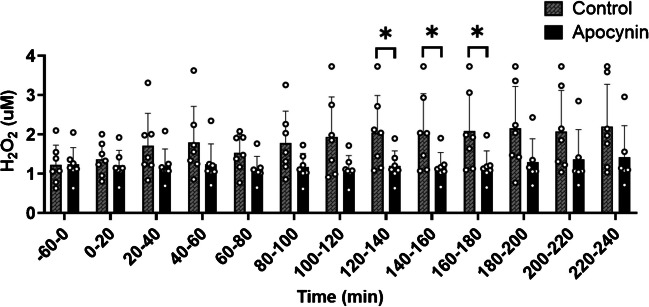
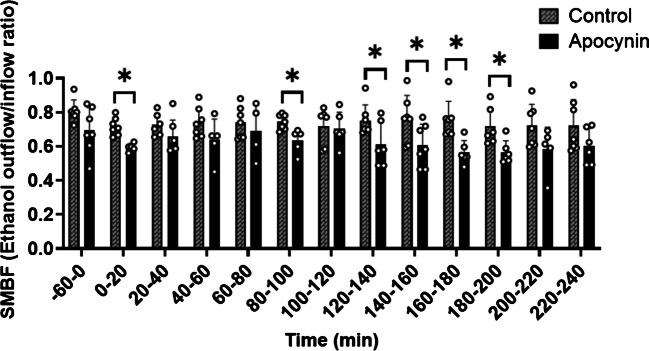
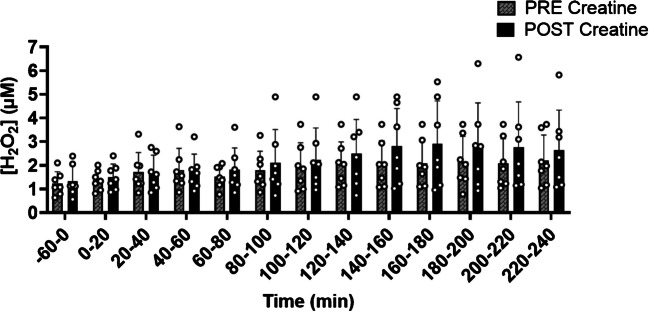
Impaired blood flow and elevated reactive oxygen species (ROS) concentrations, generated primarily from NADPH oxidase (NOX), indicate risk for cardiovascular disease (CVD). Creatine monohydrate (CM) may reduce CVD risk by lowering ROS concentrations and increasing skeletal muscle microvascular blood flow (SMBF). To determine if NOX-derived ROS impairs SMBF and whether five days of CM supplementation reduces in-vivo ROS concentrations and improves SMBF. Seven individuals had two microdialysis probes placed (control (CON) and apocynin (APO): NOX inhibitor) in skeletal muscle to measure in-vivo ROS (Hydrogen Peroxide (HO)) concentrations and SMBF (ethanol outflow/inflow ratio, inversely related to blood flow) at rest and four hours post-meal consumption. Procedures were performed before (PRE) and after (POST) five days of CM supplementation (20 g/day). Dialysate HO concentrations were lower in the APO probe compared to CON from 120-140 min (APO: 1.19 ± 0.39 µM; CON: 2.04 ± 0.95 µM, p = 0.039), 140-160 min (APO: 1.17 ± 0.37 µM; CON: 2.06 ± 0.98 µM, p = 0.034) and 160-180 min post meal ingestion (p ≤ 0.05). APO perfusion increased SMBF at 20-40 min, 120-140 min (APO: 0.61 ± 0.13; CON: 0.75 ± 0.09 µM, p = 0.048), 140-160 min (APO: 0.61 ± 0.12 µM; CON: 0.76 ± 0.14 µM, p = 0.046), 160-180 min, and 180-200 min post meal (p ≤ 0.05). Ethanol outflow/inflow ratio was lower (higher SMBF) POST CM supplementation compared to PRE CM supplementation at 0-20 min (p = 0.036) and 20-40 min (p = 0.049) following HC/HF meal consumption. Inhibition of NOX-derived ROS increased SMBF, suggesting that NOX activity may impair blood flow regulation over the duration of baseline and post-prandial time points. Further, CM supplementation could be an effective strategy for enhancing postprandial blood flow.
血流受损和活性氧(ROS)浓度升高(主要由烟酰胺腺嘌呤二核苷酸磷酸氧化酶(NOX)产生)表明存在心血管疾病(CVD)风险。一水肌酸(CM)可能通过降低ROS浓度和增加骨骼肌微血管血流量(SMBF)来降低CVD风险。为了确定NOX衍生的ROS是否会损害SMBF,以及补充五天CM是否会降低体内ROS浓度并改善SMBF。七名受试者在骨骼肌中放置了两个微透析探针(对照(CON)和夹竹桃麻素(APO):NOX抑制剂),以测量静息和餐后四小时体内ROS(过氧化氢(HO))浓度和SMBF(乙醇流出/流入比,与血流量呈负相关)。在补充CM(20克/天)五天之前(PRE)和之后(POST)进行操作。与CON相比,APO探针在餐后120 - 140分钟(APO:1.19±0.39微摩尔;CON:2.04±0.95微摩尔,p = 0.039)、140 - 160分钟(APO:1.17±0.37微摩尔;CON:2.06±0.98微摩尔,p = 0.034)和160 - 180分钟(p≤0.05)时透析液HO浓度较低。APO灌注在餐后20 - 40分钟、120 - 140分钟(APO:0.61±0.13;CON:0.75±0.09微摩尔,p = 0.048)、140 - 160分钟(APO:0.61±0.12微摩尔;CON:0.76±0.14微摩尔,p = 0.046)、160 - 180分钟和180 - 200分钟时增加了SMBF(p≤0.05)。在摄入高碳水化合物/高脂肪餐后,与补充CM前相比,补充CM后在0 - 20分钟(p = 0.036)和20 - 40分钟(p = 0.049)时乙醇流出/流入比更低(SMBF更高)。抑制NOX衍生的ROS增加了SMBF,表明NOX活性可能在基线期和餐后时间点期间损害血流调节。此外,补充CM可能是增强餐后血流的有效策略。