Chen Dongyang, Zhi Yifei, Jia Xiaoxuan, Ji Na, Zhang Jiale, Liang Jiongming, Ran Mingxia, Liu Xingting, Xu Huiyan, Lu Yangqing
Guangxi Key Laboratory of Animal Breeding, Disease Control and Prevention, College of Animal Science and Technology, Guangxi University, Nanning, 530004 PR China.
Guangxi Key Laboratory of Animal Breeding, Disease Control and Prevention, College of Animal Science and Technology, Guangxi University, Nanning, 530004 PR China.
Poult Sci. 2025 May 17;104(8):105308. doi: 10.1016/j.psj.2025.105308.
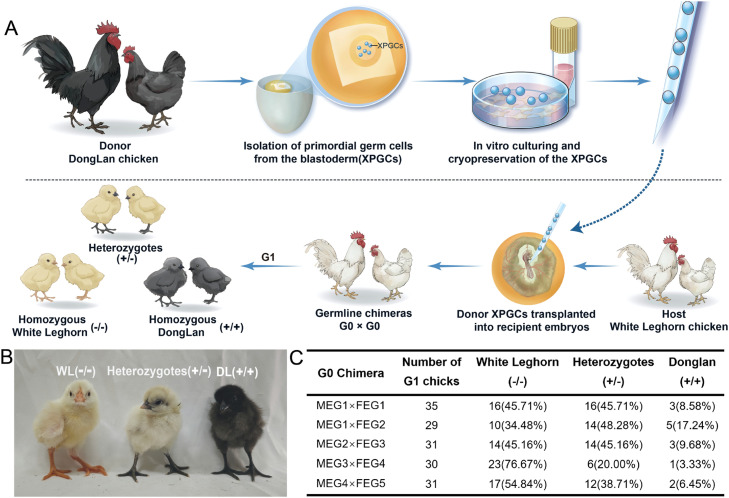
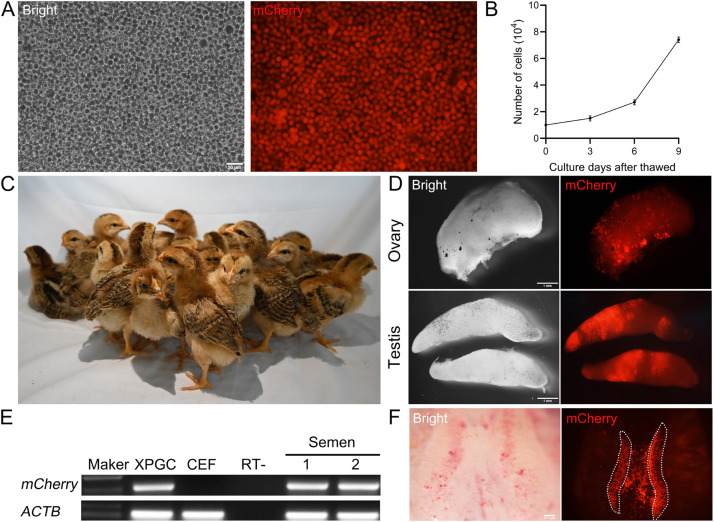
Primordial germ cells (PGCs) derived from Eyal-Giladi and Kochav (EG&K) stage X embryos (XPGCs) represent the earliest germ cells in poultry. However, little is known about the XPGCs due the difficulty in the isolation and propagation of these cells. In this study, we report a method for the stable isolation and efficient in vitro propagation of XPGCs. We conducted a thorough analysis of the characteristics exhibited by XPGCs. First, we identified an average of 42 PGCs at this stage by using an DAZL-2a-mCherry genetically modified chickens. Three stable cell lines, one male and two female, were established from eight isolates using a filter paper ring and differential adhesion. Germ cell-related protein markers, including DAZL, CVH, and SSEA-1, were detected in the established XPGCs. Re-introduction of the XPGCs into the blastoderms of EG&K stage X embryos or the cardiovascular systems of Hamilton and Hamburger (HH) stage 14 embryos showed that the XPGCs retained the ability to migrate to the gonads after long-term culture. XPGCs demonstrated a lower growth rate in vitro but a higher potential of migrating to the gonads than PGCs derived from the embryonic gonads of HH stage 27-31. The ability to isolate, culture, and characterize XPGCs advances our knowledge of early-stage germ cell development and provides a valuable cell tool for genetic conservation and genome editing in chickens.
源自伊亚尔-吉拉迪和科查夫(EG&K)X期胚胎的原始生殖细胞(PGCs,即X期PGCs)代表了家禽中最早的生殖细胞。然而,由于这些细胞的分离和增殖困难,人们对X期PGCs了解甚少。在本研究中,我们报告了一种稳定分离和高效体外增殖X期PGCs的方法。我们对X期PGCs表现出的特征进行了全面分析。首先,我们通过使用DAZL-2a-樱桃红基因编辑鸡,在此阶段平均鉴定出42个PGCs。使用滤纸环和差异黏附法,从8个分离物中建立了3个稳定细胞系,其中1个雄性和2个雌性。在所建立的X期PGCs中检测到了生殖细胞相关蛋白标志物,包括DAZL、CVH和SSEA-1。将X期PGCs重新引入EG&K X期胚胎的胚盘或汉密尔顿和汉堡(HH)14期胚胎的心血管系统中,结果表明,X期PGCs在长期培养后仍保留迁移至性腺的能力。与源自HH 27-31期胚胎性腺的PGCs相比,X期PGCs在体外显示出较低的生长速率,但具有更高的迁移至性腺的潜力。分离、培养和鉴定X期PGCs的能力增进了我们对早期生殖细胞发育的了解,并为鸡的遗传保护和基因组编辑提供了一种有价值的细胞工具。