
通过麝香酮的抗氧化作用减轻葡聚糖硫酸钠(DSS)诱导的小鼠结肠炎及MyD88/p38丝裂原活化蛋白激酶信号通路
Alleviation of dextran sulfate sodium (DSS)-induced colitis in mice through the antioxidative effects of muscone the MyD88/p38 MAPK signalling pathway.
作者信息
Yao Gang, Zhang Jian, Zhang Lingyan, Zhao Hai, Wu Shuguang, Yang Hongmei, Yu Jiangwei
机构信息
Institute of Laboratory Animal Science, Guizhou University of Traditional Chinese Medicine, Guiyang, Guizhou, China.
The First Affiliated Hospital, Guizhou University of Traditional Chinese Medicine, Guiyang, Guizhou, China.
出版信息
PeerJ. 2025 May 28;13:e19397. doi: 10.7717/peerj.19397. eCollection 2025.
BACKGROUND
Inflammatory bowel disease (IBD) is characterized by chronic inflammation. Ulcerative colitis (UC) is a subtype of IBD. The symptoms of UC include inflammation, damage to crypts, and ulceration. UC patients frequently experience comorbid psychological disorders. Muscone has notable anti-inflammatory, antioxidative, and antidementia properties. Our study aimed to investigate the potential of muscone to alleviate colitis, the underlying mechanisms, and the signalling pathways involved.
METHODS
C57BL/6 mice were administered dextran sulfate sodium (DSS) to induce colitis. The SMART v3.0 (Panlab, Barcelona, Spain) was used to measure parameters in the open field test and the tail suspension test to assess depression and anxiety. Gait changes were analysed using the DigiGait™ imaging system. The severity of colitis was assessed through body weight loss, stool consistency, gross bleeding, and histopathological evaluation. Proteins related to anti-inflammatory and antioxidative effects were analysed in dissociated tissues using mouse-specific commercial enzyme-linked immunosorbent assay (ELISA) kits.
RESULTS
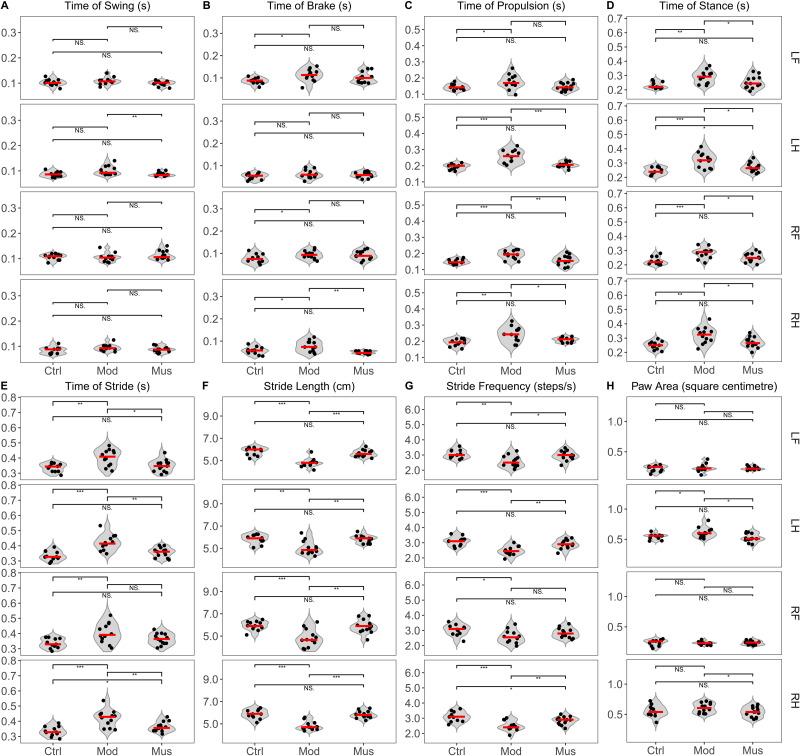
Muscone treatment reduced gross bleeding and histopathological damage scores and increased the ratio of colon length to body weight. Gait analysis revealed improvements in swing time, brake time, propulsive time, stance duration, stride duration, stride length, stride frequency, and paw area with muscone treatment. However, muscone treatment did not improve the distance travelled or the time spent in the open field test, nor did it affect the immobility duration in the tail suspension test. We observed that the expression of claudin-1, occludin, and zonula occludens-1 (ZO-1) increased in response to treatment with muscone. Muscone treatment downregulated the expression of interleukin-1β (IL-1β), interleukin-6 (IL-6), interleukin-17 (IL-17), interleukin-33 (IL-33), and tumour necrosis factor-α (TNF-α), while increasing the expression of interleukin-4 (IL-4) and interleukin-10 (IL-10). Muscone treatment increased the concentrations of catalase (CAT), superoxide dismutase (SOD), glutathione peroxidase (GSH-PX), and haem oxygenase (HO-1), and suppressed the expression of myeloperoxidase (MPO), cyclooxygenase-2 (COX-2), and nicotinamide adenine dinucleotide phosphate (NADPH) oxidases (NOX1 and NOX2). Furthermore, muscone treatment inhibited the expression of myeloid differentiation primary response 88 (MyD88) and p38 mitogen-activated protein kinase (MAPK).
CONCLUSION
Muscone effectively alleviated the symptoms of colitis, which may be due to the reduction in reactive oxygen species (ROS). The potential mechanism underlying the mitigation of colitis may involve the inhibition of the MyD88/p38 MAPK signalling pathway. Our studies suggest that muscone could be a promising target for treating IBD in clinical studies.
背景
炎症性肠病(IBD)的特征是慢性炎症。溃疡性结肠炎(UC)是IBD的一种亚型。UC的症状包括炎症、隐窝损伤和溃疡。UC患者经常伴有心理障碍。麝香酮具有显著的抗炎、抗氧化和抗痴呆特性。我们的研究旨在探讨麝香酮缓解结肠炎的潜力、潜在机制以及相关信号通路。
方法
给C57BL/6小鼠施用葡聚糖硫酸钠(DSS)以诱导结肠炎。使用SMART v3.0(西班牙巴塞罗那Panlab公司)在旷场试验和尾悬试验中测量参数,以评估抑郁和焦虑。使用DigiGait™成像系统分析步态变化。通过体重减轻、粪便稠度、肉眼出血和组织病理学评估来评估结肠炎的严重程度。使用小鼠特异性商业酶联免疫吸附测定(ELISA)试剂盒分析解离组织中与抗炎和抗氧化作用相关的蛋白质。
结果
麝香酮治疗减少了肉眼出血和组织病理学损伤评分,并增加了结肠长度与体重的比值。步态分析显示,麝香酮治疗可改善摆动时间、制动时间、推进时间、站立持续时间、步幅持续时间、步幅长度、步频和爪面积。然而,麝香酮治疗并未改善旷场试验中的行进距离或停留时间,也未影响尾悬试验中的不动持续时间。我们观察到,麝香酮治疗后紧密连接蛋白-1、闭合蛋白和闭锁小带蛋白-1(ZO-1)的表达增加。麝香酮治疗下调了白细胞介素-1β(IL-1β)、白细胞介素-6(IL-6)、白细胞介素-17(IL-17)、白细胞介素-33(IL-33)和肿瘤坏死因子-α(TNF-α)的表达,同时增加了白细胞介素-4(IL-4)和白细胞介素-10(IL-10)的表达。麝香酮治疗增加了过氧化氢酶(CAT)、超氧化物歧化酶(SOD)、谷胱甘肽过氧化物酶(GSH-PX)和血红素加氧酶(HO-1)的浓度,并抑制了髓过氧化物酶(MPO)、环氧化酶-2(COX-2)和烟酰胺腺嘌呤二核苷酸磷酸(NADPH)氧化酶(NOX1和NOX2)的表达。此外,麝香酮治疗抑制了髓样分化初级反应88(MyD88)和p38丝裂原活化蛋白激酶(MAPK)的表达。
结论
麝香酮有效缓解了结肠炎症状,这可能是由于活性氧(ROS)的减少。结肠炎缓解的潜在机制可能涉及抑制MyD88/p38 MAPK信号通路。我们的研究表明,在临床研究中,麝香酮可能是治疗IBD的一个有前景的靶点。




 Zotero 插件