Mohamed Mohamed Rabab, Elsayed Elgahrib Abdalla Ashraf, M Eissa Mohsen, Khalil Abdelrahman Reda, Galal Flefel Mohamed, Abdelbadie Asmaa, Mohammad Ezzat Hamed Darwish Jehan
Department of Anesthesiology, Surgical Intensive Care and Pain Medicine, Faculty of Medicine, Tanta University, Tanta, Egypt.
Department of Anesthesiology, Surgical Intensive Care and Pain Medicine, Faculty of Medicine, Al-Azhar University, Cairo, Egypt.
Anesth Pain Med. 2025 Feb 25;15(1):e156833. doi: 10.5812/aapm-156833. eCollection 2025 Feb 28.
Propofol is commonly used for sedation during colonoscopy but often requires high doses.
This study aimed to compare the outcomes of propofol alone versus propofol combined with clonidine for colonoscopy sedation.
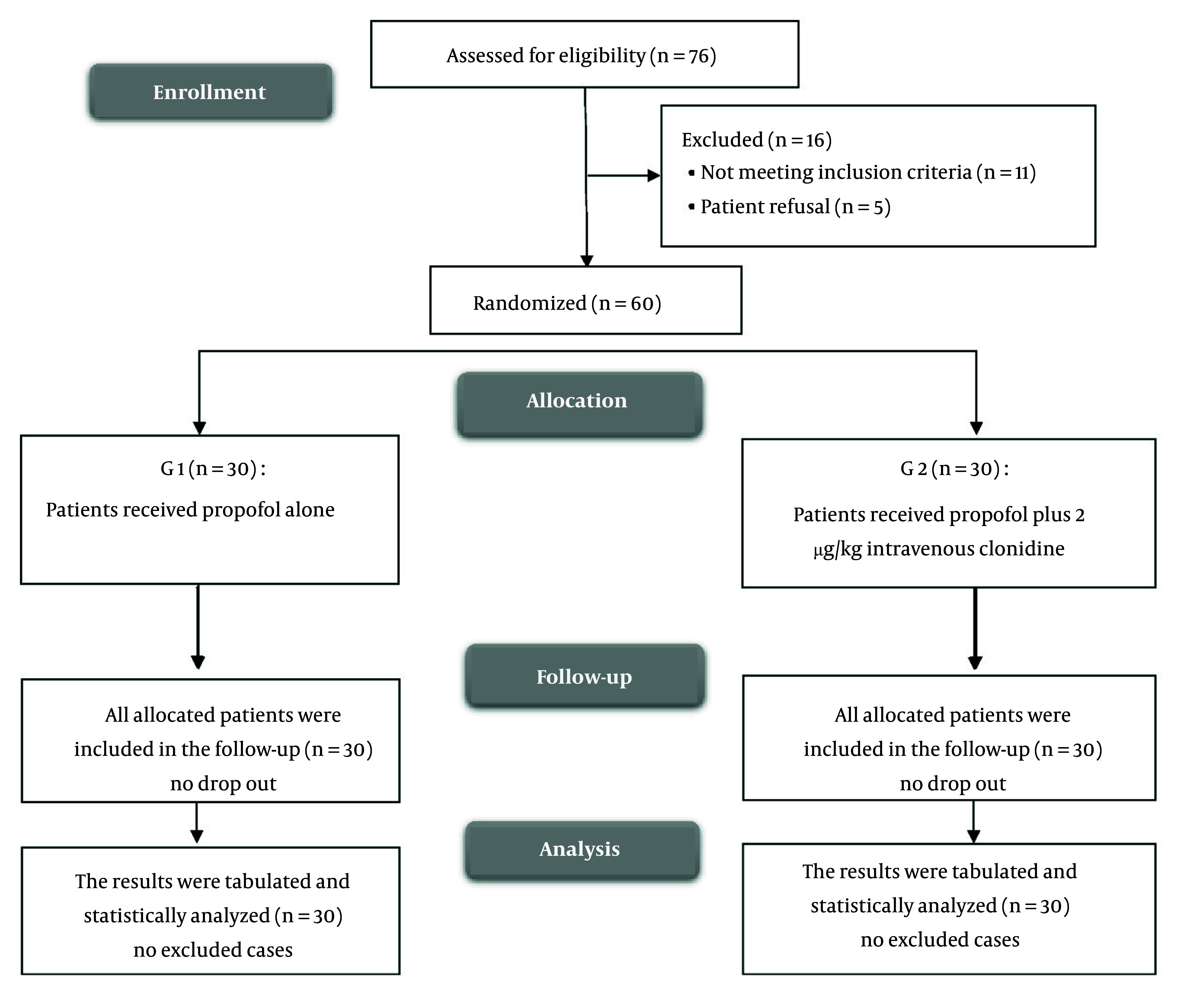
In this randomized, double-blind controlled trial, 60 adult patients scheduled for elective colonoscopy were enrolled. Patients were divided into two groups: Group 1 (G1) received propofol alone, while group 2 (G2) received propofol plus 2 μg/kg clonidine intravenously over 10 minutes. Propofol infusion was initiated at 25 - 75 μg/kg/min IV for the first 10 - 15 minutes, then titrated to 25 - 50 μg/kg/min based on clinical response.
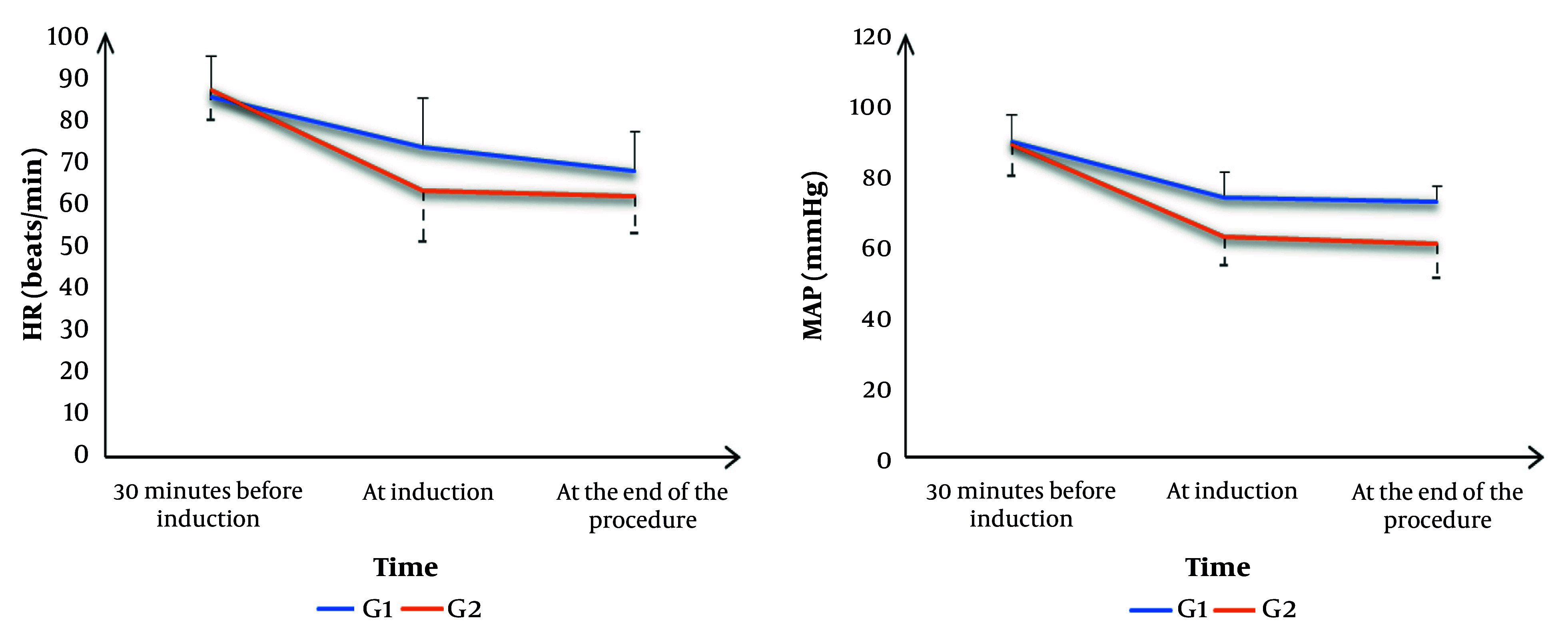
Sedation onset was significantly faster in G2 than in G1 (P = 0.001). The total propofol requirement was 22% lower in G2 (P = 0.001). Heart rate (HR) and mean arterial pressure (MAP) were significantly lower in G2 at induction and at the end of the procedure (P < 0.05). Patient satisfaction scores were higher in G2 (P = 0.042). The observer's assessment of alertness/sedation (OAA/S) score after induction was lower in G2 (P = 0.015), indicating deeper sedation. However, Aldrete scores in the post-anesthesia care unit (PACU) were lower in G2 (P = 0.001), suggesting a slower recovery.
The addition of clonidine to propofol for colonoscopy sedation led to faster sedation onset, reduced propofol requirements, improved patient satisfaction, and deeper sedation, but with potentially prolonged recovery times.
丙泊酚常用于结肠镜检查期间的镇静,但通常需要高剂量。
本研究旨在比较单独使用丙泊酚与丙泊酚联合可乐定用于结肠镜检查镇静的效果。
在这项随机、双盲对照试验中,纳入了60例计划进行择期结肠镜检查的成年患者。患者分为两组:第1组(G1)仅接受丙泊酚,而第2组(G2)在10分钟内静脉注射丙泊酚加2μg/kg可乐定。丙泊酚输注在最初10 - 15分钟以25 - 75μg/kg/min静脉注射开始,然后根据临床反应滴定至25 - 50μg/kg/min。
G2组的镇静起效明显快于G1组(P = 0.001)。G2组的丙泊酚总需求量低22%(P = 0.001)。诱导时和手术结束时,G2组的心率(HR)和平均动脉压(MAP)明显更低(P < 0.05)。G2组的患者满意度评分更高(P = 0.042)。诱导后G2组的观察者警觉/镇静评估(OAA/S)评分更低(P = 0.015),表明镇静更深。然而,G2组在麻醉后护理单元(PACU)的Aldrete评分更低(P = 0.001),提示恢复较慢。
结肠镜检查镇静时在丙泊酚中添加可乐定可导致镇静起效更快、丙泊酚需求量减少、患者满意度提高和镇静更深,但恢复时间可能延长。