
反复反馈有助于七岁儿童在记忆任务中进行不确定性监测。
Repeated Feedback Can Benefit Seven-Year-old's Uncertainty Monitoring in a Memory Task.
作者信息
Buehler Florian J, Ghetti Simona, Roebers Claudia M
机构信息
University of Bern, Bern, Switzerland.
University of California Davis, Davis, CA USA.
出版信息
J Cogn Enhanc. 2025;9(2):230-243. doi: 10.1007/s41465-025-00322-8. Epub 2025 Apr 3.
UNLABELLED
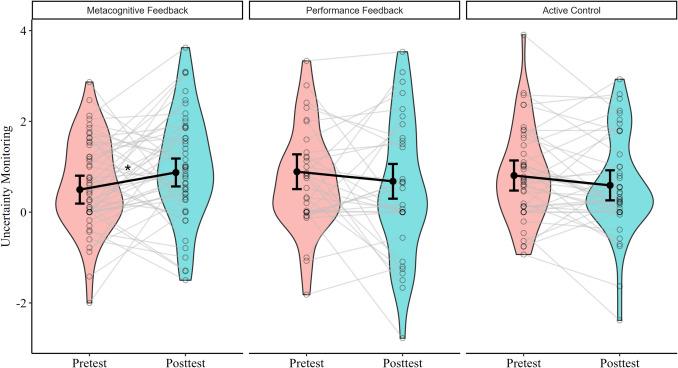
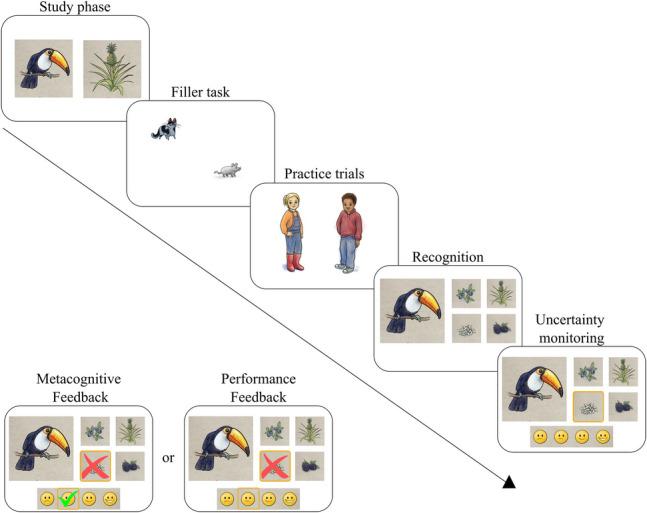
Children's ability to accurately monitor their performance is crucial for self-regulated learning and academic achievement, but interventions are rare. We aimed to improve young primary school childrens' ( = 127; = 7.45 years) uncertainty monitoring with feedback. Participants attended six training sessions in which they received either metacognitive feedback, performance feedback or were assigned to an active control group. In the metacognitive feedback group, children received feedback on the correspondence between their accuracy in a memory task and their uncertainty monitoring (confidence judgments). In the performance feedback group, children received solely feedback on their accuracy in a memory task. In the active control group, children solved attention control tasks. Pre- and post-training, we assessed participants' memory performance in a recognition test and uncertainty monitoring with confidence judgments. Results revealed that metacognitive, but not performance feedback, improved children's uncertainty monitoring from pre- to posttest. However, metacognitive and performance feedback did not improve memory accuracy. The number of required sessions and items per session might be one of the most important aspects to be clarified in future studies.
SUPPLEMENTARY INFORMATION
The online version contains supplementary material available at 10.1007/s41465-025-00322-8.
未标注
儿童准确监测自身表现的能力对于自我调节学习和学业成绩至关重要,但相关干预措施却很少见。我们旨在通过反馈来提高小学低年级儿童((n = 127);(M = 7.45)岁)的不确定性监测能力。参与者参加了六次培训课程,他们分别接受元认知反馈、表现反馈,或者被分配到一个积极对照组。在元认知反馈组中,儿童会收到关于他们在记忆任务中的准确性与他们的不确定性监测(信心判断)之间对应关系的反馈。在表现反馈组中,儿童仅收到关于他们在记忆任务中的准确性的反馈。在积极对照组中,儿童解决注意力控制任务。在培训前和培训后,我们通过识别测试评估参与者的记忆表现,并通过信心判断评估不确定性监测。结果显示,元认知反馈而非表现反馈提高了儿童从测试前到测试后的不确定性监测能力。然而,元认知反馈和表现反馈均未提高记忆准确性。所需的课程数量和每次课程的项目数量可能是未来研究中需要明确的最重要方面之一。
补充信息
在线版本包含可在10.1007/s41465-025-00322-8获取的补充材料。

 Zotero 插件