Kwiatkowski Lester, Planchat Alban, Pyolle Marc, Torres Olivier, Bouttes Nathaelle, Comte Adrien, Bopp Laurent
Laboratoire d'océanographie et du climat: expérimentations et approches numériques, Institut Pierre-Simon Laplace, Sorbonne Université, CNRS, Institut de recherche pour le développement, Muséum national d'Histoire naturelle, Paris 75005, France.
Laboratoire de Météorologie Dynamique, Institut Pierre-Simon Laplace, Ecole Normale Supérieure/Université Paris Sciences et Lettres, Département de Géosciences, CNRS, Ecole Polytechnique, Sorbonne Université, Paris 75005, France.
Proc Natl Acad Sci U S A. 2025 Jun 10;122(23):e2501562122. doi: 10.1073/pnas.2501562122. Epub 2025 Jun 2.
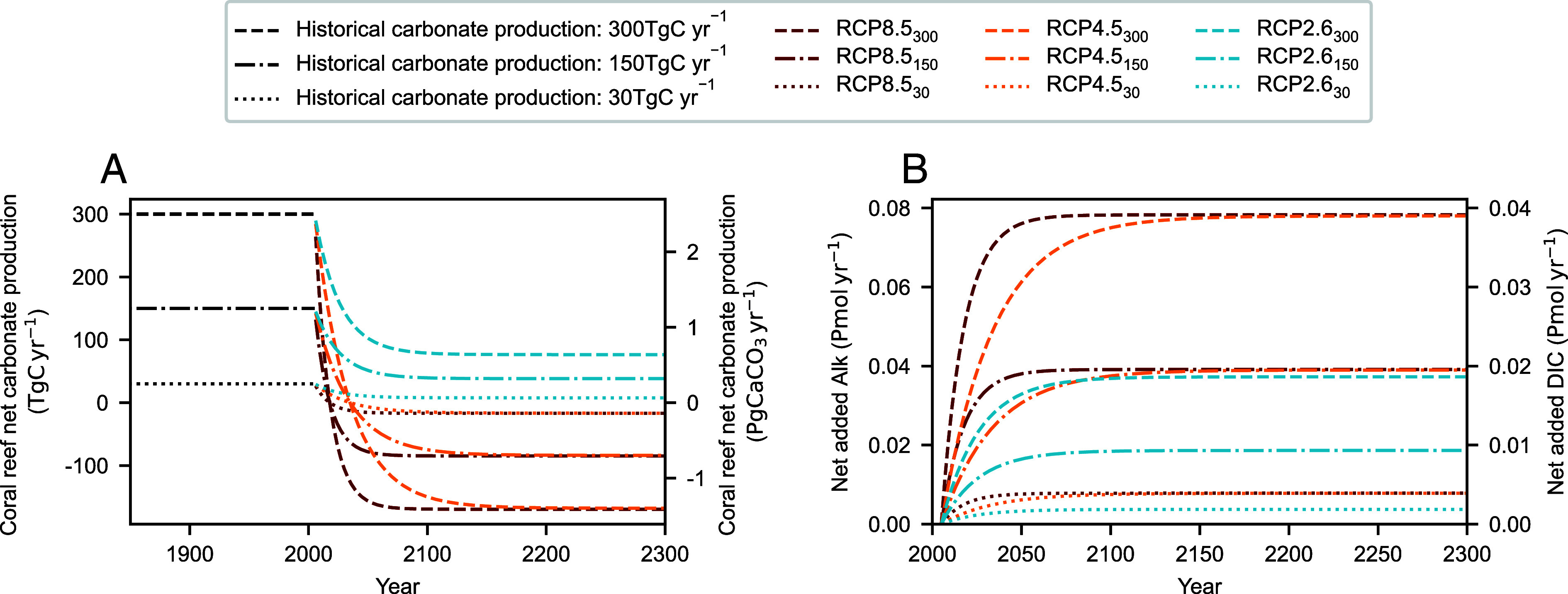
The sensitivity of coral reefs to climate change is well established. As the oceans warm and acidify, the calcification of coral reefs declines with net calcium carbonate dissolution projected under even moderate emissions trajectories. The impact of this on the global carbon cycle is however yet to be accounted for. Here, we use a synthesis of the sensitivity of coral reef calcification to climate change, alongside reef distribution products to estimate alkalinity and dissolved inorganic carbon fluxes resulting from reductions in reef calcification. Using a global ocean biogeochemical model, we simulate the impact on ocean carbon uptake under different emissions scenarios, accounting for uncertainty in present-day calcification rates. Reductions in net coral reef carbonate production can enhance the ocean carbon sink by up to 1.25 GtCO y by midcentury (0.48 GtCO y median estimate) with cumulative ocean carbon uptake up to 13% greater by 2300 (7% median estimate). Our findings indicate that accounting for the coral reef feedback in projections will increase estimates of the remaining carbon budget associated with global warming thresholds, as well as the likelihood that net zero emissions can be achieved without negative emissions.
珊瑚礁对气候变化的敏感性已得到充分证实。随着海洋变暖和酸化,即使在适度排放轨迹下预计会出现净碳酸钙溶解,珊瑚礁的钙化作用也会下降。然而,其对全球碳循环的影响尚未得到考量。在此,我们综合了珊瑚礁钙化对气候变化的敏感性,并结合珊瑚礁分布数据来估算因珊瑚礁钙化减少而产生的碱度和溶解无机碳通量。利用全球海洋生物地球化学模型,我们模拟了不同排放情景下对海洋碳吸收的影响,同时考虑了当前钙化速率的不确定性。到本世纪中叶,珊瑚礁净碳酸盐产量的减少可使海洋碳汇增加多达1.25 GtCO₂/年(中位数估计为0.48 GtCO₂/年),到2300年累积海洋碳吸收量最多可增加13%(中位数估计为7%)。我们的研究结果表明,在预测中考虑珊瑚礁反馈将增加与全球变暖阈值相关的剩余碳预算估计,以及在不进行负排放的情况下实现净零排放的可能性。