Creamer Andrew W, Horst Carolyn, Prendecki Ruth, Verghese Priyam, Bhamani Amyn, Hall Helen, Tisi Sophie, Dickson Jennifer L, Khaw Chuen R, McCabe John, Limani Tanita, Gyertson Kylie, Hacker Anne-Marie, Teague Jonathan, Farrelly Laura, Dawadi Shrinkhala, Navani Neal, Hackshaw Allan, Devaraj Anand, Nair Arjun, Janes Sam M
Lungs for Living Research Centre, UCL Respiratory, University College London, London, UK.
University College London Hospitals NHS Foundation Trust, London, UK.
Thorax. 2025 Aug 15;80(9):624-631. doi: 10.1136/thorax-2024-222086.
Prospective validation and comparison of the performance of nodule management protocols is limited. The aim of this study was to examine the performance of size and risk thresholds for assessing malignancy in solid nodules at baseline low-dose CT (LDCT) in a lung cancer screening (LCS) programme.
This was an observational study using data from the SUMMIT Study, a prospective longitudinal study investigating LDCT for LCS. Participants were 55-77 years old and met either the United States Preventative Services Task Force (2013) criteria or had a PLCO risk of ≥1.3%. LDCTs were reported using computer-aided detection software (Veolity, MeVIS) with semiautomated volumetry. Cancer outcomes were reported for solid nodules reported at baseline CT, with participants represented by the single largest solid nodule where more than one was present. Malignancy risk was stratified by long-axis diameter and volume using predefined size thresholds taken from British Thoracic Society and European Position statement guidelines: a 5/6 mm long axis diameter or 80/100 mm volume 'rule out' thresholds for low-risk nodules and ≥300 mm or ≥8 mm diameter with or without Brock score ≥10% 'Rule in' thresholds for high-risk nodules.Pearson's χ test was used to calculate statistical significance for nominal variables, McNemar's test for comparison of sensitivity/specificity and DeLong' test for comparison of areas under the receiver operating characteristic curve (AUROC). Optimal thresholds were determined with Youden's J statistic. Net benefit calculations were undertaken to compare the existing thresholds with 95% CIs calculated by bootstrap sampling.
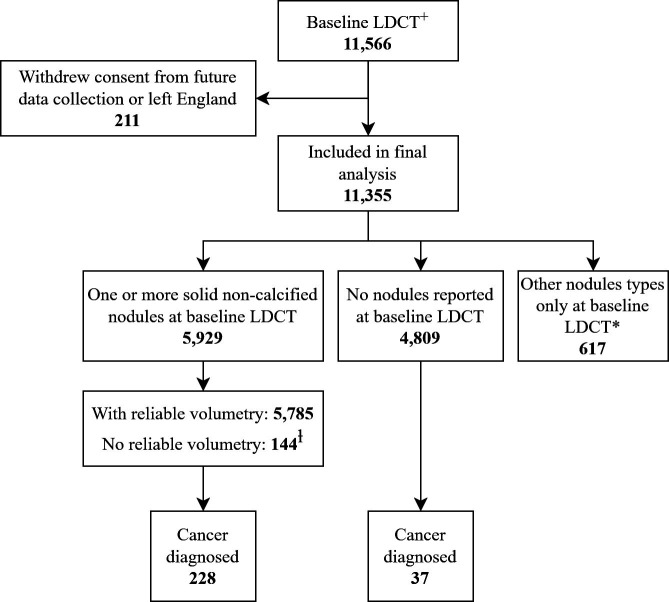
11 355 participants were included. Crude risk of malignancy in solid nodules at baseline LDCT was 3.8% (228/5929). Risk of malignancy in solid nodules <6 mm long-axis diameter or <100 mm volume was equivalent to that in participants with no nodules at baseline LDCT (0.88% and 0.84% vs 0.77%, p=0.4600 and p=0.7932, respectively). A <80 mm volume and <5 mm diameter 'rule out' threshold achieved sensitivity 86.8% and 93.4%, specificity 65.4% and 24.64%, and negative predictive value (NPV) 99.2% and 98.9%, respectively. The <80 mm volume threshold encompassed 63.3% of participants with a baseline solid nodule compared with 24.0% by the <5 mm diameter threshold.For nodules ≥8 mm diameter, the addition of a risk score (Brock ≥10%) was associated with a significant net benefit when compared with using size threshold alone by net effect analysis (31.24; 95% CI 26.19 to 35.89).
Solid nodules <100 mm or <6 mm diameter are not associated with increased risk of lung cancer compared with participants with no nodules at baseline LDCT. Volumetric rule-out thresholds achieve equivalent NPV to long-axis diameter thresholds while encompassing significantly more participants, reducing the number of interval scans required.
结节管理方案性能的前瞻性验证和比较有限。本研究的目的是在肺癌筛查(LCS)项目中,研究基线低剂量CT(LDCT)时实性结节评估恶性肿瘤的大小和风险阈值的性能。
这是一项观察性研究,使用来自SUMMIT研究的数据,这是一项调查LDCT用于LCS的前瞻性纵向研究。参与者年龄在55 - 77岁之间,符合美国预防服务工作组(2013年)标准或PLCO风险≥1.3%。LDCT使用计算机辅助检测软件(Veolity,MeVIS)进行报告,并进行半自动容积测量。报告基线CT时实性结节的癌症结局,当存在多个实性结节时,以单个最大的实性结节为代表。使用从英国胸科学会和欧洲立场声明指南中获取的预定义大小阈值,根据长轴直径和体积对恶性风险进行分层:低风险结节的长轴直径5/6 mm或体积80/100 mm的“排除”阈值,以及直径≥300 mm或≥8 mm(无论布罗克评分是否≥10%)的高风险结节的“纳入”阈值。使用Pearson卡方检验计算名义变量的统计学显著性,使用McNemar检验比较敏感性/特异性,使用DeLong检验比较受试者操作特征曲线下面积(AUROC)。使用约登J统计量确定最佳阈值。进行净效益计算,以将现有阈值与通过自助抽样计算的95%置信区间进行比较。
纳入11355名参与者。基线LDCT时实性结节的恶性肿瘤粗风险为3.8%(228/5929)。长轴直径<6 mm或体积<100 mm的实性结节的恶性风险与基线LDCT时无结节的参与者相当(分别为0.88%和0.84%对0.77%,p = 0.4600和p = 0.7932)。体积<80 mm且直径<5 mm的“排除”阈值的敏感性分别为86.8%和93.4%,特异性分别为65.4%和24.64%,阴性预测值(NPV)分别为99.2%和98.9%。体积<80 mm的阈值涵盖了63.3%的基线实性结节参与者,而直径<5 mm的阈值涵盖24.0%。对于直径≥8 mm的结节,通过净效应分析,与仅使用大小阈值相比,添加风险评分(布罗克≥10%)具有显著的净效益(31.24;95%置信区间26.19至35.89)。
与基线LDCT时无结节的参与者相比,直径<100 mm或<6 mm的实性结节与肺癌风险增加无关。体积排除阈值与长轴直径阈值具有相同的NPV,同时涵盖更多参与者,减少了所需的间隔扫描次数。