Bahadoran Zahra, Mirmiran Parvin, Kashfi Khosrow, Ghasemi Asghar
Micronutrient Research Center, Research Institute for Endocrine Disorders, Research Institute for Endocrine Sciences, Shahid Beheshti University of Medical Sciences, Tehran, Iran.
Nutrition and Endocrine Research Center, Research Institute for Endocrine Disorders, Research Institute for Endocrine Sciences, Shahid Beheshti University of Medical Sciences, Tehran, Iran.
Addict Health. 2025 Jan;17:1564. doi: 10.34172/ahj.1564. Epub 2025 Feb 22.
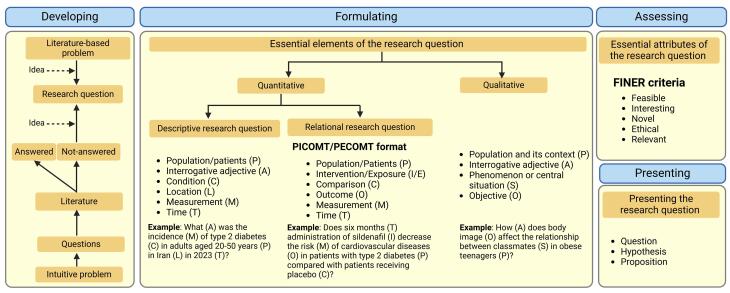
Research begins with a problem that must be translated into an answerable research question. The research question is a structured interrogative statement based on an unsolved problem, which the researcher tries to answer through the study. The art of articulating a good research question is a crucial part of the research process as it sets the stage for the rest. A critical challenge in biomedical research lies in the frequent shortcomings of research question formulation and presentation. This paper aims to provide a practical guide to assist researchers in formulating answerable and worth-answering research questions in biomedical research. The PICOT/PECOT strategy (addresses population, intervention/exposure, comparator, outcome, and time) is essential to develop an excellent relational quantitative research question. The formulated research question should pass the FINER (feasible, interesting, novel, ethical, and relevant) criteria, determining the worth-answering aspect of the research question. Research questions are presented as questions, hypotheses, and propositions.
研究始于一个必须转化为可回答的研究问题的难题。研究问题是基于一个未解决的问题构建的疑问句,研究者试图通过该研究来回答它。阐述一个好的研究问题的技巧是研究过程的关键部分,因为它为后续研究奠定了基础。生物医学研究中的一个关键挑战在于研究问题的提出和表述常常存在缺陷。本文旨在提供一份实用指南,以帮助研究者在生物医学研究中提出可回答且值得回答的研究问题。PICOT/PECOT策略(涉及人群、干预/暴露、对照、结局和时间)对于提出一个出色的相关性定量研究问题至关重要。所提出的研究问题应符合FINER(可行、有趣、新颖、符合伦理且相关)标准,这决定了研究问题是否值得回答。研究问题可以表述为问题、假设和命题。