Zhang Xuan, Han Xiaohong
Clinical Pharmacology Research Center, Peking Union Medical College Hospital, State Key Laboratory of Complex Severe and Rare Diseases, NMPA Key Laboratory for Clinical Research and Evaluation of Drug, Beijing Key Laboratory of Clinical PK & PD Investigation for Innovative Drugs, Chinese Academy of Medical Sciences & Peking Union Medical College, Beijing 100730, China.
Cancer Pathog Ther. 2024 Jul 27;3(3):226-243. doi: 10.1016/j.cpt.2024.07.005. eCollection 2025 May.
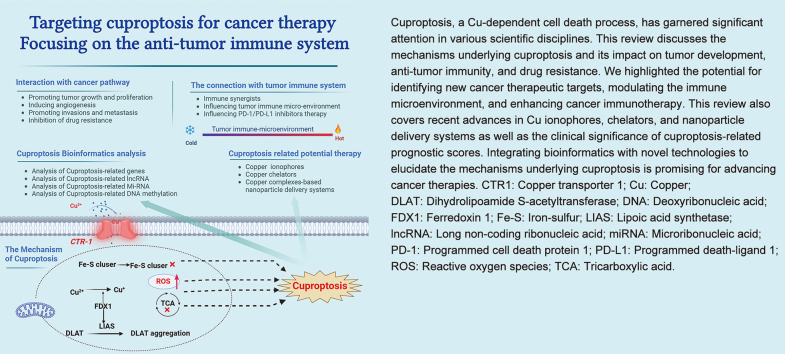
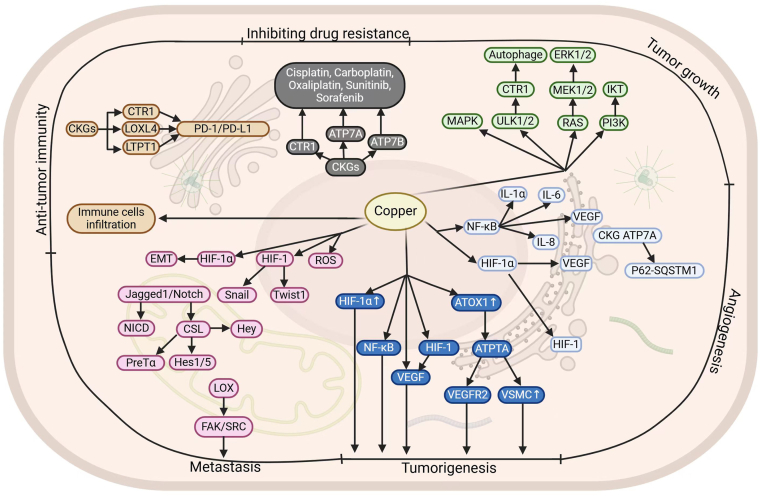
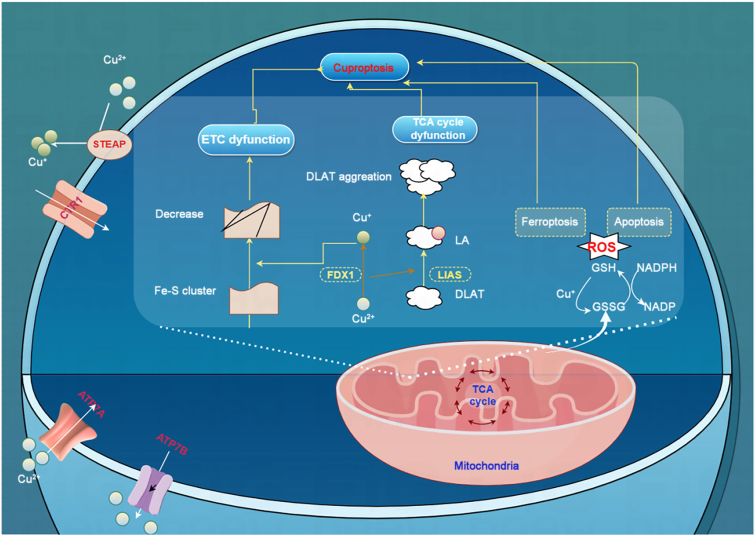
Copper (Cu) is an indispensable micronutrient that maintains signaling pathways and biological homeostasis in almost all cell types; however, its excess affects the tricarboxylic acid cycle, causes the accumulation of fatty acylated proteins, destabilization of iron-sulfur cluster proteins, and increases the levels of intracellular reactive oxygen species, leading to proteotoxic stress and cell death. Cuproptosis, a form of Cu-dependent cell death, differs from other types of regulated cell death (RCD) and was first reported in in 2022. Recently, the RCD pathways have been targeted in cancer therapy. However, the escape of apoptosis in tumor cells causes resistance to treatment and tumor recurrence. Therefore, there is an urgent need to study the alternative mechanisms of cancer cell mortality. Compared to normal patients, a significant increase in serum Cu ion levels has been observed in patients with tumors. Moreover, tumor cell proliferation, angiogenesis, and metastasis are associated with cuproptosis. Thus, exploring cancer signaling pathways related to cuproptosis will provide a new perspective for the development of anti-cancer drugs. Importantly, cuproptosis is closely associated with the modulation of anti-tumor immunity. The expression of cuproptosis-related genes (CRGs) is significantly correlated with immune cell infiltration and the immune checkpoint programmed cell death protein 1 ()/programmed death-ligand 1 (). Based on these findings, a series of cuproptosis-related drugs have been used in tumor-targeted combination therapy or as immune synergists. Therefore, elucidating the role of cuproptosis per cancer stage and in the tumor immune microenvironment (TIME) is helpful in clarifying the potential value of Cu in the treatment of specific cancers. In this review, we summarize specific cancer signaling pathways related to cuproptosis and cancer treatment based on the regulation of Cu concentration. The combination of these two approaches may help researchers develop more therapies targeting cuproptosis-related pathways. Importantly, we focused on the effect of cuproptosis on the TIME and systematically discussed the role of CRGs in tumor immunity considering CRG-related anti-tumor immune signaling pathways, tumor prognosis scoring system, anti-tumor immunotherapy, and biological experiments and bioinformatics prediction models, to provide new ideas for the development of anticancer therapy targeting cuproptosis-related pathways.
铜(Cu)是一种不可或缺的微量营养素,几乎在所有细胞类型中维持信号通路和生物稳态;然而,其过量会影响三羧酸循环,导致脂肪酰化蛋白积累、铁硫簇蛋白不稳定,并增加细胞内活性氧水平,从而导致蛋白毒性应激和细胞死亡。铜死亡是一种铜依赖性细胞死亡形式,与其他类型的程序性细胞死亡(RCD)不同,于2022年首次被报道。最近,RCD途径已成为癌症治疗的靶点。然而,肿瘤细胞中凋亡的逃逸导致对治疗的抗性和肿瘤复发。因此,迫切需要研究癌细胞死亡的替代机制。与正常患者相比,肿瘤患者血清铜离子水平显著升高。此外,肿瘤细胞增殖、血管生成和转移与铜死亡有关。因此,探索与铜死亡相关的癌症信号通路将为抗癌药物的开发提供新的视角。重要的是,铜死亡与抗肿瘤免疫的调节密切相关。铜死亡相关基因(CRGs)的表达与免疫细胞浸润以及免疫检查点程序性细胞死亡蛋白1()/程序性死亡配体1()显著相关。基于这些发现,一系列与铜死亡相关的药物已被用于肿瘤靶向联合治疗或作为免疫增效剂。因此,阐明铜死亡在每个癌症阶段和肿瘤免疫微环境(TIME)中的作用有助于明确铜在特定癌症治疗中的潜在价值。在本综述中,我们基于铜浓度的调节总结了与铜死亡和癌症治疗相关的特定癌症信号通路。这两种方法的结合可能有助于研究人员开发更多针对铜死亡相关途径的疗法。重要的是,我们关注铜死亡对TIME的影响,并系统地讨论了CRGs在肿瘤免疫中的作用,考虑了CRG相关的抗肿瘤免疫信号通路、肿瘤预后评分系统、抗肿瘤免疫治疗以及生物学实验和生物信息学预测模型,为开发针对铜死亡相关途径的抗癌治疗提供新思路。