
哺乳动物对氨基酸异手性的耐受性。
Mammalian Tolerance to Amino Acid Heterochirality.
作者信息
Taniguchi Sakiko, Adachi Kenichiro, Tran Xuan, Suzuki Masataka, Sasabe Jumpei
机构信息
Department of Pharmacology, Keio University School of Medicine, 35 Shinanomachi, Shinjuku-ku, Tokyo, 160-8582, Japan.
Research Fellow of Japan Society for the Promotion of Science, 35 Shinanomachi, Shinjuku-ku, Tokyo, 160-8582, Japan.
出版信息
Chembiochem. 2025 Jul 11;26(13):e202500273. doi: 10.1002/cbic.202500273. Epub 2025 Jun 19.
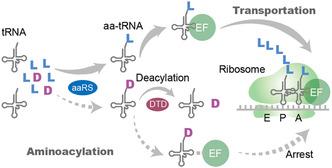
Organisms use amino acids predominantly in l-configuration. In contrast, a series of studies show that a variety of d-amino acids also occur in mammals, and amino acid homochirality is not complete. Mammals de novo synthesize most amino acids with l-configuration, but serine and aspartate are converted from l- to d-configuration by endogenous enzymes. In addition to endogenous syntheses of d-amino acids, symbiotic bacteria in mammals chiral-convert amino acids, including alanine, glutamate, proline, and leucine in the intestine, creating a heterochiral inner environment. d-amino acids are distributed in distinctive patterns among organs and have physiological roles in the central nervous, endocrine, and immune systems. Mammals manage such diverse d-amino acids with catabolism and excretion into urine at individual levels. In contrast, at the cellular levels an enantioselection mechanism to regulate chiral homeostasis of amino acids has remained unclear. In protein synthesis, the ribosome has a sophisticated system to eliminate d-amino acids, whereas non-ribosomal synthesis also utilizes d-amino acids. Furthermore, amino acid residues in proteins/peptides can be isomerized post-translationally through enzymatic or spontaneous processes. This manuscript overviews how the chiral balance of free amino acids or residues in proteins is maintained in mammals at the individual and cellular levels.
生物体主要使用 l 构型的氨基酸。相比之下,一系列研究表明,多种 d 氨基酸也存在于哺乳动物中,氨基酸的同手性并不完全。哺乳动物从头合成大多数 l 构型的氨基酸,但丝氨酸和天冬氨酸会被内源性酶从 l 构型转化为 d 构型。除了 d 氨基酸的内源性合成外,哺乳动物体内的共生细菌会对手性氨基酸进行转化,包括肠道中的丙氨酸、谷氨酸、脯氨酸和亮氨酸,从而形成一个异手性的内部环境。d 氨基酸在各器官中的分布模式独特,在中枢神经、内分泌和免疫系统中发挥生理作用。哺乳动物通过分解代谢并将其排泄到尿液中来分别处理这些多样的 d 氨基酸。相比之下,在细胞水平上,调节氨基酸手性稳态的对映体选择机制仍不清楚。在蛋白质合成过程中,核糖体有一个复杂系统来排除 d 氨基酸,而非核糖体合成也会利用 d 氨基酸。此外,蛋白质/肽中的氨基酸残基可通过酶促或自发过程在翻译后发生异构化。本文综述了哺乳动物在个体和细胞水平上如何维持游离氨基酸或蛋白质中残基的手性平衡。


 Zotero 插件