Boutilier Bryah, Warner Grace, Wolfe Brianna, Askari Sorayya, Moody Elaine, Ghanouni Parisa, Packer Tanya
School of Health Administration, Dalhousie University, Halifax, NS, Canada.
School of Occupational Therapy, Dalhousie University, Halifax, NS, Canada.
JMIR Form Res. 2025 Jun 3;9:e74191. doi: 10.2196/74191.
Innovative approaches to community-level data collection are crucial to inform policies and programs that support people in aging well within their communities. For example, community-level data can proactively identify unmet health needs, inform preventative care strategies, and ensure the equitable distribution of resources that enable older adults to age in place.
This paper presented a substudy of a larger community-based project designed to identify community-dwelling older adults' concerns about their well-being and connect them with resources to help them age well at home. The substudy aimed to identify motivations that influence older adults' engagement in research and barriers to their participation.
Data collection involved qualitative semistructured interviews with 27 older adults, with a mean age of 77 (SD 5.4), who had completed a comprehensive assessment. Purposeful sampling prioritized older adults who lived in rural areas, had more than one health condition, and represented diverse ethnicities, while attempting to reach equal numbers of participants across the participating communities. Interviews were conducted by trained research team members using an interview guide focused on reasons for research participation and perceptions of the assessment and resource action plan. Meeting minutes, gathered during 35 biweekly or monthly sessions with community coordinators, captured real-time reflections on recruitment processes, challenges, and community-specific factors influencing participation. Thematic analysis was completed using both inductive and deductive approaches.
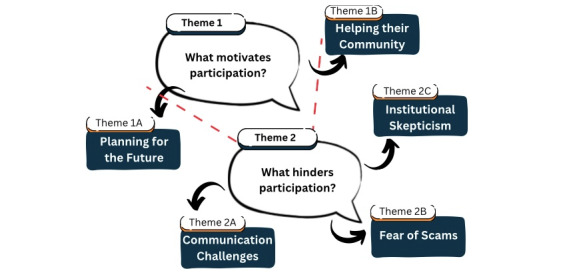
Older adult participants were primarily female (n=22, 82%), of European (n=19, 70%) or Acadian (n=8, 30%) descent, university educated (n=14, 52%), with one or more chronic health conditions (n=26, 96%). Older adults reported 2 main reasons for participating: planning for the future and helping their community. At the same time, barriers to participation identified included communication challenges, fear of scams, and institutional skepticism. Participants emphasized a desire for practical outcomes from the research, especially related to aging-in-place supports. Although trust in local, personal relationships facilitated participation, skepticism toward institutions and digital communication channels were barriers to participation.
This research highlighted the need to tailor communication strategies to older adults by understanding factors influencing engagement. Addressing institutional skepticism and leveraging trusted community members are possible strategies to overcome barriers to successful engagement in community-based research. These findings advance our understanding of why older adults participate in research and suggest ways to improve recruitment strategies. Participation was motivated not only by personal benefit but also by a strong sense of civic responsibility, social connection, and a desire to contribute to future community well-being. Framing research as community-driven and future-oriented, rather than problem- or deficit-based, studies can resonate more deeply with older adults. Integrating research within existing, trusted local networks and venues helps build legitimacy and accessibility-especially in rural contexts where institutional trust may be low and digital communication less effective.
创新的社区层面数据收集方法对于为支持人们在社区中安享晚年的政策和项目提供信息至关重要。例如,社区层面的数据可以主动识别未满足的健康需求,为预防保健策略提供信息,并确保资源的公平分配,使老年人能够在原地养老。
本文介绍了一个更大的基于社区项目的子研究,该项目旨在识别居住在社区中的老年人对自身福祉的担忧,并为他们提供资源以帮助他们在家中安享晚年。该子研究旨在确定影响老年人参与研究的动机及其参与的障碍。
数据收集包括对27名老年人进行定性半结构化访谈,这些老年人的平均年龄为77岁(标准差5.4),他们已完成全面评估。有目的抽样优先考虑居住在农村地区、患有多种健康状况且代表不同种族的老年人,同时试图在参与社区中达到相等数量的参与者。访谈由经过培训的研究团队成员进行,使用侧重于研究参与原因以及对评估和资源行动计划看法的访谈指南。在与社区协调员进行的35次每两周或每月一次的会议期间收集的会议记录,记录了对招募过程、挑战以及影响参与的社区特定因素的实时反思。使用归纳法和演绎法完成主题分析。
老年参与者主要为女性(n = 22,82%),欧洲(n = 19,70%)或阿卡迪亚(n = 8,30%)血统,受过大学教育(n = 14,52%),患有一种或多种慢性健康状况(n = 26,96%)。老年人报告参与的两个主要原因是为未来做规划和帮助他们的社区。与此同时,确定的参与障碍包括沟通挑战、对诈骗的恐惧以及对机构的怀疑。参与者强调希望研究能产生实际成果,特别是与就地养老支持相关的成果。虽然对当地个人关系的信任促进了参与,但对机构和数字通信渠道的怀疑是参与的障碍。
本研究强调需要通过了解影响参与的因素来为老年人量身定制沟通策略。解决机构怀疑并利用受信任的社区成员是克服成功参与基于社区研究障碍的可能策略。这些发现增进了我们对老年人参与研究原因的理解,并提出了改进招募策略的方法。参与不仅受到个人利益的驱动,还受到强烈的公民责任感、社会联系以及为未来社区福祉做出贡献的愿望的驱动。将研究构建为社区驱动和面向未来,而不是基于问题或缺陷的研究,可能会更深刻地引起老年人的共鸣。将研究整合到现有的、受信任的当地网络和场所中有助于建立合法性和可及性,特别是在机构信任可能较低且数字通信效果较差的农村地区。
