Morales Daniel R, Bu Fan, Viernes Benjamin, DuVall Scott L, Matheny Michael E, Simon Katherine R, Falconer Thomas, Richter Lauren R, Ostropolets Anna, Lau Wallis C Y, Man Kenneth K C, Chattopadhyay Shounak, Mathioudakis Nestoras, Minty Evan, Nishimura Akihiko, Sun Feng, Yin Can, Seager Sarah L, Chai Yi, Zhou Jin J, Lu Yuan, Reyes Carlen, Pistillo Andrea, Duarte-Salles Talita, Blacketer Clair, Schuemie Martijn J, Ryan Patrick B, Krumholz Harlan M, Hripcsak George, Khera Rohan, Suchard Marc A
Division of Population Health and Genomics, School of Medicine, University of Dundee, Dundee, U.K.
Department of Biostatistics, University of Michigan at Ann Arbor, Ann Arbor, MI.
Diabetes Care. 2025 Aug 1;48(8):1386-1394. doi: 10.2337/dc25-0154.
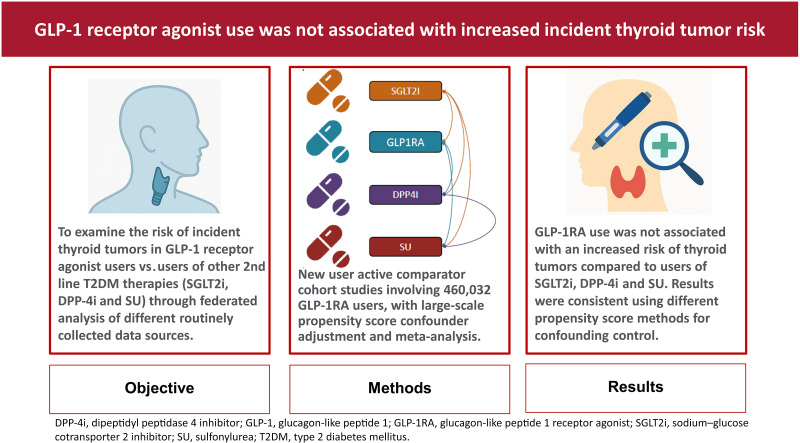
To assess the association between glucagon-like peptide 1 receptor agonist (GLP-1RA) use and risk of incident thyroid tumors.
The retrospective, active-comparator new-user cohort study used international administrative claims and electronic health record databases. Participants included patients with type 2 diabetes mellitus (T2DM) with prior metformin therapy initiating a GLP-1RA versus new users of sodium-glucose cotransporter 2 inhibitors (SGLT2is), dipeptidyl peptidase 4 inhibitors (DPP-4is), and sulfonylureas (SUs). The outcome was incident thyroid tumor and thyroid malignancy. Propensity score matching and stratification were used to adjust for confounders with an intention-to-treat and on-treatment strategy. Cox regression was used to estimate hazard ratios (HRs) pooled using a random-effects meta-analysis. Unmeasured confounding was evaluated using negative outcomes, with calibration of the HR.
A total of 460,032 users of GLP-1RAs, 717,792 users of SGLT2is, 2,055,583 users of DPP-4is, and 1,119,868 users of SUs were included. Only U.S. cohorts passed study diagnostics. Thyroid tumor incidence ranged from 0.88 to 1.03 per 1,000 person-years in GLP-1RA cohorts. GLP-1RA exposure was not associated with an increased risk of thyroid tumors compared with SGLT2is, DPP-4is, or SUs (meta-analysis: GLP-1RA vs. SGLT2i HR range from 0.83 [95% CI 0.57-1.27] to 0.95 [0.85-1.06]; GLP-1RA vs. SU HR range from 0.95 [0.75-1.20] to 1.03 [0.87-1.23]; GLP-1RA vs. DPP-4i HR range from 0.78 [0.60-1.01] to 0.93 [0.83-1.04]). Analysis using thyroid malignancy and including a 1-year lag period produced similar conclusions.
In patients with T2DM initiating second-line treatments, we observed no increased risk of thyroid tumors with GLP-1RA exposure.
评估使用胰高血糖素样肽1受体激动剂(GLP-1RA)与甲状腺肿瘤发病风险之间的关联。
这项回顾性、活性对照新用户队列研究使用了国际行政索赔和电子健康记录数据库。参与者包括接受过二甲双胍治疗的2型糖尿病(T2DM)患者,这些患者开始使用GLP-1RA,与钠-葡萄糖协同转运蛋白2抑制剂(SGLT2i)、二肽基肽酶4抑制剂(DPP-4i)和磺脲类药物(SU)的新用户进行对比。研究结果为甲状腺肿瘤发病和甲状腺恶性肿瘤。采用倾向评分匹配和分层的方法,以意向性治疗和治疗中策略调整混杂因素。使用Cox回归估计通过随机效应荟萃分析汇总的风险比(HR)。使用阴性结果评估未测量的混杂因素,并对HR进行校准。
共纳入460,032名GLP-1RA使用者、717,792名SGLT2i使用者、2,055,583名DPP-4i使用者和1,119,868名SU使用者。只有美国队列通过了研究诊断。GLP-1RA队列中甲状腺肿瘤发病率为每1000人年0.88至1.03例。与SGLT2i、DPP-4i或SU相比,GLP-1RA暴露与甲状腺肿瘤风险增加无关(荟萃分析:GLP-1RA与SGLT2i相比,HR范围为0.83[95%CI 0.57-1.27]至0.95[0.85-1.06];GLP-1RA与SU相比,HR范围为0.95[0.75-1.20]至1.03[0.87-1.23];GLP-RA与DPP-4i相比,HR范围为0.78[0.60-1.01]至0.93[0.83-1.04])。使用甲状腺恶性肿瘤并纳入1年滞后期进行分析得出了类似结论。
在开始二线治疗的T2DM患者中,我们观察到GLP-1RA暴露不会增加甲状腺肿瘤风险。