Khera Rohan, Dhingra Lovedeep Singh, Aminorroaya Arya, Li Kelly, Zhou Jin J, Arshad Faaizah, Blacketer Clair, Bowring Mary G, Bu Fan, Cook Michael, Dorr David A, Duarte-Salles Talita, DuVall Scott L, Falconer Thomas, French Tina E, Hanchrow Elizabeth E, Horban Scott, Lau Wallis Cy, Li Jing, Liu Yuntian, Lu Yuan, Man Kenneth Kc, Matheny Michael E, Mathioudakis Nestoras, McLemore Michael F, Minty Evan, Morales Daniel R, Nagy Paul, Nishimura Akihiko, Ostropolets Anna, Pistillo Andrea, Posada Jose D, Pratt Nicole, Reyes Carlen, Ross Joseph S, Seager Sarah, Shah Nigam, Simon Katherine, Wan Eric Yf, Yang Jianxiao, Yin Can, You Seng Chan, Schuemie Martijn J, Ryan Patrick B, Hripcsak George, Krumholz Harlan, Suchard Marc A
Section of Cardiovascular Medicine, Department of Internal Medicine, Yale University, New Haven, CT, USA.
Center for Outcomes Research and Evaluation, Yale New Haven Hospital, New Haven, CT, USA.
BMJ Med. 2023 Oct 6;2(1):e000651. doi: 10.1136/bmjmed-2023-000651. eCollection 2023.
To assess the uptake of second line antihyperglycaemic drugs among patients with type 2 diabetes mellitus who are receiving metformin.
Federated pharmacoepidemiological evaluation in LEGEND-T2DM.
10 US and seven non-US electronic health record and administrative claims databases in the Observational Health Data Sciences and Informatics network in eight countries from 2011 to the end of 2021.
4.8 million patients (≥18 years) across US and non-US based databases with type 2 diabetes mellitus who had received metformin monotherapy and had initiated second line treatments.
The exposure used to evaluate each database was calendar year trends, with the years in the study that were specific to each cohort.
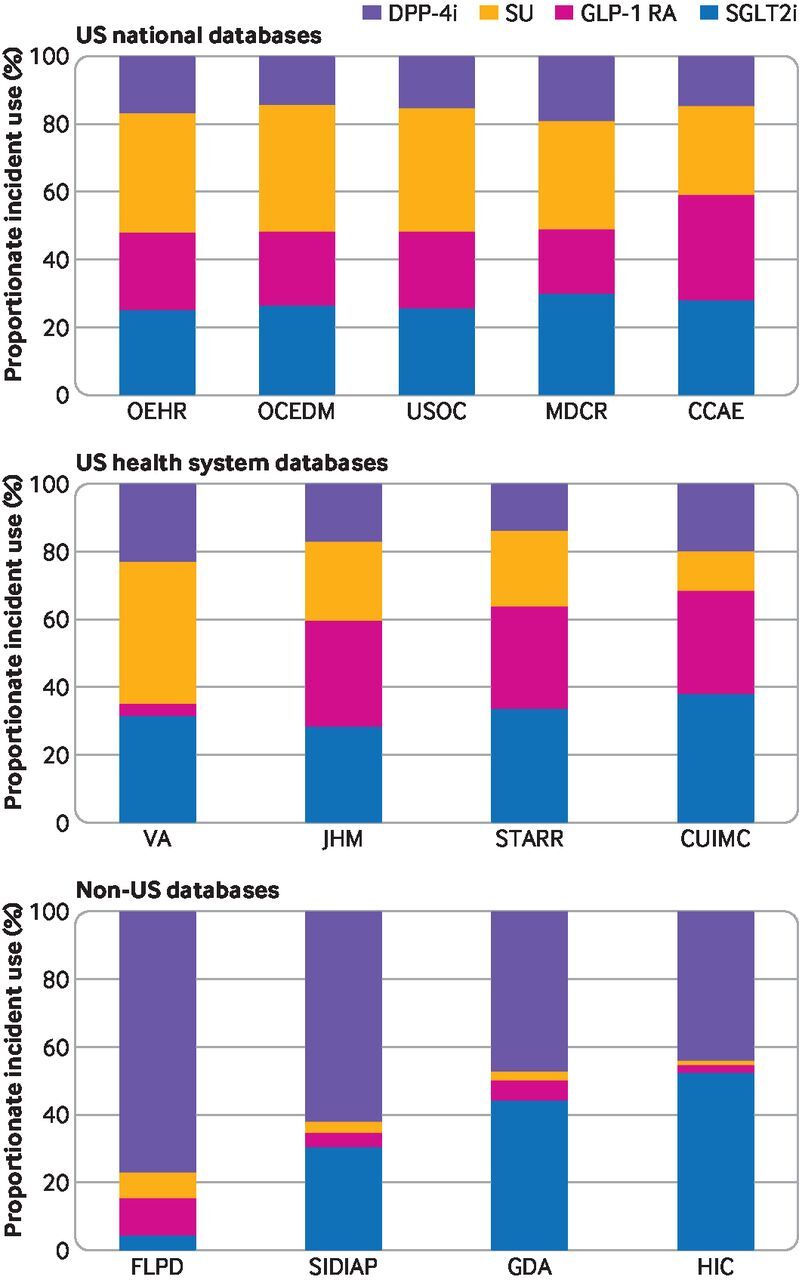
The outcome was the incidence of second line antihyperglycaemic drug use (ie, glucagon-like peptide-1 receptor agonists, sodium-glucose cotransporter-2 inhibitors, dipeptidyl peptidase-4 inhibitors, and sulfonylureas) among individuals who were already receiving treatment with metformin. The relative drug class level uptake across cardiovascular risk groups was also evaluated.
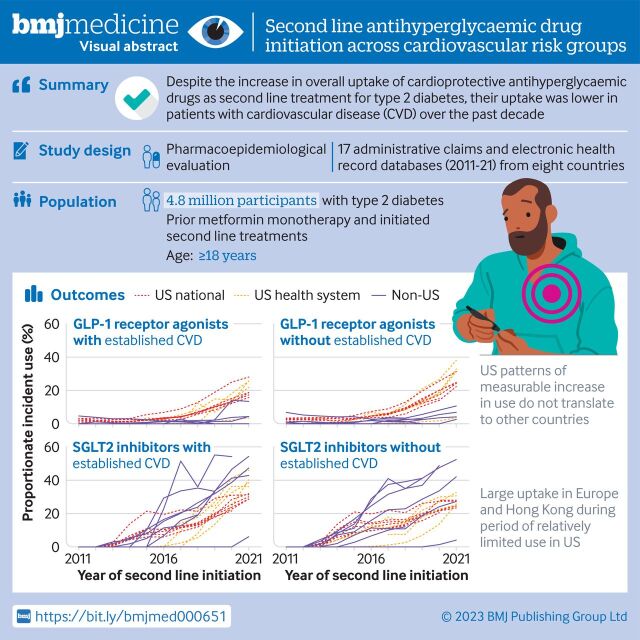
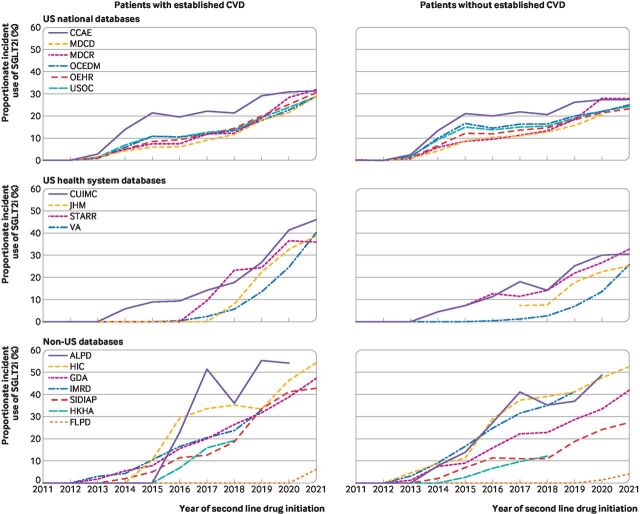
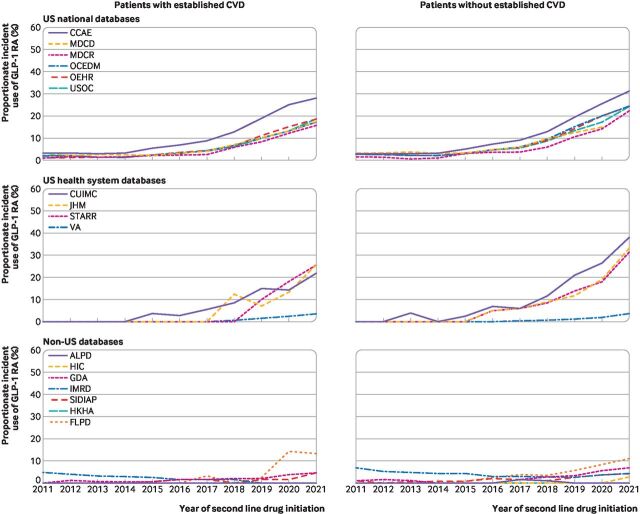
4.6 million patients were identified in US databases, 61 382 from Spain, 32 442 from Germany, 25 173 from the UK, 13 270 from France, 5580 from Scotland, 4614 from Hong Kong, and 2322 from Australia. During 2011-21, the combined proportional initiation of the cardioprotective antihyperglycaemic drugs (glucagon-like peptide-1 receptor agonists and sodium-glucose cotransporter-2 inhibitors) increased across all data sources, with the combined initiation of these drugs as second line drugs in 2021 ranging from 35.2% to 68.2% in the US databases, 15.4% in France, 34.7% in Spain, 50.1% in Germany, and 54.8% in Scotland. From 2016 to 2021, in some US and non-US databases, uptake of glucagon-like peptide-1 receptor agonists and sodium-glucose cotransporter-2 inhibitors increased more significantly among populations with no cardiovascular disease compared with patients with established cardiovascular disease. No data source provided evidence of a greater increase in the uptake of these two drug classes in populations with cardiovascular disease compared with no cardiovascular disease.
Despite the increase in overall uptake of cardioprotective antihyperglycaemic drugs as second line treatments for type 2 diabetes mellitus, their uptake was lower in patients with cardiovascular disease than in people with no cardiovascular disease over the past decade. A strategy is needed to ensure that medication use is concordant with guideline recommendations to improve outcomes of patients with type 2 diabetes mellitus.
评估正在接受二甲双胍治疗的2型糖尿病患者二线降糖药物的使用情况。
LEGEND-T2DM中的联合药物流行病学评估。
2011年至2021年底,来自八个国家的观察性健康数据科学与信息学网络中的10个美国和7个非美国电子健康记录及行政索赔数据库。
来自美国和非美国数据库的480万例(≥18岁)2型糖尿病患者,这些患者接受过二甲双胍单药治疗并已开始二线治疗。
用于评估每个数据库的暴露因素是日历年趋势,具体针对每个队列的研究年份。
结局为已经接受二甲双胍治疗的个体中二线降糖药物(即胰高血糖素样肽-1受体激动剂、钠-葡萄糖协同转运蛋白-2抑制剂、二肽基肽酶-4抑制剂和磺脲类药物)的使用发生率。还评估了心血管风险组中相对药物类别水平的使用情况。
在美国数据库中识别出460万例患者,西班牙61382例,德国32442例,英国25173例,法国13270例,苏格兰5580例,中国香港4614例,澳大利亚2322例。在2011 - 2021年期间,所有数据源中心血管保护类降糖药物(胰高血糖素样肽-1受体激动剂和钠-葡萄糖协同转运蛋白-2抑制剂)的联合比例起始使用情况均有所增加,2021年这些药物作为二线药物的联合起始使用率在美国数据库中为35.2%至68.2%,法国为15.4%,西班牙为34.7%,德国为50.1%,苏格兰为54.8%。从2016年到2021年,在一些美国和非美国数据库中,与已确诊心血管疾病的患者相比,无心血管疾病人群中胰高血糖素样肽-1受体激动剂和钠-葡萄糖协同转运蛋白-2抑制剂的使用增加更为显著。没有数据源提供证据表明与无心血管疾病人群相比,心血管疾病人群中这两类药物的使用增加幅度更大。
尽管心血管保护类降糖药物作为2型糖尿病二线治疗药物的总体使用有所增加,但在过去十年中,心血管疾病患者的使用率低于无心血管疾病的人群。需要一种策略来确保药物使用符合指南建议,以改善2型糖尿病患者的预后。