Duan Yipei, Sun Wenjing, Wang Qian, Cao Lingling, Wang Huiyu, Hao Jinghong, Han Yingyan, Liu Chaojie
College of Plant Science and Technology, Beijing University of Agriculture, Beijing, 102206, China.
Beijing Agricultural Technology Extension Station, Beijing, 100029, China.
BMC Plant Biol. 2025 Jun 4;25(1):754. doi: 10.1186/s12870-025-06781-7.
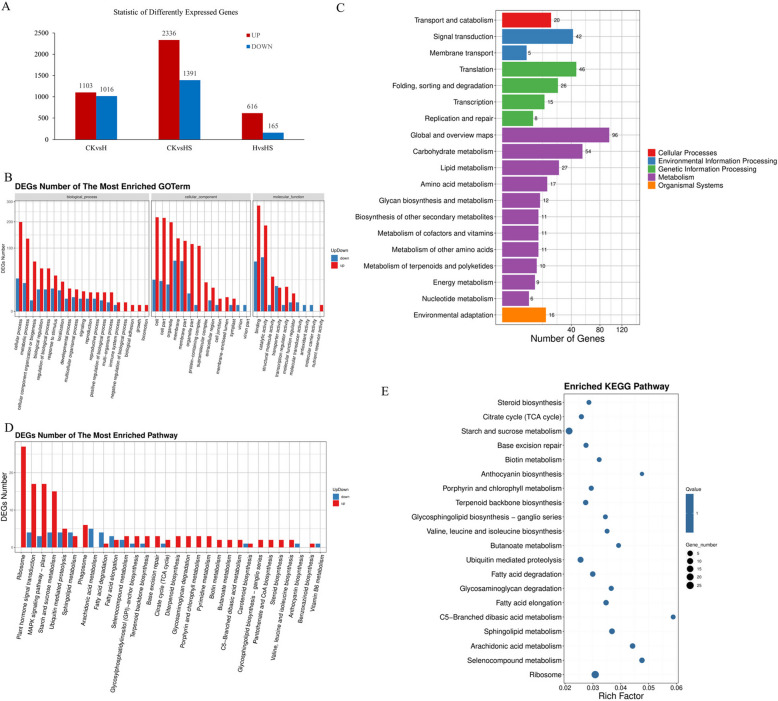
Lettuce (Lactuca sativa L.) is sensitive to high temperatures, and the growth is inhibited under excessive temperature. Spermidine can improve the ability of lettuce to tolerate high temperatures, however, the molecular mechanism was poorly understood. The molecular mechanism of lettuce response to heat stress (2h) were investigated by physiology, transcriptome, and proteome. The results showed that 781 differentially expressed genes (DEGs) and 255 differentially expressed proteins (DEPs) were detected in lettuce treated with spermidine under heat stress. The DEGs and DEPs of lettuce were treated with 1 mM spermidine under high temperatures stress. There were 718/236 genes/proteins with the same expression trend. Kyoto Encyclopedia of Genes and Genomes (KEGG) enrichment analysis revealed the genes were mainly enriched in intracellular signal transduction and carbohydrate metabolism pathways, which stimulated the expression of genes/proteins related to hormone and mitogen-activated protein kinase (MAPK) signal transduction pathways, starch and sucrose metabolism, pentose and glucose mutual transformation pathways. It also increased the contents of auxin and cytokinin, starch and soluble sugar. String network analysis showed that spermidine promoted material transport and antioxidant enzyme activity to improve lettuce resist high-temperature stress by removing superoxide radicals, binding and central transport of nuclear pores. In summary, signal transduction and gluconeogenic pathways may be the main ways in which spermidine improve lettuce to tolerate in heat stress. These results increase the understanding of the heat tolerance of lettuce at the transcriptional and protein levels, and provide a better understanding of the heat tolerance mechanism of lettuce.
生菜(Lactuca sativa L.)对高温敏感,在温度过高时生长会受到抑制。亚精胺可以提高生菜耐受高温的能力,然而,其分子机制尚不清楚。通过生理学、转录组学和蛋白质组学研究了生菜对热胁迫(2小时)的分子机制。结果表明,在热胁迫下用亚精胺处理的生菜中检测到781个差异表达基因(DEGs)和255个差异表达蛋白(DEPs)。在高温胁迫下用1 mM亚精胺处理生菜的DEGs和DEPs。有718/236个基因/蛋白具有相同的表达趋势。京都基因与基因组百科全书(KEGG)富集分析表明,这些基因主要富集在细胞内信号转导和碳水化合物代谢途径中,刺激了与激素和丝裂原活化蛋白激酶(MAPK)信号转导途径、淀粉和蔗糖代谢、戊糖和葡萄糖相互转化途径相关的基因/蛋白的表达。它还增加了生长素和细胞分裂素、淀粉和可溶性糖的含量。String网络分析表明,亚精胺通过去除超氧自由基、核孔的结合和中心运输促进物质运输和抗氧化酶活性,从而提高生菜对高温胁迫的抗性。综上所述,信号转导和糖异生途径可能是亚精胺提高生菜耐热性的主要途径。这些结果增加了在转录和蛋白质水平上对生菜耐热性的理解,并为更好地理解生菜的耐热机制提供了依据。