Wang Zitong, Zhang Ling, Qin Chuan
NHC Key Laboratory of Human Disease Comparative Medicine, Institute of Laboratory Animal Sciences, Chinese Academy of Medical Sciences (CAMS)& Comparative Medicine Center, Peking Union Medical College (PUMC), Beijing, 100021, China.
Changping Laboratory, Chinese Academy of Medical Sciences & Peking Union Medical College, Beijing, 102206, China.
Mol Neurodegener. 2025 Jun 4;20(1):67. doi: 10.1186/s13024-025-00857-6.
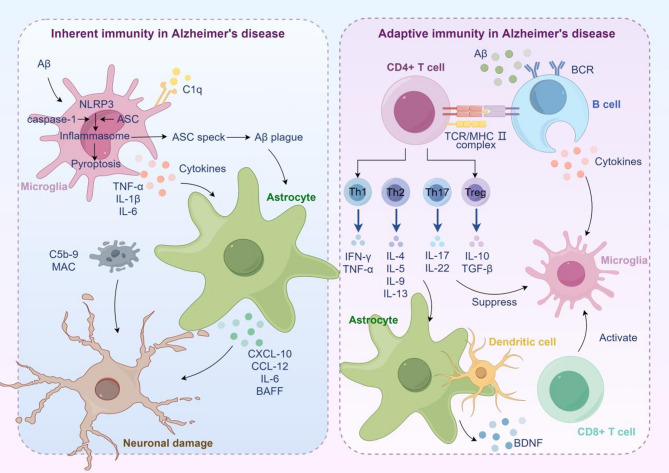
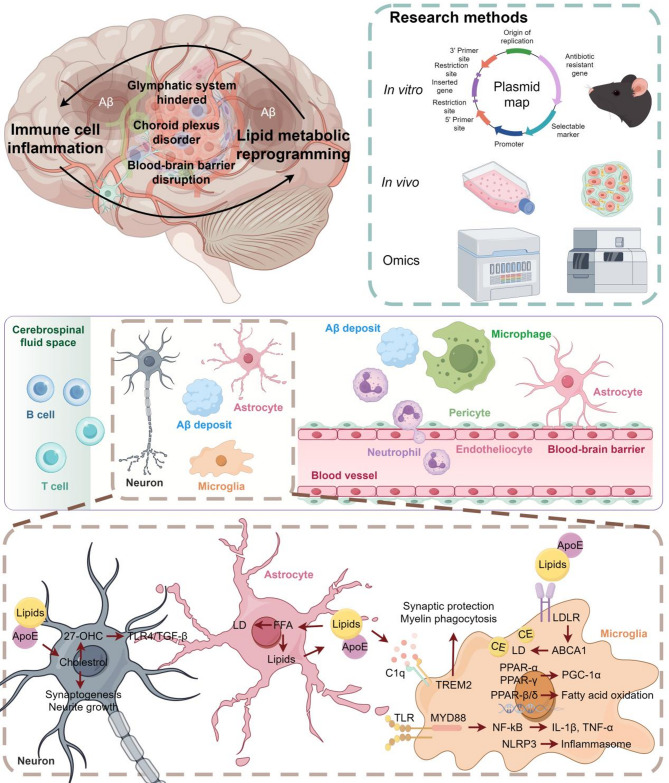
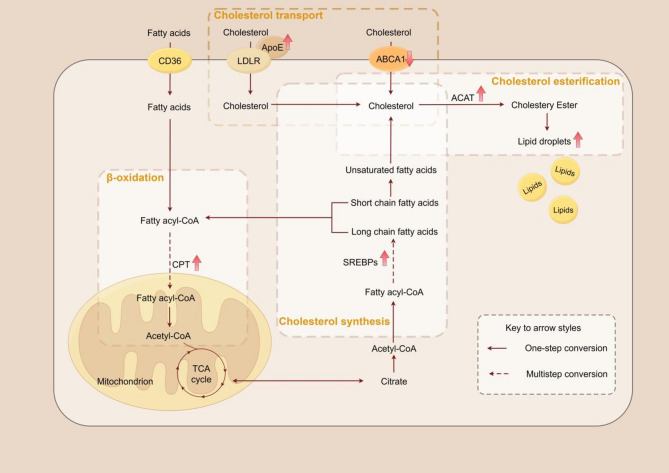
Alzheimer's disease (AD) is a neurodegenerative disorder characterized by macroscopic features such as cortical atrophy, narrowing of the gyri, widening of the sulci, and enlargement of the ventricles. At the cellular level, the pathological characteristics include the extracellular aggregation of β-amyloid (Aβ) forming senile plaques, and the intracellular accumulation of hyperphosphorylated tau proteins forming neurofibrillary tangles. AD leads to the progressive decline of cognitive, behavioral, and social abilities, with no effective treatment available currently. The pathophysiology of AD is complex, involving mechanisms such as immune dysregulation and lipid metabolism alterations. Immune cells, such as microglia, can identify and clear pathological aggregates like Aβ early in the disease. However, prolonged or excessive activation of immune cells may trigger chronic neuroinflammation, thereby accelerating neuronal damage and the progression of AD. Lipid metabolism plays a critical role in maintaining cell membrane structure and function, regulating the production and clearance of Aβ, and supplying energy to the brain. Disruptions in these processes are closely linked to the pathological progression of AD. The interaction between lipid metabolism and the immune system further exacerbates the disease progression of AD. In this review, we discuss the lipid metabolism and immune response in AD, summarize their intricate interactions, and highlight the complexity of the multifactorial pathogenic cascade, offering insights into new interventions targeting the immune-metabolic axis in AD.
阿尔茨海默病(AD)是一种神经退行性疾病,其宏观特征包括皮质萎缩、脑回变窄、脑沟增宽和脑室扩大。在细胞水平上,病理特征包括β-淀粉样蛋白(Aβ)在细胞外聚集形成老年斑,以及过度磷酸化的tau蛋白在细胞内积累形成神经原纤维缠结。AD导致认知、行为和社交能力逐渐下降,目前尚无有效的治疗方法。AD的病理生理学很复杂,涉及免疫失调和脂质代谢改变等机制。免疫细胞,如小胶质细胞,在疾病早期可以识别并清除像Aβ这样的病理聚集体。然而,免疫细胞的长期或过度激活可能引发慢性神经炎症,从而加速神经元损伤和AD的进展。脂质代谢在维持细胞膜结构和功能、调节Aβ的产生和清除以及为大脑提供能量方面起着关键作用。这些过程的紊乱与AD的病理进展密切相关。脂质代谢与免疫系统之间的相互作用进一步加剧了AD的疾病进展。在这篇综述中,我们讨论了AD中的脂质代谢和免疫反应,总结了它们复杂的相互作用,并强调了多因素致病级联反应的复杂性,为针对AD免疫代谢轴的新干预措施提供了见解。