Koh Hyun Gi, Park Kyungmoon, Park See-Hyoung, Kim Minsik, Kang Nam Kyu
Department of Biological and Chemical Engineering, Hongik University, Sejong, Republic of Korea.
Department of Biological Engineering, Inha University, Incheon, Republic of Korea.
Front Microbiol. 2025 May 21;16:1601691. doi: 10.3389/fmicb.2025.1601691. eCollection 2025.
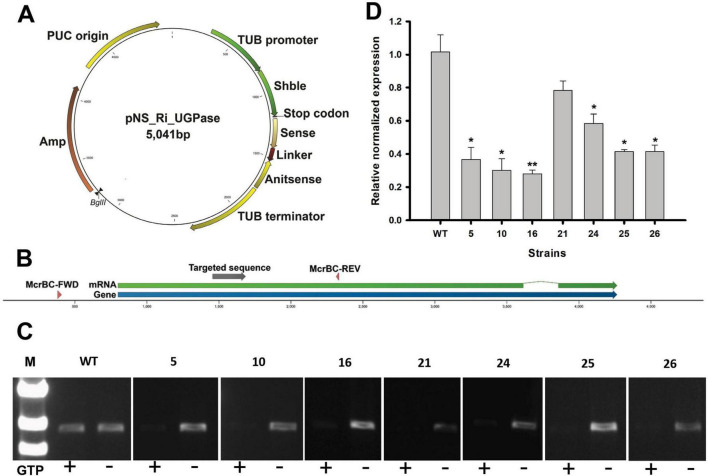
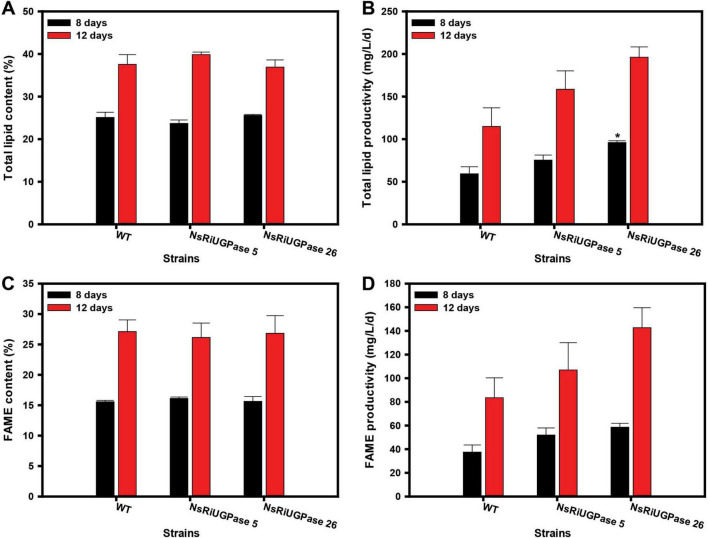
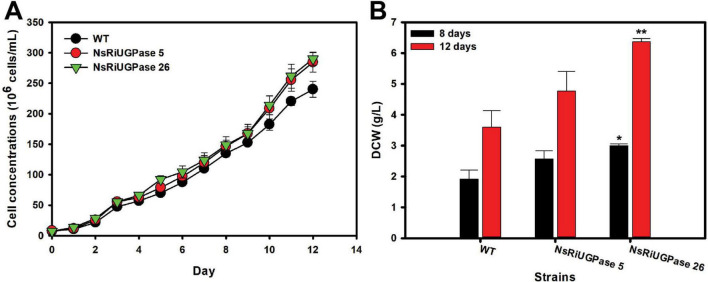
Microalgae are promising platforms for sustainable biofuel production owing to their high photosynthetic efficiency and carbon fixation capacity. is particularly valued for its robust growth and lipid accumulation. However, redirecting carbon flux from carbohydrate to lipid biosynthesis remains a key challenge in microalgal metabolic engineering. In this study, RNA interference (RNAi) was employed to downregulate uridine diphosphate-glucose pyrophosphorylase (UGPase), a central enzyme in chrysolaminarin biosynthesis. After confirming the presence of core RNAi machinery (Argonaute, Dicer, and RDR) in , an RNAi construct targeting UGPase was introduced. Two transformants, NsRiUGPase 5 and NsRiUGPase 26, were selected through McrBC-PCR and qRT-PCR screening based on reduced methylation-sensitive PCR band intensity and UGPase transcript levels. These RNAi mutants exhibited significantly enhanced growth compared to wild-type. On day 12, dry cell weight (DCW) reached 4.77 g/L in NsRiUGPase 5 and 6.37 g/L in NsRiUGPase 26, representing 32.4% and 76.9% increases, respectively, compared to WT (3.60 g/L). Despite similar lipid contents per biomass, lipid productivity was markedly improved. On day 12, NsRiUGPase 26 achieved 196.3 mg/L/day, a 71.0% increase over WT (114.8 mg/L/day). Fatty acid methyl ester (FAME) analysis showed no significant difference in lipid composition among strains, indicating that UGPase knockdown did not affect lipid quality. These results demonstrate that RNAi-mediated suppression of UGPase successfully redirected carbon flux away from carbohydrate storage toward growth, thereby enhancing overall lipid productivity. This study provides new insights into carbon partitioning in and underscores RNAi as a powerful tool for microalgal biofuel optimization.
微藻因其高光合效率和碳固定能力,是可持续生物燃料生产的理想平台。 因其强劲的生长和脂质积累而备受重视。然而,将碳通量从碳水化合物生物合成转向脂质生物合成仍然是微藻代谢工程中的一个关键挑战。在本研究中,采用RNA干扰(RNAi)来下调尿苷二磷酸葡萄糖焦磷酸化酶(UGPase),这是金黄藻多糖生物合成中的一种关键酶。在确认 中存在核心RNAi机制(Argonaute、Dicer和RDR)后,引入了靶向UGPase的RNAi构建体。通过基于甲基化敏感PCR条带强度降低和UGPase转录水平的McrBC-PCR和qRT-PCR筛选,选择了两个转化体NsRiUGPase 5和NsRiUGPase 26。与野生型相比,这些RNAi突变体的生长显著增强。在第12天,NsRiUGPase 5的干细胞重量(DCW)达到4.77 g/L,NsRiUGPase 26的干细胞重量达到6.37 g/L,与野生型(3.60 g/L)相比,分别增加了32.4%和76.9%。尽管每生物量的脂质含量相似,但脂质生产率显著提高。在第12天,NsRiUGPase 26达到196.3 mg/L/天,比野生型(114.8 mg/L/天)增加了71.0%。脂肪酸甲酯(FAME)分析表明,各菌株之间的脂质组成没有显著差异,这表明UGPase基因敲低不影响脂质质量。这些结果表明,RNAi介导的UGPase抑制成功地将碳通量从碳水化合物储存转向生长,从而提高了整体脂质生产率。本研究为 中的碳分配提供了新的见解,并强调RNAi是微藻生物燃料优化的有力工具。