Wu Zhichao, Sadda Srinivas R, Ach Thomas, Blodi Barbara A, Bottoni Ferdinando, Chakravarthy Usha, Chew Emily Y, Curcio Christine A, Ferris Frederick L, Fleckenstein Monika, Freund K Bailey, Grunwald Juan E, Holz Frank G, Jaffe Glenn J, Liakopoulos Sandra, Lim Tock Han, Monés Jordi M, Pagliarini Sergio, Pauleikhoff Daniel, Pfau Maximilian, Rosenfeld Philip J, Sarraf David, Schmitz-Valckenberg Steffen, Spaide Richard F, Sparrow Janet R, Staurenghi Giovanni, Tufail Adnan, Viola Francesco, Guymer Robyn H
Centre for Eye Research Australia, Royal Victorian Eye and Ear Hospital, East Melbourne, Australia.
Ophthalmology, Department of Surgery, The University of Melbourne, Melbourne, Australia.
Ophthalmol Sci. 2025 Mar 28;5(5):100777. doi: 10.1016/j.xops.2025.100777. eCollection 2025 Sep-Oct.
To investigate whether consensus can be reached on the acceptability of end-stage atrophy onset as a clinical end point in early intervention trials of age-related macular degeneration (AMD), and the criteria for defining such an end point.
A modified Delphi study.
International panel of experts in AMD, retinal imaging, and histopathology that are part of the Classification of Atrophy Meetings group.
A modified Delphi study was undertaken to determine if there is consensus on the acceptability of the onset of end-stage atrophic AMD as a clinical end point to evaluate early interventions and the criteria for defining such an end point. Two initial rounds of online surveys were conducted. Aggregate results and anonymized comments were provided after each round, followed by a face-to-face meeting before a final survey round was completed.
Statements where consensus was reached, defined as ≥80% of responses within the 3-point bracket for agreement or disagreement based on a 9-point Likert rating scale, from a total of 33 statements included in the final round of the survey.
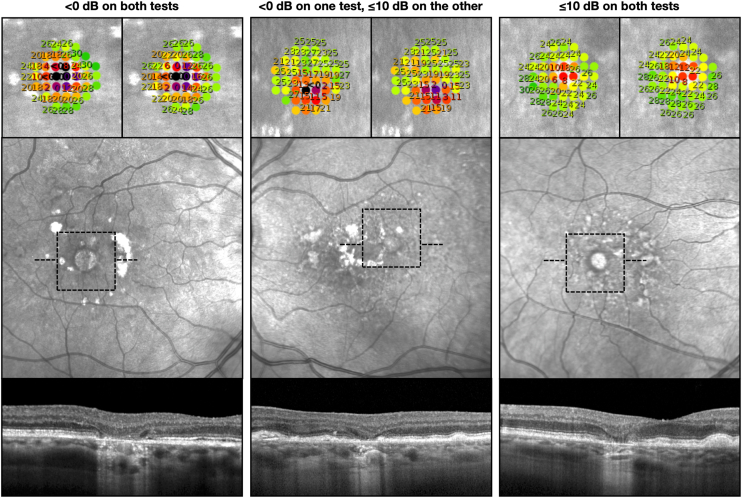
Consensus was reached for the statement that the onset of end-stage atrophic AMD was an appropriate clinical end point to evaluate early interventions (82% responses in agreement). Consensus was also reached for the statement that such an end point should be defined based on anatomical changes that have been previously shown in clinical studies to be associated with marked, but not necessarily complete, functional loss (95% responses in agreement). Consensus was nearly reached for the specific criterion that ≥90% of such atrophic AMD lesions should have ≥1 test location that was ≤10 decibels on 2 microperimetry tests (77% responses in agreement).
There was expert group consensus that the onset of end-stage atrophy is an appropriate clinical end point to evaluate early interventions in AMD, and that such an end point should show evidence of marked functional loss in prior clinical studies. We believe these findings will help to define incident clinical end points that are acceptable to regulatory authorities.
Proprietary or commercial disclosure may be found in the Footnotes and Disclosures at the end of this article.
探讨在年龄相关性黄斑变性(AMD)早期干预试验中,对于将晚期萎缩性病变的发生作为临床终点的可接受性以及定义该终点的标准,是否能够达成共识。
一项改良的德尔菲研究。
作为萎缩性病变分类会议小组一部分的AMD、视网膜成像和组织病理学领域的国际专家小组。
进行了一项改良的德尔菲研究,以确定对于将晚期萎缩性AMD病变的发生作为评估早期干预措施的临床终点以及定义该终点的标准,是否存在共识。开展了两轮初始在线调查。每轮调查后提供汇总结果和匿名评论,随后在完成最后一轮调查之前举行了一次面对面会议。
在调查最后一轮包含的总共33条陈述中,基于9点李克特量表,在同意或不同意的3分区间内达成共识的陈述,即≥80%的回复。
对于晚期萎缩性AMD病变的发生是评估早期干预措施的合适临床终点这一陈述达成了共识(82%的回复表示同意)。对于应基于先前临床研究中显示与明显但不一定完全的功能丧失相关的解剖学变化来定义这样一个终点这一陈述也达成了共识(95%的回复表示同意)。对于≥90%的此类萎缩性AMD病变在2次微视野检查中应在≥1个检测部位≤10分贝这一具体标准几乎达成了共识(77%的回复表示同意)。
专家组达成共识,即晚期萎缩性病变的发生是评估AMD早期干预措施的合适临床终点,并且这样一个终点在先前的临床研究中应显示出明显功能丧失的证据。我们相信这些发现将有助于定义监管机构可接受的突发临床终点。
在本文末尾的脚注和披露中可能会发现专有或商业披露信息。