Jin Huan, Huang Cai, Zhang Yan, Dong Ying, Xiong Qi, Wang Di, He Ziyi, Shen Lin, Ma Chen, Wang Zixian, Shuai Bo
Department of Integrated Traditional Chinese and Western Medicine, Union Hospital, Tongji Medical College, Huazhong University of Science and Technology, Wuhan, China.
College of Sports Medicine, Wuhan Sports University, Wuhan, China.
Front Pharmacol. 2025 May 21;16:1605279. doi: 10.3389/fphar.2025.1605279. eCollection 2025.
Teriparatide (TPTD), a widely used bone-promoting drug in osteoporosis (OP) treatment, may cause compensatory bone resorption with long-term monotherapy (>6 months). Combining TPTD with anti-bone resorption drugs (e.g., bisphosphonates and denosumab) could reduce bone loss, yet existing randomised controlled trials (RCTs) remain inconclusive regarding their effects on bone mineral density (BMD) and bone turnover markers (BTMs). This study aimed to systematically evaluate the effect of TPTD combined with bisphosphonates or denosumab on BMD and fracture risk in OP patients, compared with TPTD monotherapy.
PubMed, Embase, Cochrane Library, and Web of Science databases (until March 2025) were searched for RCTs comparing TPTD monotherapy with combination therapy. Primary outcomes included vertebral/non-vertebral fracture risk reduction and BMD changes (lumbar spine, femoral neck, hip); secondary outcomes covered BTM variations and adverse events.
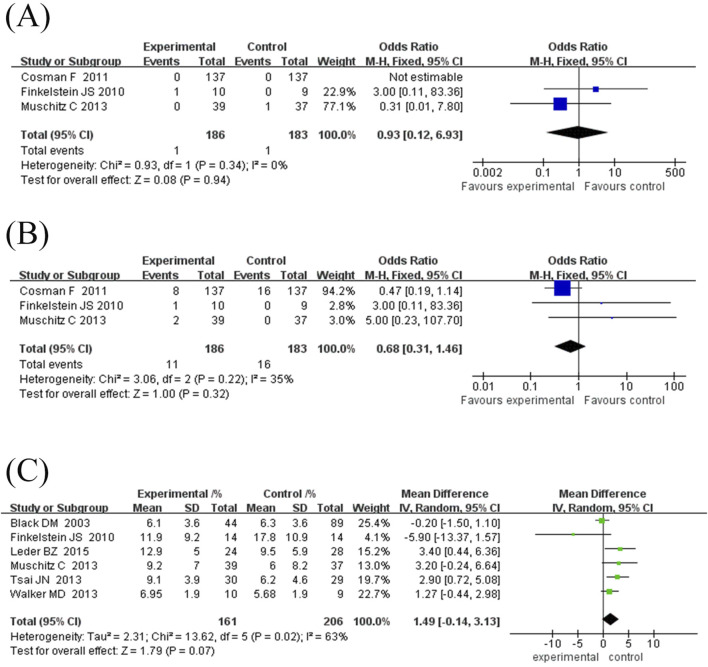
Eight RCTs (n = 787) were meta-analysed using Review Manager 5.4. Results showed: ① No significant differences in vertebral (OR = 0.93, 95%CI 0.12-6.93) or non-vertebral fractures (OR = 0.68, 0.31-1.46) between groups. ② TPTD combined with denosumab significantly increased lumbar spine (+3.40%, 0.44-6.36), femoral neck (+4.00%, 1.96-6.04), and hip BMD (+4.25%, 3.20-5.29). Bisphosphonate combinations improved hip BMD in the short term (<24 months: +1.81%, 0.65-2.97) but not long-term (≥24 months).③ Combination therapies regulated BTMs bidirectionally: bisphosphonates suppressed P1NP (40%-80% reduction vs. monotherapy), while denosumab preserved OC levels (-8-16% vs. monotherapy).④ Safety profiles were comparable: hypercalcemia incidence (16.3% vs. 14.7%, OR = 1.22, 0.55-2.69), musculoskeletal pain (9.8% overall), with no osteonecrosis cases reported.
TPTD-denosumab combination is clinically preferable for BMD enhancement, though its long-term (>24 months) fracture risk reduction requires further validation.
特立帕肽(TPTD)是骨质疏松症(OP)治疗中广泛使用的促骨药物,长期单一治疗(>6个月)可能会导致代偿性骨吸收。将TPTD与抗骨吸收药物(如双膦酸盐和地诺单抗)联合使用可减少骨质流失,但现有的随机对照试验(RCT)在其对骨密度(BMD)和骨转换标志物(BTM)的影响方面仍无定论。本研究旨在系统评价与TPTD单一疗法相比,TPTD联合双膦酸盐或地诺单抗对OP患者BMD和骨折风险的影响。
检索PubMed、Embase、Cochrane图书馆和Web of Science数据库(截至2025年3月),查找比较TPTD单一疗法与联合疗法的RCT。主要结局包括椎体/非椎体骨折风险降低和BMD变化(腰椎、股骨颈、髋部);次要结局涵盖BTM变化和不良事件。
使用Review Manager 5.4对8项RCT(n = 787)进行荟萃分析。结果显示:①两组之间椎体骨折(OR = 0.93,95%CI 0.12 - 6.93)或非椎体骨折(OR = 0.68,0.31 - 1.46)无显著差异。②TPTD联合地诺单抗显著增加腰椎BMD(+3.40%,0.44 - 6.36)、股骨颈BMD(+4.00%,1.96 - 6.04)和髋部BMD(+4.25%,3.20 - 5.29)。双膦酸盐联合用药在短期内(<24个月:+1.81%,0.65 - 2.97)可改善髋部BMD,但长期(≥24个月)则无此效果。③联合疗法双向调节BTM:双膦酸盐抑制I型前胶原氨基端前肽(P1NP)(与单一疗法相比降低40% - 80%),而地诺单抗维持骨钙素(OC)水平(与单一疗法相比降低8% - 16%)。④安全性相当:高钙血症发生率(16.3%对14.7%,OR = 1.22,0.55 - 2.69),肌肉骨骼疼痛(总体发生率9.8%),未报告骨坏死病例。
TPTD与地诺单抗联合使用在提高BMD方面临床上更可取,但其长期(>24个月)降低骨折风险的效果需要进一步验证。