Borrell Lauren R, Venezia Andrew C, Smith J Carson
Neuroscience and Cognitive Science Program, University of Maryland, College Park, MD, 20742, USA.
Department of Health and Human Performance, The University of Scranton, Scranton, PA, 18510, USA.
Brain Struct Funct. 2025 Jun 5;230(6):85. doi: 10.1007/s00429-025-02952-2.
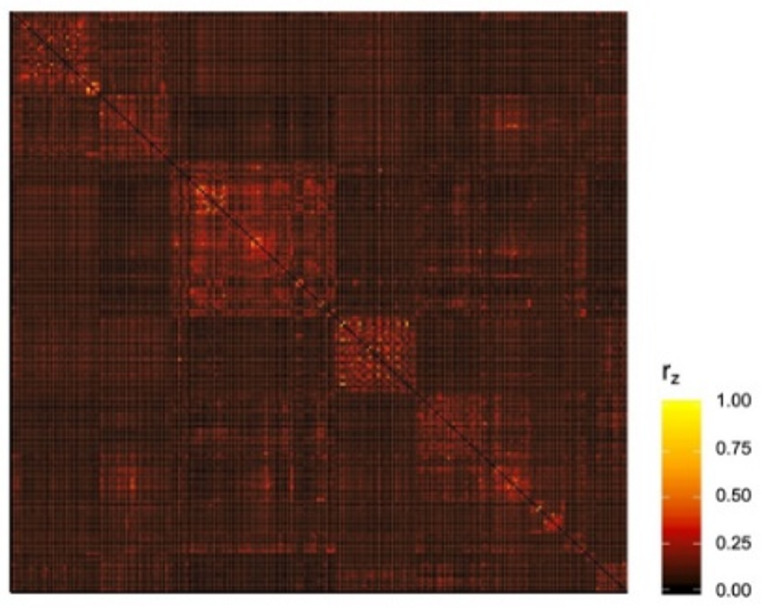
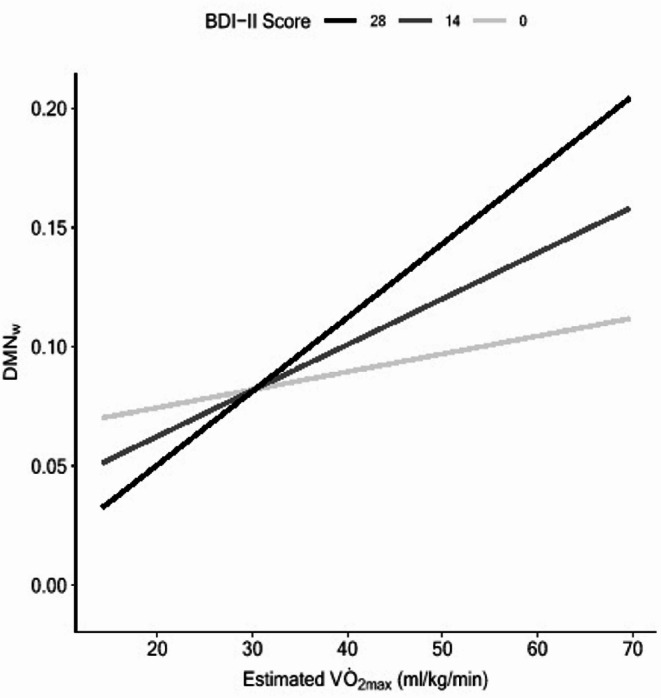
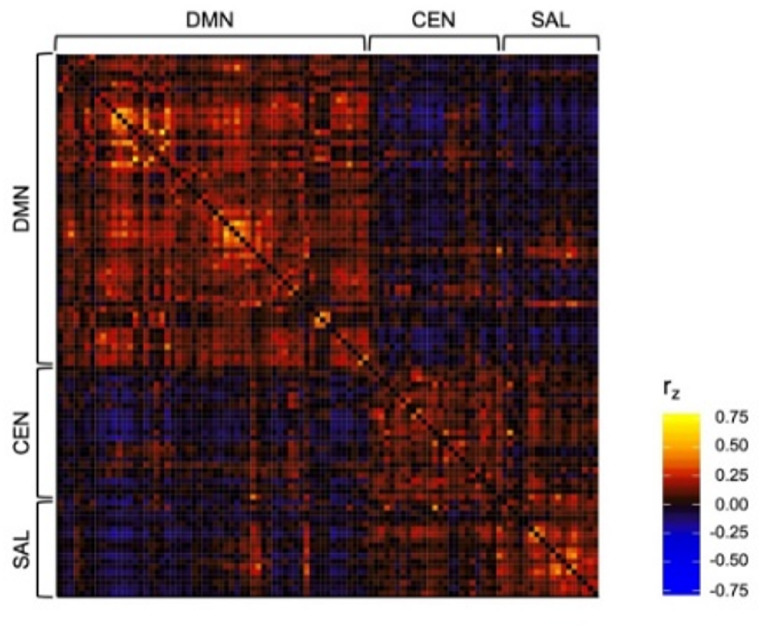
Cardiorespiratory fitness may protect against or alleviate depression through neuroplastic mechanisms within disrupted brain networks underlying cognitive and affective symptoms. There is a scarcity of research examining the effects of cardiorespiratory fitness on functional brain networks in representative samples spanning adulthood. Further, little is known about the interaction of cardiorespiratory fitness with depression in these networks. To address this problem, this study made use of the NKI-Rockland sample dataset and magnetic resonance imaging to examine whether functional brain network features associated with cardiorespiratory fitness were moderated by depression symptom severity in a community sample of 217 participants (134 females, 83 males) between the ages of 18 and 71 (M = 43.8 years, SD = 16.2). Cardiorespiratory fitness was positively associated with whole-brain modularity, between-network connectivity of the central executive and salience networks, and within-network connectivity of the default mode, central executive, and salience networks. The association of cardiorespiratory fitness and default mode network connectivity was stronger in the presence of moderate-to-severe depression symptoms. Taken together, these observations lend support to prior work that has demonstrated the associations of cardiorespiratory fitness with reduced concurrent and prospective depression risk and symptom severity. Depression symptoms moderated default mode network connectivity, suggesting that cardiorespiratory fitness may differentially impact neural substrates for those with moderate-to-severe depression symptoms.
心肺适能可能通过认知和情感症状背后受干扰的脑网络中的神经可塑性机制来预防或缓解抑郁症。在涵盖成年期的代表性样本中,研究心肺适能对功能性脑网络影响的研究较少。此外,对于这些网络中心肺适能与抑郁症之间的相互作用知之甚少。为了解决这个问题,本研究利用NKI-Rockland样本数据集和磁共振成像,在一个由217名年龄在18至71岁之间(M = 43.8岁,SD = 16.2)的参与者(134名女性,83名男性)组成的社区样本中,检验与心肺适能相关的功能性脑网络特征是否受到抑郁症状严重程度的调节。心肺适能与全脑模块化、中央执行网络和突显网络的网络间连通性以及默认模式网络、中央执行网络和突显网络的网络内连通性呈正相关。在存在中度至重度抑郁症状的情况下,心肺适能与默认模式网络连通性之间的关联更强。综上所述,这些观察结果支持了先前的研究工作,即已证明心肺适能与降低同时期和未来抑郁症风险及症状严重程度之间存在关联。抑郁症状调节了默认模式网络连通性,这表明心肺适能可能对中度至重度抑郁症状患者的神经基质产生不同的影响。